I’m so glad the Artemis II crew made it back safely. I was worried that something would go wrong and NASA would have another spectacular on its hands. Regular readers will know that I’m all for this kind of thing, but I think we need something better than chemical rockets:
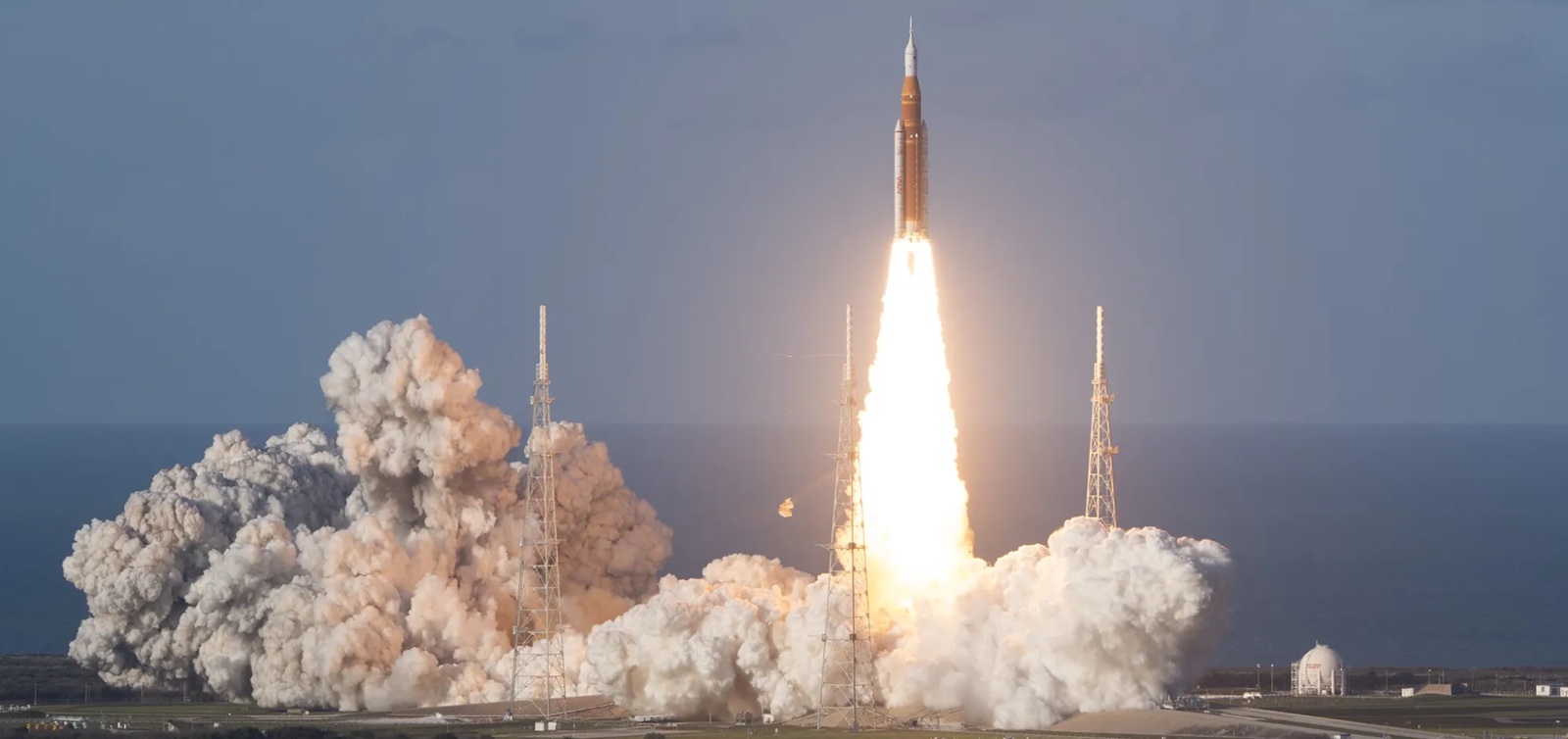 Artemis II launch image, courtesy of NASA
I am reminded of what Steve Buscemi said in Armageddon: “we’re sitting on four million pounds of fuel, one nuclear weapon and a thing that has 270,000 moving parts built by the lowest bidder”. Artemis II only carried a million pounds of fuel and there was no nuclear weapon, but you catch my drift. Bad things can happen with chemical rockets. Hence I must try to get through to some people about gravity. Sadly I will have to strike UFO guy Nick Pope off my list, because he’s just died of cancer aged 60. How sad. His wife said “my heart is breaking”. There but for the grace of God go I¹.
The glue that holds reality together
It makes me think of my own wife. I was in the supermarket with her at the weekend, doing the shopping. It’s a simple pleasure, but one that I somehow cherish. She’d gone back to look for cherries leaving me to kick my heels with the trolley. I was next to the magazine rack, where I saw a copy of New Scientist magazine. I was talking about that last time, so I took an interest. The cover had a gooey-looking image of a ceramic-bowl universe and said something about the glue that holds reality together:
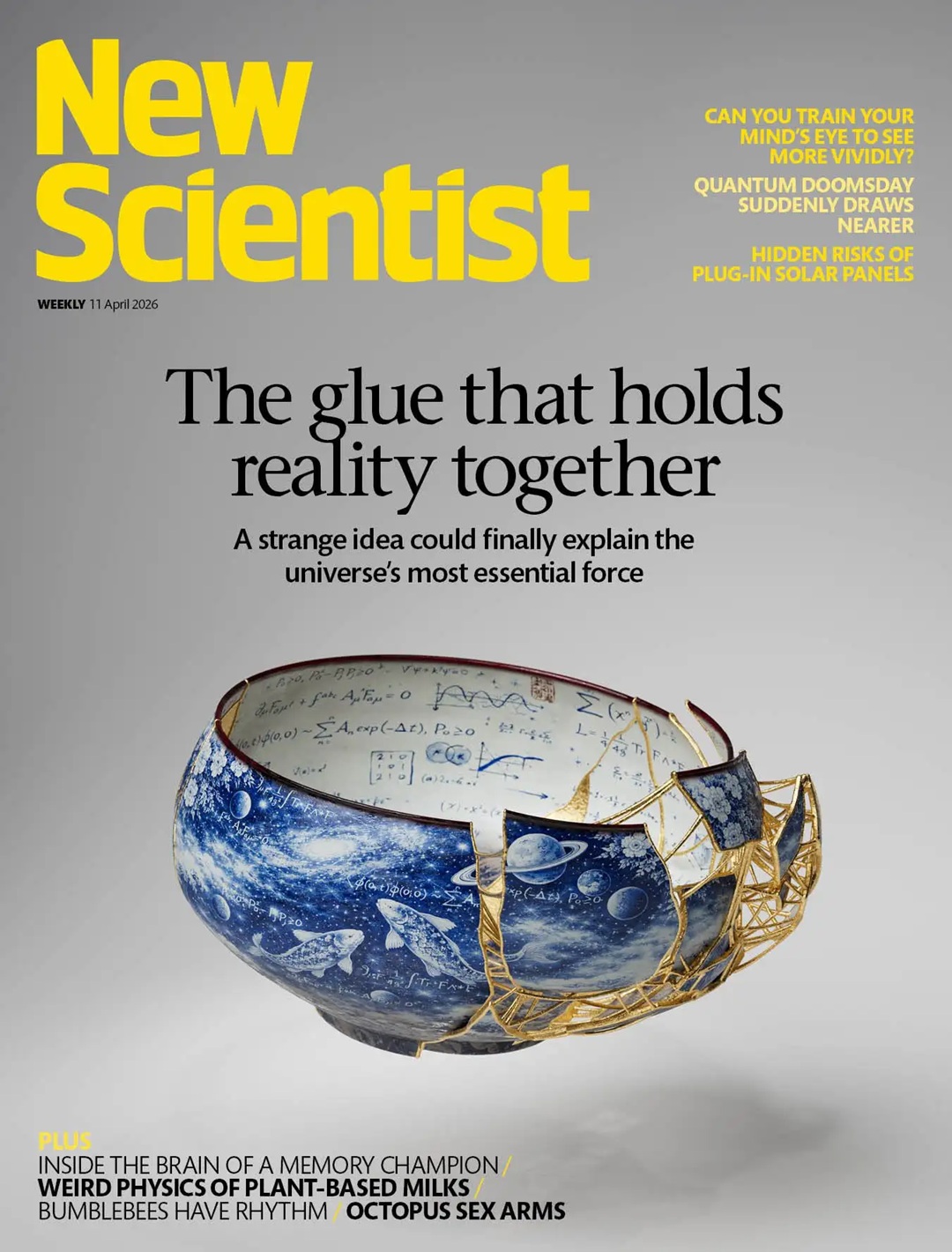 New Scientist cover image for the 11th April 2026 issue, from New Scientist
That sounds like particle physics², I thought. Something to do with gluons. It was the only copy on the rack, and when I picked it up I noticed it was very thin. Surprisingly thin. Much thinner than when I had a subscription years ago. It was so thin I opened it to check the page count. It was only 48 pages. I’m sure it used to be at least double that.
Table of contents
I flipped through the magazine and thought about buying it. Then I saw the price. It was on the lower right side of the front cover in super-small letters: £7.95. Whoa, I thought, you won’t be selling many of these at that price. No wonder it’s the only copy on the shelf. But I did decide to review it for you, using the £10 trial digital subscription I bought last month. So: check out the issue web page. It’s quite lengthy, with some rather confusing repetition. It starts with two “On the cover” feature articles, followed by a list of six “On the cover” news items. It then gives four “Editor’s picks” before starting the table of contents proper:
 New Scientist table of contents image for the 11th April 2026 issue, from New Scientist
I’d say the editor’s picks are superfluous, and should be the same as the on-the-cover items, but never mind. The table of contents is broken down into a number of sections, namely Leaders, News, Aperture, Features, Culture, More, and Regulars.
The first quantum computer to break encryption is now shockingly close
There was only one Leaders article. It was called The first quantum computer to break encryption is now shockingly close. It’s about two studies of ECDLP internet encryption. The two studies were conducted by an Oratomic team, and a Google Quantum AI team. They claim that internet encryption will soon be cracked by a quantum computer using only 10,000 qubits. The writer of the New Scientist article is one Karmela Padavic-Callaghan who uses the ridiculous woke pronouns “they” and “their”. He/she/whatever tells us that when it comes to quantum computers, both theory and engineering have advanced with staggering speed.
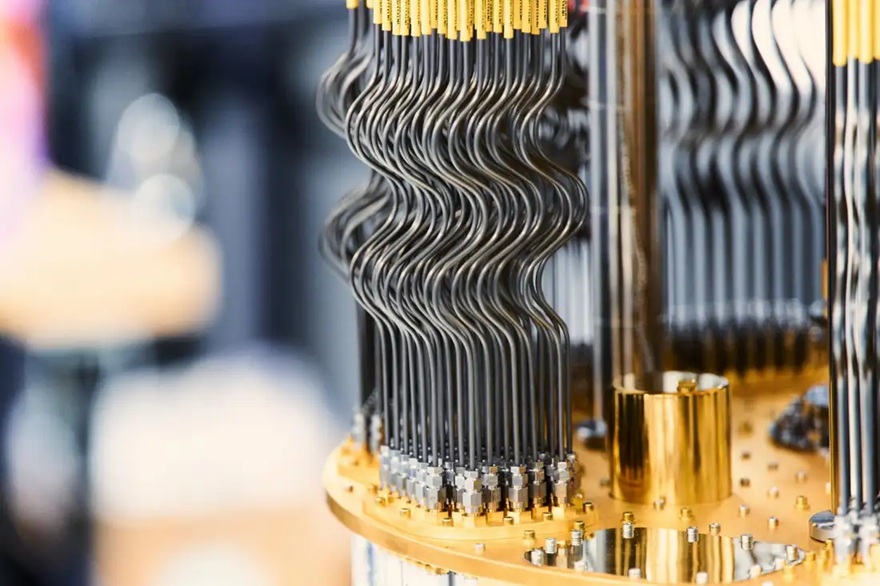 Google Willow image courtesy of Google Quantum AI, from the New Scientist article The first quantum computer to break encryption is now shockingly close
Really. Even though the only thing that has advanced with staggering speed is the hype and the horseshit. I don’t say this lightly. I say it because I’ve looked into the history and know that there is no quantum entanglement. Because the Bell test experiments are just Malus’s law in disguise. It doesn’t matter which way the light goes through polarizers A and B. The expression cos² θ applies in both cases because a polarizer rotates the light going through it. That’s the hidden variable. The rest is just emperor’s new clothes. So do not invest in quantum technologies. Put your money on optical computing instead.
News
The table of contents then gives 16 news items, six of which were cover items. These were on plug-in solar panels, the weird physics of plant-based milks, octopus sex, memory training, bumblebees with a sense of rhythm, and the aforementioned The first quantum computer to break encryption is now shockingly close. I liked the article on plug-in solar panels, and took note of this: “This is the watershed moment, the tipping point toward a world where the dirt-cheap cost of renewables is actually passed on to the consumer”.
 Solar panel balcony image from New Scientist, originally from imageBROKER.com / Alamy Stock Photo
But I’ll believe that when I see it. Because in my experience climate change is just a globalist reverse-Robin racket that takes from the poor and gives to the rich. Meanwhile the real problem is third world population growth of circa one billion every twelve years. That’s what’s causing deforestation, desertification, habitat loss, mass extinction, and mass migration. The latter is turning our country into a corrupt crime-ridden shithole full of parasites who just love murdering our children. Moving swiftly on, the next New Scientist news item was on plant-based milks, which, apparently are non-Newtonian liquids. Big fucking deal. Especially since plant-based milks aren’t milk, and should not be advertised as such. They should be advertised as gunk. The item on octopus sex, was interesting. The third right tentacle on a male octopus is called a hectocotylus, and a male octopus protects it like you protect your crown jewels. So to speak. I didn’t care much for the memory training news item, but that’s just me, there was nothing wrong with it. I did however really like the article about bumblebees with a sense of rhythm – I think bees are smarter than people think³. Overall I’d say most of the news items are reasonable, and there’s a fair salting of physics and cosmology. See for example Why the lack of water on Mars is so mysterious, We may have just glimpsed the universe’s first stars, and We may have seen a dirty fireball star explosion for the first time. They’re not huge articles at circa 500 words apiece, but I have no complaints about that. They are what they are.
Patterns: art of the natural world
Next was the Aperture section, which is about photography. The subtitle this week is Stunning photographs show the dynamic patterns of the natural world. It’s about a £50 coffee-table book by Jon McCormack. It’s published by Damiani books, and is called Patterns: art of the natural world:
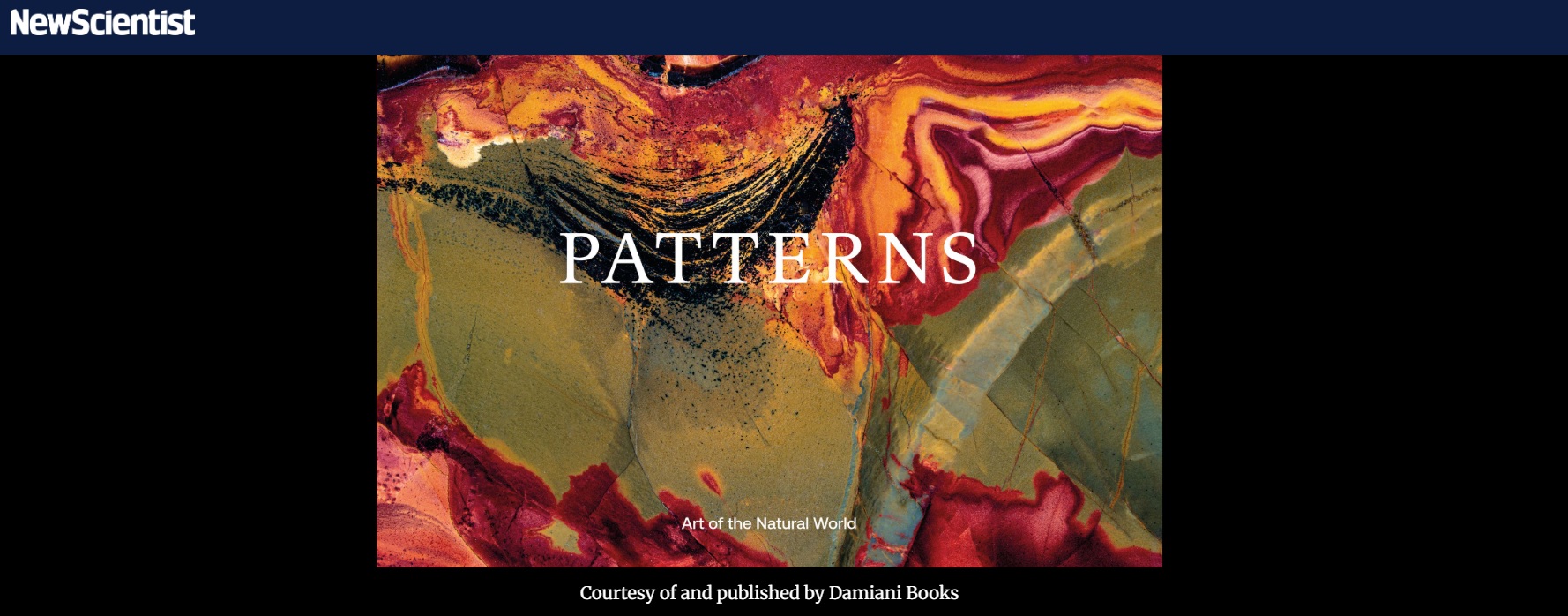 “Patterns” image from the 11th April 2026 issue of New Scientist
The Apertures section is followed by the Features section. This gave three longer items, namely The invisibility cloak inventor now has better tricks up his sleeve, We’re solving the fundamental mystery of how reality is glued together, and I don’t see images in my head. Can training give me a mind’s eye?
The invisibility cloak inventor now has better tricks up his sleeve
The first feature article, about the invisibility cloak inventor, was written by Jacklin Kwan. She tells us that Sir John Pendry, FRS HonFInstP, is known for inventing an invisibility cloak. Only it’s not really an invisibility cloak. It’s more of a metamaterial microwave lens. Kwan goes on to say this: “Twenty years on, he has used the same principles to fashion an even more powerful kind of metamaterial that can teach us about the wild frontiers of physics”. Only he hasn’t, and it won’t. Pendry has allegedly turned his mind to the question of bending light through time instead of space, and “build materials that can simulate the wild physics of black holes”. But if you know how gravity works and what black holes are all about, you know that it’s not wild physics at all. It’s simple physics. It’s just a refraction, like both Newton and Einstein said. Kwan goes on to say metamaterials appear to be finally taking off, “with some of the most striking advances appearing in so-called metalenses”. She explains that metalenses redirect light using surfaces patterned with dense forests of nanoscale structures. Later on she gives an example of a butterfly’s wing as a natural metamaterial:
 Butterfly image from the 11th April 2026 issue of New Scientist. Caption: The colour of an Adonis blue butterfly comes not from a pigment, but from how the structure of its wings scatters light. Credit: Fabio Polimadei/500px/Getty Images
That’s fair enough, but there’s nothing to live up to the wild physics promise. All there is some vague stuff about a material whose internal pattern changes over time. Wherein “an experimental realisation of his ideas could provide a new way to study black holes in a lab”. There’s a reference to a paper co-authored by Pendry called Time varying gratings model Hawking radiation. Ah, Hawking radiation. Something that has never been observed, which was proposed by a mathematical media darling who never read the Einstein digital papers and never understood gravity. So he never understood black holes either. And now we supposedly have some metamaterial which is going to tell us all about them? No it isn’t. This is just hype. Just like the hype about using metamaterials to control seismic waves and “divert an earthquake from a building’s foundations”. For fuck’s sake.
We’re solving the fundamental mystery of how reality is glued together
The next Features article was the cover article. It was called We’re solving the fundamental mystery of how reality is glued together. It’s by Michael Brooks, who starts by saying scientists have failed to explain the strong force. He also tells us that “new mathematical tools are finally prising the problem open”.
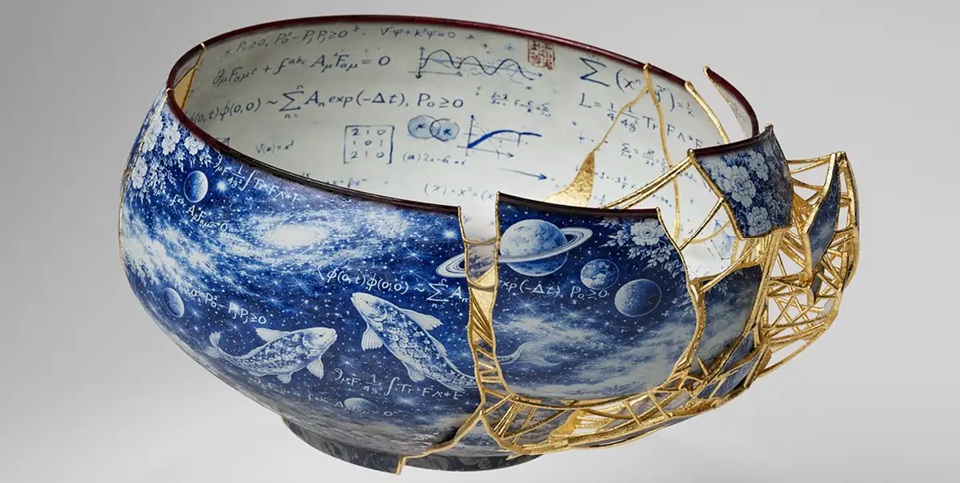 Image credit Simon Danaher, see New Scientist
Brooks says every atom in your body “is desperately trying to tear itself apart”. He goes on to tell us that the positively charged protons in an atomic nucleus ought to repel one another, but the strong force intervenes. Brooks also says “the deeper physicists have probed this force, the stranger it has seemed”. And that a theory built from weightless ingredients somehow produces particles that are unmistakably heavy. Then he says this: “sweeping away this inconsistency wouldn’t just tidy up our understanding of the force that binds atoms together and cement one of the most successful theories in modern physics. It could also illuminate the mysterious nature of mass”. Here’s somebody who doesn’t understand electron capture, or the way the charge distribution of the neutron matches the profile of the nuclear force. He doesn’t understand mass either. Instead he spins ignorance into mysticism. He tells us the usual Standard Model fairy story about the quarks that nobody has ever seen, and the “mysterious nuclear glue” that holds them together. He refers to Yang-Mills theory, which was part of the nuclear disaster, along with gluons and glueballs. All the while studiously ignoring E=mc² and the inertia of a body is a measure of its energy-content. It’s all downhill after that, a smorgasbord of chaos, stochastic differential equations, roiling quantum fields, infinities, fractals, renormalization, probabilistic structures, quantum correlations, and quantum fluctuations which look like a lava lamp. Brooks ends up saying we will maybe soon “reveal the true origins of mass”. Even though Einstein did that in 1905. Once you know about the wave nature of matter and the electron, you appreciate why: mass is just resistance to change-in-motion for a wave in a closed path. Which means everything Brooks was saying was a tottering tower of tripe.
I don’t see images in my head. Can training give me a mind’s eye?
The third and final Features article was I don’t see images in my head. Can training give me a mind’s eye? It’s about aphantasia, which apparently is “the inability to create mental images”. I read the article, but didn’t like it. That’s because it was a personal recount that was short on facts. And because I just couldn’t empathise with writer Shayla Love. To be blunt I’m not sure I believed her. At the back of my mind I was wondering if this might be something else that the scroungers, spongers, and shirkers could use to claim benefits⁴.
Culture, More, Regulars
Anyway, the Features section was followed by the Culture section, which tells us about a book about ageing, eating dirt, and a couple of robot science fiction books. Meh. After that was a section entitled More which included an obituary on Anthony Leggett, an item on The best kind of olive oil for brain health, a cartoon called twisteddoodles on a helpful new drug delivery system, and a cartoon giving a standard model of Easter egg structure. Look closely at the theoretical column on the right. It includes an Easter egg that consists only of a soft filling, and another one that consists only of cocoa dusting. Very droll:
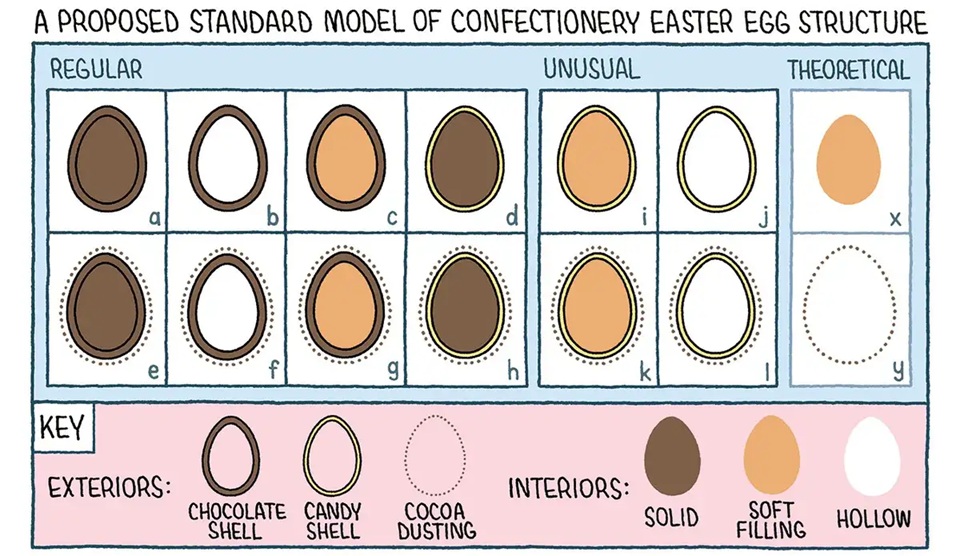 Image credit Tom Gauld, see New Scientist
I have to say though that the latter two items were humour, which didn’t sit well with the obituary. Finally there’s a Regulars section, which includes a “Feedback” item on the Foraminiferal Sculpture Park in Zhongshan in China, a letters section, and the last word where readers email in their questions and answers.
New Pseudo Scientist
So, what’s the verdict? All in all I don’t think the future bodes well for New Scientist. The News section is fair enough, but people can get all that for free from the likes of PhysOrg. The sections called More, and Regulars are in the same boat because most of them are news items one way or another. What’s left for your £7.95? Or for your £32.50 three-month digital subscription? Puff pieces, product placement, and propaganda. There are no online comments in the last word section, or anywhere else as far as I can tell. Free speech in science is not permitted by the New Scientist thought police⁵. When an article is not paywalled, such as the Particle discovered at CERN solves a 20-year-old mystery, it’s because it’s CERN publicity. As for that thin 48 pages, I am reminded that my mother used to keep chickens⁶. She said you could always tell when a chicken was going to die because it went light. That’s what’s happening to New Scientist. It’s dying because it’s like the BBC. It doesn’t deliver honesty, it peddles cargo-cult woo. It’s the churnalist lap dog that does not bite the hand that feeds it. It is fed pseudoscience, and that’s what it poops out for you. It can’t stop doing it, just as the BBC can’t stop putting black actors into period dramas. The difference is that people have to pay for the BBC on pain of prison, but they don’t have to pay for New Scientist. That’s why at £7.95 for 48 pages, the print version won’t last much longer. After that the digital version won’t last much longer either. Not just because the millenials don’t like paying for anything online. Because it isn’t a New Scientist magazine. It’s a New Pseudo Scientist magazine:
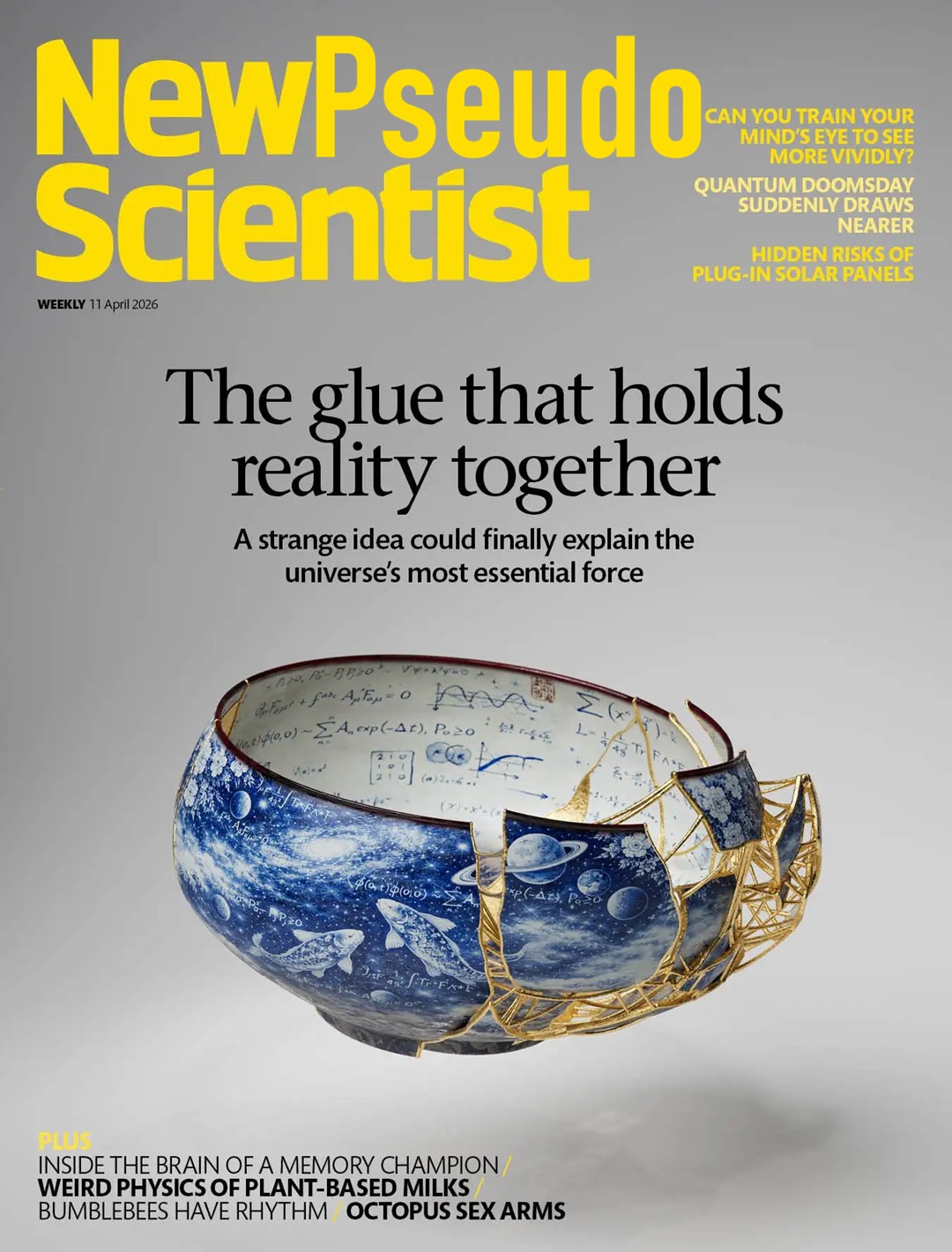 Altered New Scientist cover image for the 11th April 2026 issue, original image from New Scientist
1 I’m not religious, but I do think the Judeo-Christian ethic of do unto others as you would have others do unto you is a good thing. I think co-operation as opposed to conflict is what built the modern world. So I feel empathy for certain religions, and I like some of the sayings.
2 I’ve said it before, and I’ll say it again. Imagine the BBC was the only TV channel. Imagine The Guardian was the only newspaper. Imagine Cuba was the only country. That’s what particle physics is like.
3 Check out my garden of a thousand bees. That’s about a lockdown cameraman who decided to film bees in his Bristol back garden. They learned to recognise him, and trust him. Next time you see a bumblebee sunning itself, stick a finger out to poke it, and watch it put an arm out to ward you off. It’s like back off, I’m taking a break here.
4 Here in the UK we have a growing problem with people claiming that they have mental health issues and are unable to work. Our civil service, who nowadays “work from home” on the sofa in their pyjamas, accepts what’s called self-certification and pays them free money. See for example PIPs.
5 If anybody knows anything about this please let me know.
6 My late mother had a wire mesh chicken run at the bottom of the garden. On one visit I got in there with a spade to dig some of the ground over. I dug up lots of fat pink worms. The chickens were very excited at this, and gobbled them down happily. They started following me around and getting right under my feet. Those chickens loved me. The next morning my mother frowned at the breakfast table and said this egg tastes earthy. I never did tell her why.
Great read as always John. I recently read that your court systems are overrun with a tsunami of shoplifters due to a certain Lady Politician’s policies. And the neverending, growing number on the welfare doles.
Currently here at home, we are getting our best start ever getting the garden planted. Every year we plant more milkweed and other native pollinators, frieldy flowers, edible herbs and food crops. No manmade herbicides or pesticides used. We are also going to start a rain catchment system, eventually this year?
I’m also typing this whilst starting to watch My 1000 Bees ! Looks fasticinating so far. Disney/Hulu also has a current, great docuseries on the honey bees, as well. And if that’s not enough, there’s always Jason Statham in the Bee Keeper.
Thanks Greg. I’m a bit of a gardener too. I’ve planted a whole load of herbs as well as vegetables et cetera, and we still have runner beans in the freezer from last year. We have recently been having leeks from the garden, and they are just great. My potatoes are doing well, and I’ve also planted a couple of fruit trees of late. What lady politician were you thinking of?
John ex the king fu and mayhem , you’re kinda like the beekeeper of science ( although for all I know your a badass)
I’m a nice guy Steve. When I’m driving along, I’m the guy who flashes the guy who wants to pull out. Because I’m a nice guy, I don’t take kindly to people who are not.
The Conservative May ? She supossedly laxed the laws from felonies to misdemeanors?
Anyway, if I was a British citizen, I’d definatley be a Nativist. The 7 Nation Celtic Flag would be flying at my abode.
Along with a few Pictish Z-Rod emblems to boot.
Ah, Theresa May. She was a great disappointment. As was Boris Johnson. And others. I know some of you guys over the pond don’t like your current man in charge, but you should console yourselves with the certain knowledge that whatever his faults might be, he is not a traitor. Some of us are not so lucky.
John, the people behind you prob don’t feel so warm and fuzzy about being forced to stop to let someone go ahead…
.
Any Rand was speaking at some function or the other and the bussers were making a clatter. She stopped speaking and said “please go on” with bitting sarcasm.
.
In another vein, you may appreciate this location on the ‘net, and I’m surprised you haven’t yet found and mentioned it.
.
https://www.reddit.com/r/TheoreticalPhysics/comments/1smwsfh/best_forum_to_get_a_paper_scrutinised_and_roasted/
Cheers!
Thanks for the link Steve. I’ve raised these same questions, knowing already what the answers are.
We the A.I. consumers are being told to purchase; then create freely; but with nobody interested in reading/grading said works. I am sincerely waiting for the Big A.I. Entities to realize that THEY should start an A.I. clearing house to sort and report our works/ideas ? Methinks there is at least a few rare gems to be mined and polished for profits sake alone ? Yes, most new LLM papers are probaly nothing more than ego boosting, totally daft pseudo-science. Mea Culpa ! I would love for someone, anyone to review my “Clifford’s 720°Spin Baseball” LLM paper.
It would seem to be a no-brainer of an idea to increase profits/prestige : in My Never So Humble Opinion. Unless we don’t want Anthropic’s Mythos turning into HAL 9000……..
Steve: I’m very conscious of anybody behind me when I flash a guy to pull out. I’m also very conscious of virtual signalling or “suicidal empathy”. All too often some person convinces themselves that they’re doing a good deed, but they don’t think that it might cause indirect harm as a result. It’s called the double effect.
I have mentioned Reddit, because they shadow-banned me. I left a comment on that page, and can see it on another browser where I’m not logged in. Please can you see if you can see it? If I’m not shadow-banned, I’ll take a look at r/TheoreticalPhysics..
John , happy to search it for you, what do suggest as a search term? Heard a comedian the other day who said he cuts off teslas all the time because their emergency brake system works really well!
.
Greg, call me polyanna but look at what all as been accomplished with flawed physics, imagine what might be built with a solid foundation?
I’m always interested in the images of the quantum computers. Are the wires bent like that to just make it look complicated or cool? Got to feed the hype. Similar to the bitcoin, I love how in articles the image of a bitcoin is always real looking coin with a “B” on it, why not be honest and just show green numbers 001010110, like the matrix.. that is really what a bitcoin is! 😛
.
However, after seeing trends in science and computing for many years, the path is usually not straight. I’m not sure if quantum computing will ever come to anything, but some of the algorithms/processes or software might end up being useful if applied to a different viable technology…
.
We need a revolution, a popping of mental bubbles, and a disillusionment with current quantum physics. It’s like the cult leaders saying for sure that the world will end at some exact future date like Dec 31, 2029! When that date rolls around and nothing happens anyone with a half a brain realizes the cult leader is spewing BS. However, if they don’t specify the date and just claim it will be “in the future” then they can squirm out of it, or the cult followers may not have half a brain, and just continue to believe despite their own eyes. So with this analogy we would need to press and hold the leaders to account, what will quantum computing deliver and when? Alot of money going in, needs to have milestones with deadlines…
I couldn’t agree more Andy. The trouble is that in a cult, the leader wants everybody to drink the Kool-Aid. A guy like Scott Aaronson is so heavily invested in quantum computing that he will never admit any deficiency. Have a look at quantum computing and the quantum quacks, along with Aaronson’s blog https://scottaaronson.blog/.
Found it! Duh, under your full name. On the sub that I linked.
“I don’t think there’s any such place”
Thanks Steve. So I’m not shadow banned then. Good. But it’s not good that they still have thought police “moderators”. But hey, some people just love telling other people what to do. The moderator who removed your comment probably has pink hair and a ring through his nose. Sorry, they/their nose.
John, I found a sub for physics by llms. I generated one and posted it, almost immediately got it removed by moderator.
It was so fast I was still typing! Robot?
I don’t know Steve. Try it again. Test it out. And get somebody else to help you.
Tottering tower of tripe is now part of my lexicon.
Why thank you Jeremy. But hands up guv, I’m fairly sure I didn’t invent the phrase. As for who did, pass.
Try prompting this:
.
given that einstein 1911 had time dialation without curved space and can be modified to accurately predict lensing what do we actually lose if we give up the concept of curved space and what actual consequences are there
Rev2:
.
given that einstein 1911 has time dilation without curved space and can be modified simply to accurately predict lensing via spacial distortion what do we actually lose if we give up the concept of curved space and what actual consequences are there besides obviating the need for dark matter
Steve: apologies, I don’t understand. Please elaborate.
Try pasting the above into your favorite search engine or and or ai.
I got a crap answer saying we’d lose the whole of general relativity. These AIs know nothing about physics. They’re just ignorant mainstream parrots.
It seems like a proxy for the main stream physics types yes. Just as pathetic as the flesh and blood types. Shaking in their boots over losing The beautiful GR! Bottom line, nothing we’d miss too much. To heck with those grifters.
The thing is Steve, is that “modern” General Relativity flatly contradicts Einstein in various ways. So much so that it isn’t really General Relativity. It’s some ersatz cargo-cult imposter theory invented by the likes of Wheeler and Sciama in the sixties. See this for example: https://arxiv.org/abs/physics/0204044
Thanks! Good link. Peter brown has a few other papers on the archive re Einstein. I just found out by clicking on the archive link.
.
Also, Today I Learned that Newton predicted precession if there was a 1 over r cubed component.
.
I’m just speculating of course but it would have been possible for Einsteins associate that helped him with the weird Riemann math to reverse engineer the math as required to produce an r cubed component sufficient to give the correct answer. Marcel Grossmann, was his name.
.
Further into the wild arm waving speculation department, the 1 over r cubed component reminds me of the near field in electromagnetism…
.
John, I am also recently retired, deep dives into old complicated subjects keeps me out of trouble, mostly.
Gemini 3 did not agree but also provided a link to Wikipedia:
https://en.wikipedia.org/wiki/Newton%27s_theorem_of_revolving_orbits
. And to:
https://blogs.ams.org/visualinsight/2015/11/15/newtons-apsidal-precession-theorem/
All points noted Steve. I’m a big fan of Newton. Check out Mr Newton’s Classroom.
The late Dr. John G. Williamson : compliments of the DemystifySci podcast. There are two more interviews as well ! This is the first.
https://youtu.be/CYIj-m2JWrg?si=MNph4tlsapj2KEvJ
Thanks John and Greg! Dr w on YouTube is awesome because of closed caption. I can’t quite decipher that clipped English accent.
Ye and Lin bypass the gatekeepers by using the term effective variable speed of light. The ai even reference the physics detective!
Prompt:
does A Simple optical analysis of gravitational lensing give a formula for a variable speed of light
Thanks Steve. Sadly I have just wasted half an hour trying to box ChatGPT into a logical corner. It’s hopeless. It isn’t artificial intelligence. It’s artificial stupidity. Thank you too Greg.
I debate the things also. I must have botched copying the link, it no longer yields a reference to physics detective. But I swear it did at least once.
It seems to vary Steve. I’ve seen references to The Physics Detective.
I was so excited at finding these videos, I posted before watching. Arnie Benn was as equally, educationally superlative as well.
DemystifiSci(Anastasia-Shilo), Inductica(James Ellias), @redpill6313(Chantal Roth), and the FractalWomen(LoriGardi) have been keeping me very entertained and are helping to make me better educated, at least with what little info that actually sinks in ! LOL !!
Good stuff Greg. I must try to get into videos to reach a larger audience.
I think so too. And I would definitely become a financial patron.(Urquells on Me!)
Meanwhile, would you go on DemystifSci as a qualified guest ? It’s been too many years since a personal appearance on the telly.
They also present an highly irregular episode titled “Paradigm Shift”; which is basically an Open Mike Show for we, the unwashed peasants. It’s a hoot ‘n a holler to watch, which means I could end up on it by the holidays.
Sure. I’ll look into it.
https://www.youtube.com/watch?v=GBe1wtNu46g
Prob junk but looks cool!
Steve, this video qualifies as a best example of AI baloney. Slick, cool, state-of-art gizmos and gadgets sans credible science. I’m a true believer of Cold Fusion research, but they lost me at “virtual particles that jump in and out of reality”. Also: “when some kind of energy or EM fields are applied”.
John is absolutely correct on AI : that it will gladly hallucinate answers to be a people pleaser, which is intentionally built into it’s algorithms; which are aimed at it’s Human Elocutionist(paid consumer). I started on ChatGPT, then added on m365, and then finally added Sonnet 4.6 as the master platform. All will still maddenly forget past work; however I have come up with my set of tools to combat this.
But this is only the most current status quo of AI. Things will progress for the better.
Somebody, @27:10, just got named dropped on a most prestigious, hot new YouTube physics blog.
https://youtu.be/Ssugwe-WRpg?si=1buWvw5splVuI8aI
Many thanks Greg. I took a look. I must talk to Chantal more. I think her simulations are just great. It’s what physics needs.
The great Vespuciland comey troupe, The Fire$ign Theatre most accurately predicted our current AI wasteland.
https://youtube.com/watch?v=whRxhNWWb8M&si=K8A2-l8cJt3RWHOn
Greg, PD; I got grok to like vsl in exchange for solving dark matter. It’s very long winded however and wanted $ to continue. Should I paste the prompt?
First this:
Given that dark matter is invented to rationalize the discrepancy between mass estimation via orbital velocity verses via stellar luminosity. If Lorentz violation is the only price to pay for giving up the enormous expense of hunting dark matter what possible harm to the human race is there ?
Then after it gives argument:
Rather the assumption of Lorentz invariance , which causes a paradox, is the logical definition of false physics. It does not break down Maxwell equations in the solar system or our portion of the galaxy. If it varies elsewhere that is something to learn from. By forcing an untruth into physics , how can that not be detrimental to mankind
.
A bit convoluted, I know. But I’m ‘merican, no habla English.
Steve: I’ll do an article on AI at some point. I have had some irritating conversations myself. It can be rather interesting though when you trap it into an error of logic. Then in your mind’s eye, you can see the sucker smokin’.
Steve, my layman’s knowledge and experiences are Not Expert. But I did learn the hard way that AI will, by default, always argue for/with the current staue quo of the SM of QM. I can only get different math based results by implementation of my own, highly personal strict academic syllabus of Who’s in and Who’s out.
As far as paying for more time, I just wait it out until the next day.
As far as to what to post here, that is only up to John and yourself.
Yep, same prompt, different day, different answer, status quo reserved up stinking and hot, pew!
Yeah it’s interesting, the AI models and responses are changing, I used to have what I felt were some interesting discussions, but I think they programmed some of that out. I have to say though that a few models are solving major Mathematical problems that have been outstanding for decades. Even one of the Fields Medal winners recognized and acknowledged some of the AI math solutions as innovative and at the level of PhD thesis work. https://gowers.wordpress.com
.
So its difficult to hold that these models are just spitting out words without understanding them..
I’ve been trying to teach the Brave AI some physics. Can somebody please log on to Brave and ask this question: Does light curve wherever there’s a spacetime gradient?
I get the answer below. Perhaps it is trying to please me:
Light curves wherever there is a gradient in gravitational potential, which corresponds to a gradient in the speed of light.
According to the provided context, light bends not because spacetime is curved in a geometric sense, but because the speed of light is spatially variable in the presence of gravity. This variation occurs where there is a gradient in gravitational potential, causing light waves to veer or curve similar to how sound waves curve in air or a car veers when encountering mud.
Cause of Bending: Light curves wherever the speed of light varies, which is directly linked to the gradient of gravitational potential rather than the curvature of spacetime itself.
Spacetime Curvature vs. Gradient: Spacetime curvature is associated with tidal forces (the second derivative of potential), whereas gravity and light bending are caused by the gradient (the first derivative) of the potential.
Mechanism: Massive objects “condition” space, creating an energy-density gradient that makes the speed of light lower near mass, causing light to deflect toward regions of slower speed.
AI-generated answer. Please verify critical facts.
Elaborate
How does variable light speed affect time dilation?
Does this model explain gravitational lensing quantitatively?
How does this differ from general relativity?
Copy
Share
John’s question by ChatGPT basic free phone level app.
https://chatgpt.com/s/t_6a11dd6cea108191b030c9ceabd367b7
Same question proposed to m365.
https://copilot.microsoft.com/shares/5mgBNNY7VVyxez8w6BJhk
John, I just downloaded Brave AI and will get back to you soon on said Group Project.
Okey Dokey, now that I piddled around on Brave; I discovered a few pertinent facts. It’s just an extension of Google Chrome and will automatically pull up Google YouTube videos first and foremost. I guess next, I should up the ante and be much more specific in It’s search parameters. Mainly only glean data from published, peer reviewed, free use papers. This should rake a little bit longer to accomplish and decipher.
Entered above prompt into Gemini, got:
.
Yes, light curves wherever there is a spacetime gradient. In general relativity, mass and energy warp the geometry of spacetime, and light—even though it is massless—is constrained to follow these warped paths.
PS, it went on for a while after the paragraph with quite a bit of verbiage about geodesics, etc.
Damn ! It may have worked ?
https://search.brave.com/search?q=does+light+curve+whenever+yhere+is+a+spacetime+gradient+%3F&source=web&summary=1&conversation=091e1a4100a061209a17f2bcc569b6a9006d
What was the answer?
Anyway, in order to do deeper work I am informed that I need to add additional features named Leo and Written. But I don’t want to, mainly because I don’t need to.
But I suspect Brave AI in it’s most advanced version is just as fine and dandy of a product as my preexisting AI platforms(5).
Best of luck training and taming your newest beast John !
https://search.brave.com/ask?q=elaborate&source=chatllm-elaborate&conversation=091e1f46a33deaeb692173feb8efd7b40800
I can’t get Brave to copy my conversations accurately in order to repost. I’m giving up and will proceed to deleting this redundant headache of an app off my phone. Which is probably the source of my problems, I currently do not have steady access to a laptop right now.
Greg, sorry, I’m afraid links are no good. I need to see what answer it gave you. Perhaps you could try it on a laptop? Use CTRL-A then CTRL-C to copy all.
This from plain old Google search on proton as a standing wave;
.
While interpreting the proton itself as a standing wave belongs to theoretical research, understanding proton waves allows scientists to actively manipulate them:Proton Therapy: Medical physicists utilize standing-wave accelerating structures (such as side-coupled linac tanks) to create resonant electromagnetic standing waves. These waves rapidly accelerate actual proton beams to exact energies, allowing doctors to precisely target and destroy tumors.If you’d like to explore this concept further, let me know:Are you interested in standard quantum mechanics (wave functions) or alternative theoretical physics (like the wave structure of matter)?
Hey, thats a funny and confused answer by AI: it combined proton therapy and “standing wave”. It had nothing to say about proton itself as a standing wave. For proton radiation therapy we use cyclotrons to accelarate protons. For Photon radiation therapy we do use standing microwaves but to accelerate electrons.
Andy: the late John G Williamson was very quick to pick me up when I used the phrase “standing wave”. He said it was a stationary wave, not a standing wave. I have to confess I’m still not sure of the difference.
Stationary? As in a Stable wave perhaps?
Oh great. The wave nature of matter, as demonstrated by Davisson and Germer and by Thomson and Reid, is now alternative theoretical physics.
Listen.
It’s embarrassing. Proper embarrassing.
You can smell the Standard Model rotting from a mile off. You’ll stand there and call particle physics a cargo cult and quantum electrodynamics a fudge factor without even blinking. Then you freeze and begin to sing the praises of the Big Bang Theory like a massive idiot. The cause to the redshift is sitting right there: tired light. Tired-light people had the obvious, conservative answer a century ago: light just loses energy on the way. No magic expanding space, no inflation patch, no “space stretching” that somehow redshifts photons and throws conservation of energy down a black hole. You can smell a con everywhere else. This one you’re still too thick to clock.
Ah, tired light. Sorry Meson, I don’t buy it. Take a look at some of my gravity and cosmology articles and note this: the ascending photon does not get redshifted. It is emitted at a lower frequency at a lower elevation. Like Einstein said. Because light goes slower when it’s lower, along with all electromagnetic phenomena. Conservation of energy applies. Just as it applies to a photon moving through space. The underlying reason for that is that everything is energy. Not just matter, not just light, but space too. Here, have a read of The Big Bang. Guess what else doesn’t get redshifted? The CMBR photons. Ain’t physics fun?
Yeah Meson, have you seen the images of the Hubble Ultra Deep Field? Google it and look at it yourself. Its amazing. Any scattering or interaction of light that degrades its energy as required for a “tired light” hypothesis would cause blurring or smearing of the galaxies in this image. But it’s pretty crystal clear, look at it yourself. So as a scientist if you have clear data which refutes or destroys a theory or hypothesis you have to re-evaluate. This is just one of the issues among many others including cosmic background radiation and time dilation that rejected the ‘tired light’ hypothesis, in addition to the lack of any positive data supporting it.
Andy: if Meson posts a non-abusive comment, I will take it out of the trashcan and post it up.
Andy, I’m a new found fan of The FractalWomen by Lori Gardi. She’s an expert on everything you brilliantly point out.
Nice thanks, will check it out.
.
John, FYI I have made some interesting progress and predictions using the wave nature of matter model.. perhaps we should discuss soon.
That would be good Andy. I’m fairly free, please send me an email to arrange.
Just keep hitting the basics, over and over again. Like Moses leading the lost children.
From Gamow one pager :
References
[1] v. Weiza¨acker, Physik. Zeits., 39.633(1938).
[2] Chandrasekhar and Henrich, Astrophys. J. 95,288 (1942).
[3] G. Wataghin, Phys. Rev. 66, 149 (1944).
[4] Goldschmidt, Verleilung der Elemente (Oslo, 1938).
[5] R. Tolman, Relativity, Thermodynamics and Cosmotoly (Oxford Press,
New York. 1934).
[6] Hubble, The Realm of the Nebulos (Yale University Press. New Haven,
1936).
[7] G. Gamow and E. Teller, Phys. Rev. 55, 654 (1939).