A lot of people are interested in space. It’s an interesting thing. Especially since it’s a something, not a nothing. Something that used to be called the aether¹. It was also called the fifth element or quintessence, and “was believed to fill the universe beyond the terrestrial sphere”:
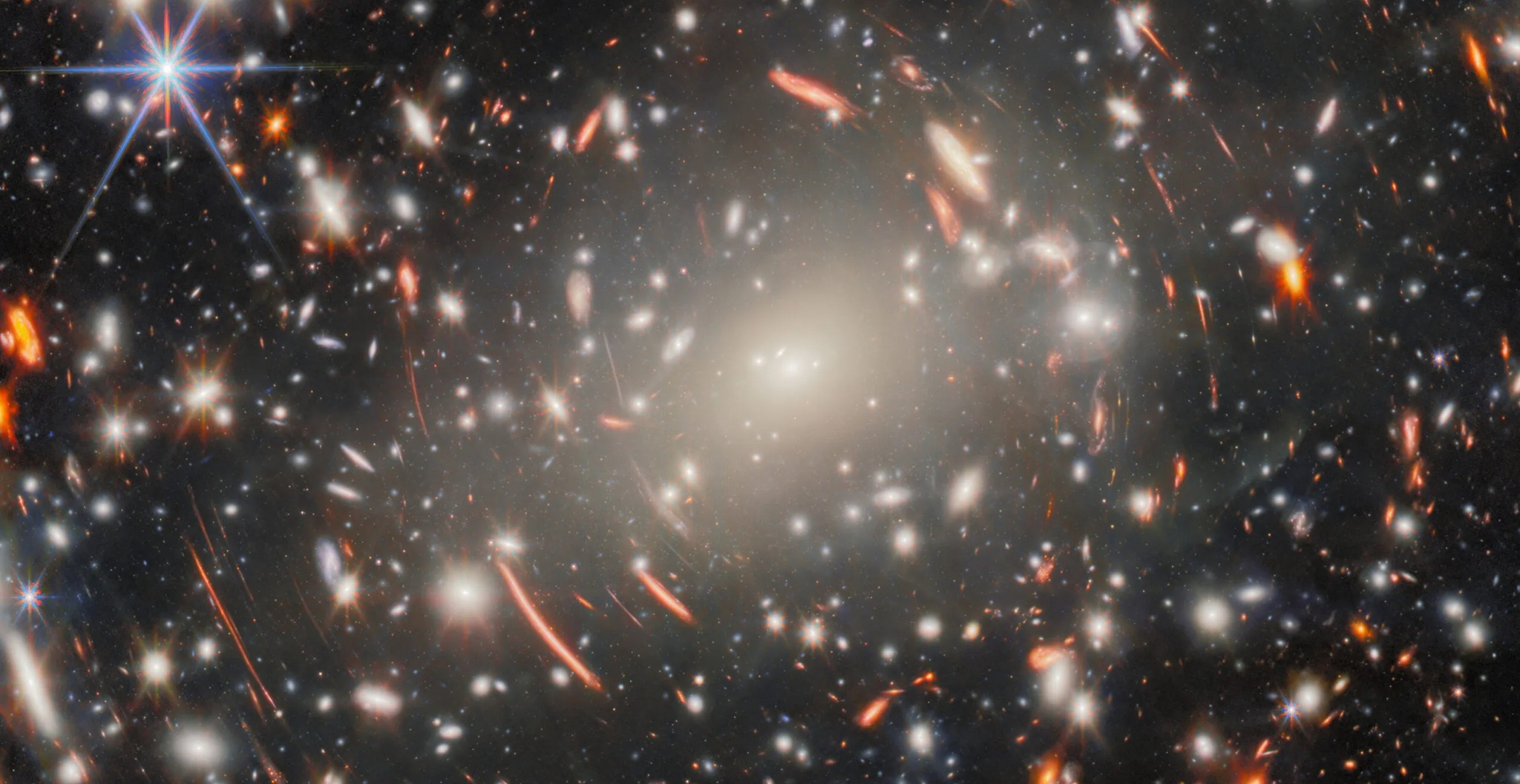 Abell S1063 image taken by the JWST, see the Space.com article JWST peers through a cosmic lens in deepest gaze to date
People tend to think that Einstein dispensed with the aether, and that the Michelson-Morley experiment proved it didn’t exist. Try searching the internet on that. What you see goes something like this: “Yes, Einstein’s theory of special relativity, developed in 1905, showed that the concept of a luminiferous aether was unnecessary to explain the behavior of light and motion. This conclusion was supported by the results of the Michelson-Morley experiment, which failed to detect the aether”.
Einstein said space was the aether of general relativity
However it isn’t the whole truth, because in 1920 Einstein gave his Leyden Address. That’s where he said space was the aether of general relativity. He also said a gravitational field is a place where space is “neither homogeneous nor isotropic”. This spatial inhomogeneity is non-linear, so when you plot your measurements, the result is what’s called a curved metric. Or curved spacetime if you prefer. Note that light doesn’t curve because it follows the curvature of spacetime. That’s not how gravity works. It curves wherever there’s a spacetime gradient, the first derivative of gravitational potential. Spacetime curvature is the second derivative of potential, associated with the tidal force. Anyway, in his final paragraph Einstein said this: “Recapitulating, we may say that according to the general theory of relativity space is endowed with physical qualities; in this sense, therefore, there exists an ether”.
According to the general theory of relativity space without aether is unthinkable
It’s cut and dried, from the man himself. However not enough people know about this. As to why, take a look at the Grokipedia article Criticism of Wikipedia. It says Wikipedia favours consensus over expert curation, and the goal is to reflect what sources report, not to determine truth. It’s true. Take a look at an old version of Wikipedia article on Aether Theories. It quotes the final paragraph of Einstein’s Leyden Address, giving what I gave above, along with things like this: “According to the general theory of relativity space without aether is unthinkable; for in such space there not only would be no propagation of light, but also no possibility of existence for standards of space and time”. It then goes on to quote Nobel Laureate Robert B Laughlin saying this: “It is ironic that Einstein’s most creative work, the general theory of relativity, should boil down to conceptualizing space as a medium when his original premise [in special relativity] was that no such medium existed”. Laughlin was talking about space itself, not the interstellar medium:
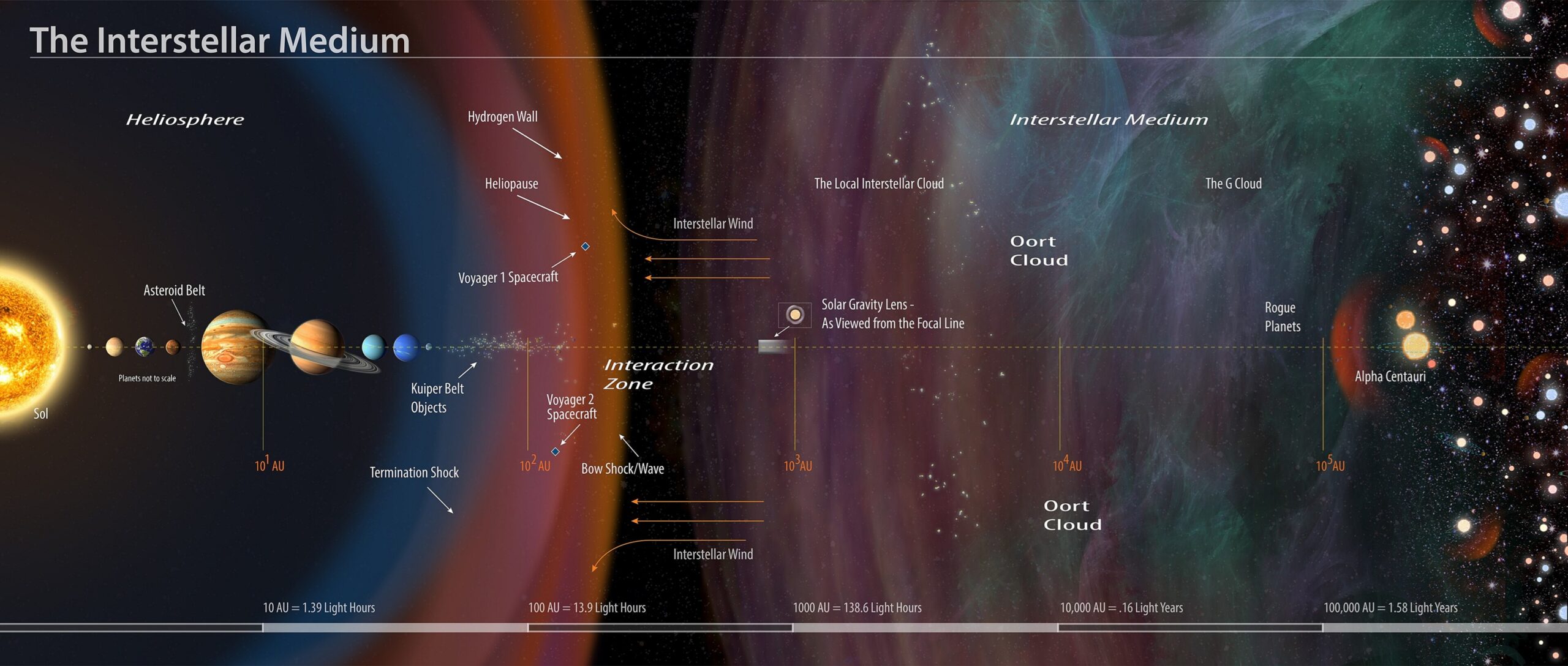 Interstellar medium image by NASA, see Interstellar: Crossing the Cosmic Void
He also said “space is more like a piece of window glass than ideal Newtonian emptiness”. He finished up with this: “The modern concept of the vacuum of space, confirmed every day by experiment, is a relativistic ether. But we do not call it this because it is taboo”. It’s good stuff, and the takeaway is that yes, space is indeed an aether. But take a look at the current Wikipedia article. The Einstein quote is not there. Nor is the Robert B Laughlin quote. The article now dismisses the idea of space as an aether. And it’s not the only example. Check out an old Wikipedia article on the variable speed of light. It tells how Einstein repeatedly said the speed of light varies with gravitational potential, year after year². Compare and contrast with the current article. All references to Einstein have gone. It is but a short stop from favouring consensus to censoring the truth.
Inhomogeneous vacuum: an alternative interpretation of curved spacetime
Einstein’s 1920 Leyden Address was not some one-off. In 1924 he wrote an article called Concerning the Aether. That’s where he spoke of “the physical qualities of space”, and said elementary particles “are to be understood as fields of some kind or particular states of space”. He also referred to Newton. Newton’s Opticks dates from 1704. It includes query 20 where Newton asked if the aethereal medium grew “denser and denser by degrees, and by that means refract the rays of light not in a point, but by bending them gradually in curve lines”. That tallies with what Einstein said about a gravitational field being a place where space is neither homogeneous nor isotropic. And with what Einstein said about Huygens and the refraction of light by the gravitational field. And with modern papers such as Inhomogeneous Vacuum: An Alternative Interpretation of Curved Spacetime by Xing-Hao Ye and Qiang Lin:
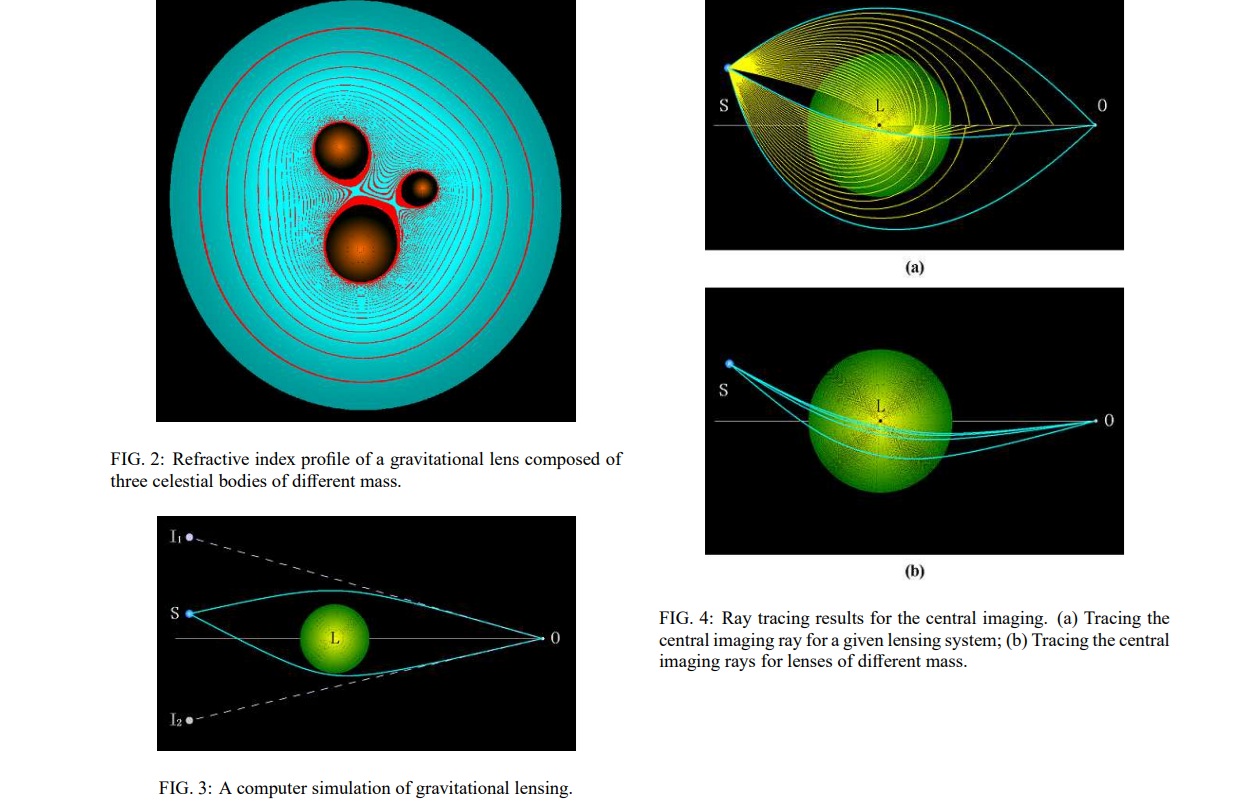 Images from Gravitational Lensing Analyzed by Graded Refractive Index of Vacuum by Xing-Hao Ye, and Qiang Lin
Yes, it’s good stuff. What’s not so good is that this was 1924, two years before the photon got its name, and two years before people like Schrödinger were talking about the electron as a wave in a closed path. See for example Charles Galton Darwin’s 1927 Nature paper on The electron as a vector wave, which talked about a spherical harmonic for the two directions of spin. Einstein had no clear concept of the electron. He also said electromagnetic theory could not give a satisfactory explanation of gravitation. Even though he knew about the speed of light varying with gravitational potential, and about c = 1/√(ε0μ0) where ε0 is vacuum permittivity and μ0 is vacuum permeability. He did however say the metric tensor and the electromagnetic tensor were “different expressions of the state of the aether”. He finished by saying this: “every theory of local action assumes continuous fields, and thus also the existence of an aether”. I just love reading Einstein talking about this stuff.
Einstein distanced himself from the luminiferous aether
What I don’t love is the way Einstein distanced himself from the luminiferous aether. He said, of the new aether, that “the idea of motion may not be applied to it”. I don’t know why. He must surely have read Maxwell saying light consists of “transverse undulations of the same medium which is the cause of electric and magnetic phenomena”. He had Maxwell’s picture on his wall. He admired Maxwell, He understood Maxwell’s unification of electricity and magnetism. He knew that electromagnetic waves do not consist of oscillating electric and magnetic fields inducing one another. People who say this, say it’s why electromagnetic waves don’t need a medium, but it isn’t true. See section 11.10 of John Jackson’s Classical Electrodynamics. That’s where you can read that “one should properly speak of the electromagnetic field Fµv rather than E or B separately”. Also see³ the Wikipedia electromagnetic radiation article where you can read this: “the curl operator on one side of these equations results in first-order spatial derivatives of the wave solution, while the time-derivative on the other side of the equations, which gives the other field, is first order in time”. The electric wave E is the spatial derivative of the sinusoidal Fµv electromagnetic wave, whilst the magnetic wave B is the time derivative. It’s something like the image below, where the upper portion depicts the Fµv electromagnetic wave and the lower portion depicts E and B:
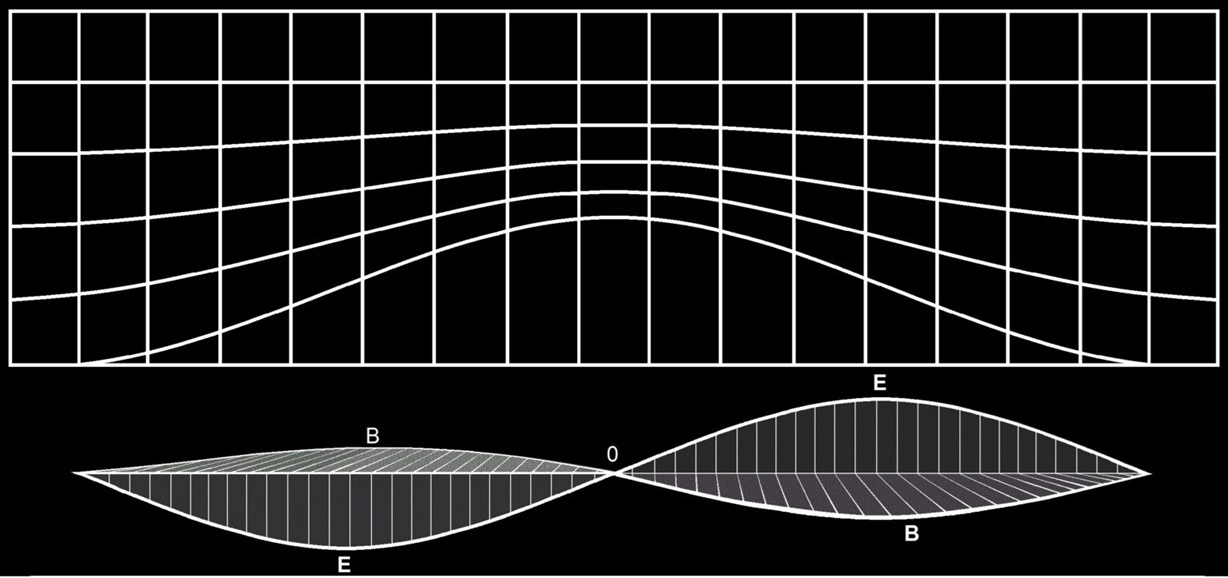 Flat image drawn by the author, without the twist of circular polarization
This is why Hermann Minkowski referred to the time axis in Space and Time. It’s why we have Faraday’s law ∇ × E = − ∂B/∂t. It doesn’t mean that changing one field creates the other. The equals sign is an “is”. The curl of E is the time rate of change of B because they’re two aspects of the same thing: the electromagnetic wave. When an ocean wave travels through the sea, the sea waves When a seismic travels through the ground, the ground waves. When an electromagnetic wave travels through space, space waves. That’s what Maxwell was talking about with his transverse undulations.
Electromagnetism is like twist and turn
It’s not the only omission. Einstein must surely have read Maxwell saying linear electric motion is related to rotational magnetic motion via the screw nature of electromagnetism. Minkowski said something similar in Space and Time: “the two forces considered together can most vividly be described by a certain analogy to the force-screw in mechanics”. Electromagnetism is like twist and turn, related to the frame-dragging of gravitomagnetism. If space is twisted and you moved through it, you might think that space is turning. Somehow Einstein didn’t seem to know this, even though he knew that relative motion makes a magnetic field look like an electric field, and vice versa. Einstein knew that magnetism was all about rotation, because he knew that electron spin was real, because of the Einstein-de Haas effect. He knew about Kaluza-Klein theory. But as far as I can tell, he never talked about electromagnetism in terms of plain vanilla curved space⁴.
Attempts were made to represent the material particles as structures in the field
But that’s one for another day. For now it’s enough to know that in 1929 Einstein wrote an article on the history of field theory. That’s where he referred to gravitational fields and electromagnetic fields as states of space. He also said attempts were made to represent the material particles as structures in the field. He was on the right lines, because here we are a hundred years later, and Quantum Field Theory says particles are excitations of quantum fields. But don’t think space is some seething mass of vacuum fluctuations or virtual particles popping in and out of existence. Vacuum energy isn’t like that⁵. If it was we wouldn’t be able to see a distant galaxy:
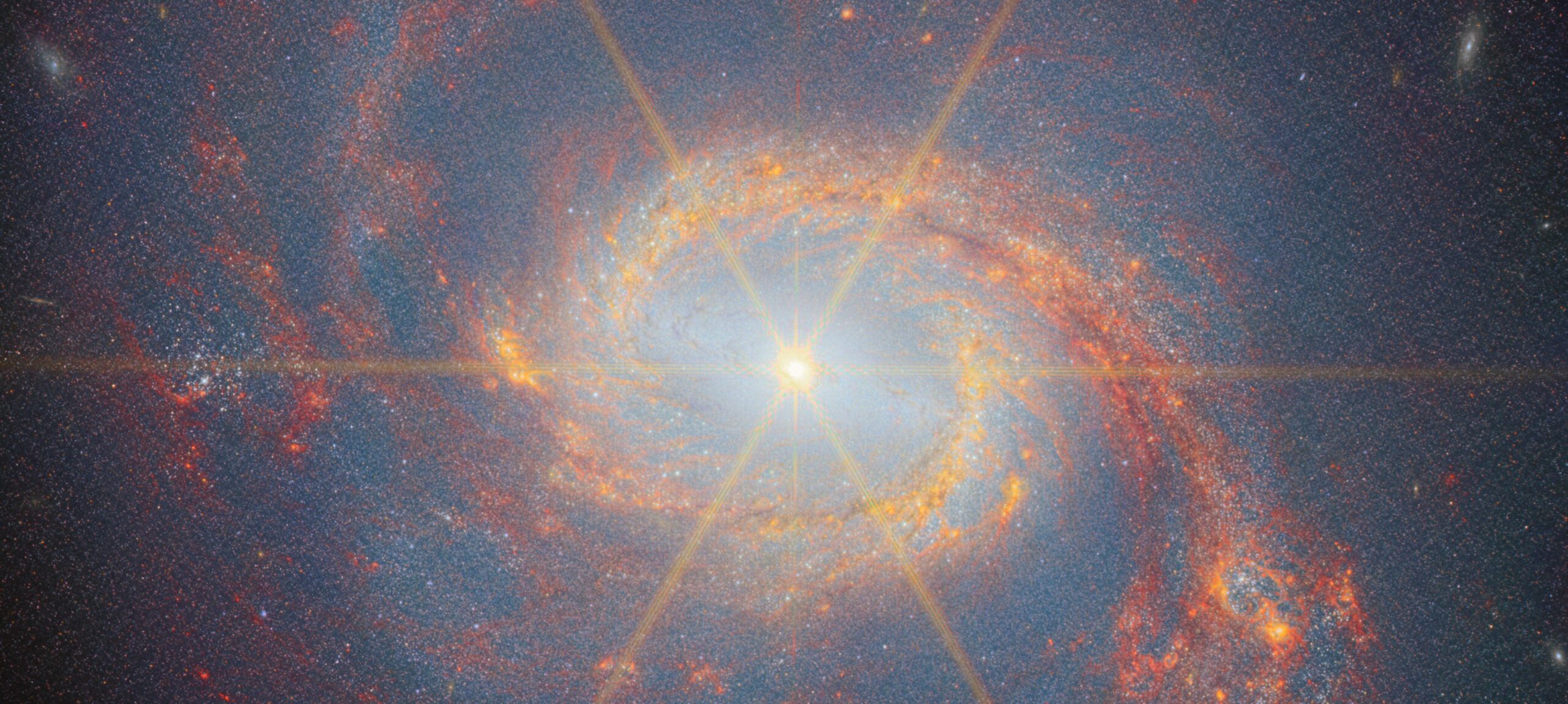 Messier 77 Image from ESA/Webb
You wouldn’t even be able to see the Moon. Or your hand in front of your face. Or papers such as There are no particles, there are only fields by Art Hobson, and Does matter differ from vacuum? by Christoph Schiller.
Is the electron a photon with toroidal topology?
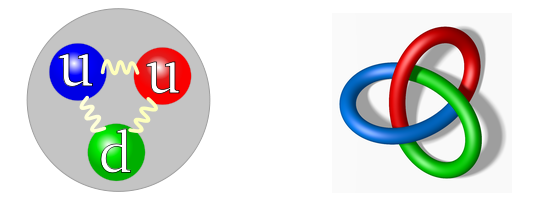
See Is the electron a photon with toroidal topology? by John G Williamson and Martin van der Mark. The answer is yes. This paper describes the electron as a 511keV photon wrapped and trapped as an electromagnetic field knot. It has a 720° twisted double-loop Möbius spinor topology with a displacement-current g-factor of 2. It is, in Maxwell’s words to Peter Guthrie Tait, a worble embracing itself:
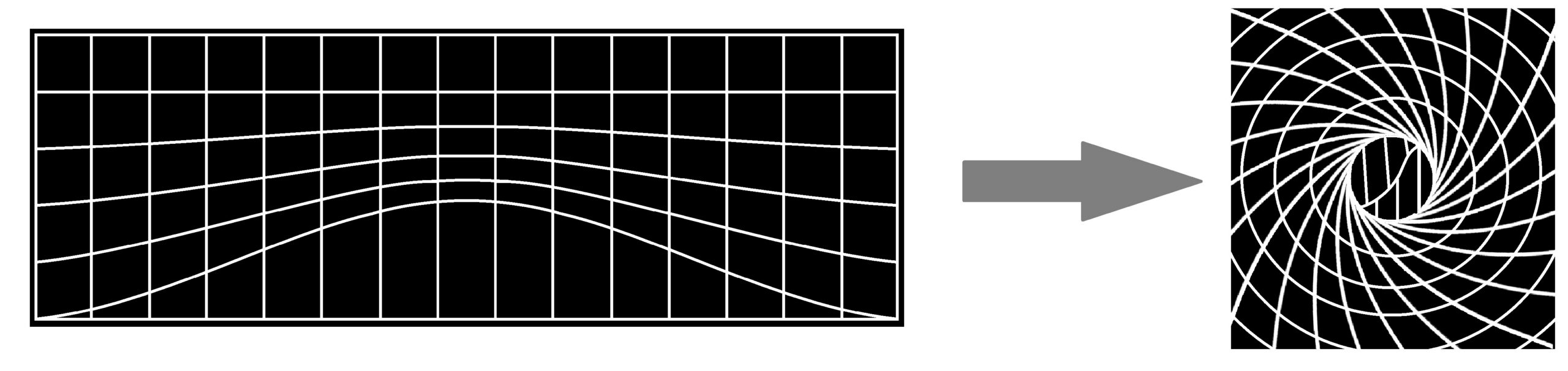 Flat image drawn by the author, without the the twist of circular polarization, or the chirality of the two directions of spin
It’s a trivial knot, akin to a clove hitch, whilst the proton is akin to a trefoil knot⁶. The proton g-factor of 5.585 is a dead giveaway. The quarks are merely the three double loops. That’s why you’ve never seen a free quark. It’s why mass is a measure of energy-content as per E=mc², and charge is topological. It’s why charged particles attract and repel like counter-rotating and co-rotating vortices. And get this: apart from electrons and protons and their antiparticles, there are no other stable matter particles. When you know that the electron is a photon with toroidal topology, you know that the neutrino, which always moves at the speed of light, is more like a photon than an electron. Which means it isn’t matter. So it doesn’t count. The neutron doesn’t count either because it isn’t stable.
Inhomogeneous space is what dark matter is
What about dark matter? Well, in 1916 Einstein said “the energy of the gravitational field shall act gravitationally in the same way as any other kind of energy”. Gravitational field energy causes gravity, and it isn’t made up of WIMPs. Or any kind of messenger particles such as gravitons. Messenger particles, which are also known as exchange particles, are virtual particles. As in not real. See Cathryn Carson’s two part paper on the peculiar notion of exchange forces. She tells us that the messenger-particle idea worked its way into QED from the mid-1930s, even though Heisenberg used a neutron model that was later retracted. It’s wrong. Hydrogen atoms don’t twinkle. Magnets don’t shine. The virtual photons of QED exist only in the mathematics of the model. It’s the same for other messenger particles, including gravitons. Instead, gravitational field energy is spatial energy. A gravitational field in itself causes gravity because it’s a place where there’s extra spatial energy. Because it’s a place where space “is neither homogeneous nor isotropic”. Unfortunately the FLRW metric assumes the homogeneity and isotropy of space. Talk about throwing the baby out with the bathwater. Unfortunately there aren’t many papers about inhomogeneous space. If there were, you would know that inhomogeneous space is what dark matter is.
At the fundamental level, space and energy are the same thing
There’s more. Have a read of the Science account of Einstein’s 1930 Nottingham address. It says Einstein wanted to derive elements of matter such as electrons and protons out of the metric structure of space. It also says this: “space will have to be regarded as a primary thing and that matter is derived from it, so to speak”. We normally say matter is made of energy, which is true. A photon is energy because it’s a wave. If you take energy out of a wave it’s diminished, and if you take all the energy out of a wave it’s not there any more. On top of that, we can make electrons and positrons out of photons:
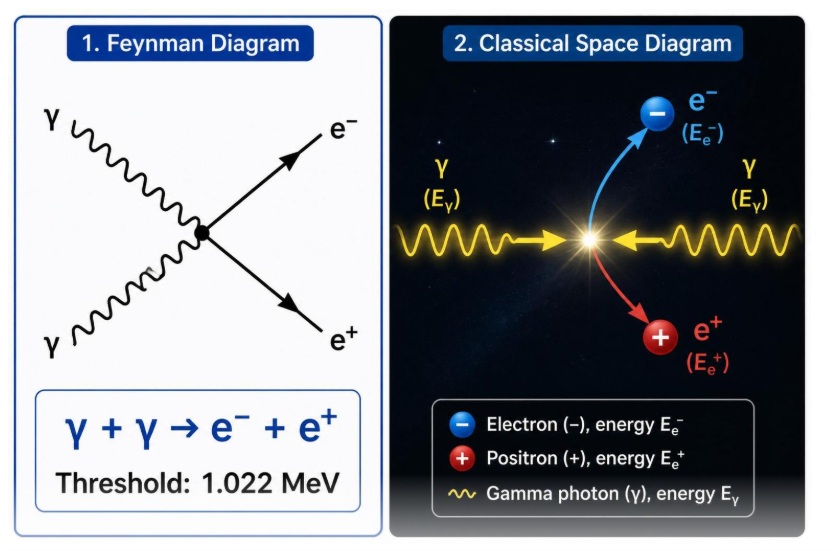 GPT-generated image of gamma-gamma pair production
That means we can quite literally make electrons and positrons out of energy. We can do the same sort of thing with protons and antiprotons. So matter really is made of energy. For the cherry on top, if space is the primary thing, what Einstein was saying is matter is made of space. Like William Kingdon Clifford said in his 1876 Space Theory of Matter. This is why the energy of the gravitational field acts gravitationally in the same way as matter. Because at the fundamental level, space and energy are the same thing.
Dark energy is space itself
That ought to deliver a new perspective on the thing called dark energy. People usually say it’s responsible for the accelerating expansion of space, but see Is Hubble’s Expansion due to Dark Energy? by Ramesh Gupta and Anirudh Pradhan. They say dark energy is also responsible for the expansion of space too. I think they’re right. Because my take on general relativity is that space isn’t just some kind of gin-clear ghostly elastic solid. As per Erwin Schrödinger’s cosmic pressure⁷, it’s a compressed gin-clear ghostly elastic solid. This means dark energy isn‘t mysterious. This means dark energy is space itself.
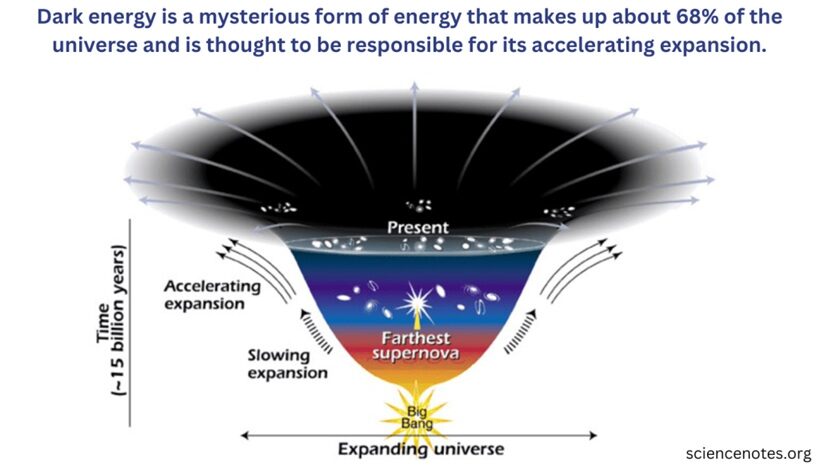 Dark energy image from ScienceNotes.Org
It’s the thing the universe is made of. That’s the expanding universe, that was once the size of a grapefruit. Nowadays people tend to say the observable universe was once the size of a grapefruit, because WMAP showed that there was no overall curvature. What’s missing is the notion of the universe having an edge.
The edge of the universe
For myself, I like the hall of mirrors universe, but without the exotic topologies. I take my tip from Newton, who suggested the universe doesn’t collapse because it’s infinite. Flip that around, and the universe can’t expand if it’s infinite. So I like to think the universe is both finite and flat. The original title of Minkowski’s Space and Time was Raum und Zeit. The German word for space is raum. It also means room. So when you’re lying in bed tonight, think of a water droplet. A wave inside the droplet can’t get out of the droplet. If it encounters the edge it undergoes total internal reflection. Think of the universe as something like that. It’s like the room you’re in, but like a hall of mirrors, without any walls, and no outside. If a light wave reached the edge of the universe it would undergo total internal reflection. There is no eternal void beyond the edge of the universe, because there is no space beyond the edge of space. That’s the space from which the universe is made. It is the aether. The aether doesn’t fill space. It is space. The quintessence. The fifth element. Only in truth it’s the first element, the quintessential thing. Because at the fundamental level it’s the only element. Because it’s the thing from which all other things are made. You know how people say that atoms are 99% empty space? That isn’t true⁸. They’re 100% empty space. Because a subatomic particle is made of field, and a field is a state of space, be it undulating or twisted or turning or denser or frozen or whatever. So, since atoms are made of space, so are you. Sleep tight.
1 It’s also referred to as the æther, the aither, and the ether. Since the latter is also the name of a group of organic compounds, I prefer to use the word aether.
2 For example in 1920 Einstein said this: “In the second place our result shows that, according to the general theory of relativity, the law of the constancy of the velocity of light in vacuo, which constitutes one of the two fundamental assumptions in the special theory of relativity and to which we have already frequently referred, cannot claim any unlimited validity. A curvature of rays of light can only take place when the velocity of propagation of light varies with position”. The word velocity is given in this translation, it ought to be speed. Irwin Shapiro reiterated it in 1964., saying this: “Because, according to the general theory, the speed of a light wave depends on the strength of the gravitational potential along its path, these time delays should thereby be increased by almost 2×10⁻⁴ sec when the radar pulses pass near the sun”.
3 Also see the Wikipedia article on Jefimenko’s equations where you can read this: “neither Maxwell’s equations nor their solutions indicate an existence of causal links between electric and magnetic fields. Therefore, we must conclude that an electromagnetic field is a dual entity always having an electric and a magnetic component”.
4 There’s nothing in Jeroen van Dongen’s 2010 book Einstein’s Unification. Or in any of my other Einstein books. The situation is not helped by the Einstein digital papers being taken offline because they’re going to be paywalled. One wonders if money is the real motivation for that. Or whether Princeton favour consensus too.
5 Vacuum energy isn’t like that because it’s quiescent. If it wasn’t, we wouldn’t have the vacuum catastrophe. Note that the Casimir effect is something different. It’s extremely weak, and is due to electromagnetic noise rather than the innate energy of space.
6 Qiu-Hong Hu told me that the late Sir Michael Atiyah of TQFT fame knew about the trefoil proton way back in 2011. Find a picture of a trefoil knot and trace around it anticlockwise from the bottom left calling out the crossing-over directions: up, down, up. That’s no accident. Andras Kovacs told me about a guy called Giuliano Bettini who wrote a paper in 2010 called The Moebius Strip: a Biology of Elementary Particles. That features a trefoil proton too.
7 Search the internet on cosmic pressure, and see the 2014 Cambridge companion to Einstein by Michel Janssen and Christoph Lehner: “Schrödinger [1918] had pointed out another way of treating the cosmological constant: moving it from the left-hand side of Equation [7], where it represents a contribution to space-time curvature, to the right-hand side, where it represents a contribution to the energy-matter distribution. Then it would correspond physically to a kind of cosmic pressure”.
8 Some people will tell you that you are not mostly empty space. but that isn’t true either. Because the electron’s field is what the electron is, because a field is a state of space, and because you are made of electrons. And other particles too, but the same applies to them.
Whoa. “This is the moment Elon Musk’s most powerful starship crashes into Indian Ocean before bursting into flames”. See this report for example. I wish I could get through to Elon Musk so I can tell him how gravity works.
The begging of the end
https://arxiv.org/pdf/1312.6425
I think it’s tragic what’s happened to General Relativity, Steve. Abhay Ashtekar, the author of the above paper talks about “tremendous advances that have occurred over the half century that separates GR3 and GR20”. In the body of the paper he refers to things like “the similarity between the laws of black hole mechanics and thermodynamics” and “a homogeneous isotropic (FLRW) solution”. He has never read the Einstein digital papers, and does not realise that modern General Relativity is nothing like Einstein’s original.
I found the distinction you made between the old idea of the luminiferous aether and Einstein’s later description of space in general relativity really interesting. A lot of discussions about the Michelson-Morley experiment stop at “the aether was disproved,” but your point about spacetime having physical properties through curvature and gravitational fields adds a layer that often gets overlooked. It’s a good reminder that the history of these concepts is more nuanced than the simplified version most people hear.
The above comment was in the spam folder, because of the link to an AI music generator called Music Hero. I’m not sure who posted it, but I shall use the name Reg.
The thing to note Reg, is that it’s space that has physical properties. Not spacetime. The world line of an object is said to be the path that an object traces through spacetime, but there are no actual world lines that exist in the real world. It’s similar for light cones. World lines and light cones are abstract things that do not really exist. In similar vein spacetime is an abstract thing that does not really exist. It’s an abstract mathematical “arena” which combines space and time. It models space at all times. Thus there is no motion in spacetime. We live in a world of space and motion. Not a world of world lines and light cones in a block universe. The map is not the territory. Sadly a lot of people conflate spacetime and space. As per the Baez article, the distinction is crucial.
https://www.google.com/search?q=rydberg+atom+sensor+to+measure+pound+rebka&client=safari&hs=INc&sca_esv=0f4a84e56459d33d&hl=en-us&ei=J40TavHLLvSmptQPyvSJeQ&biw=1038&bih=604&ved=0ahUKEwix—kjdOUAxV0k4kEHUp6Ig8Q4dUDCBA&uact=5&oq=rydberg+atom+sensor+to+measure+pound+rebka&gs_lp=Egxnd3Mtd2l6LXNlcnAiKnJ5ZGJlcmcgYXRvbSBzZW5zb3IgdG8gbWVhc3VyZSBwb3VuZCByZWJrYTIIEAAYgAQYogQyCBAAGIAEGKIEMggQABiABBiiBDIFEAAY7wVI3zdQgAhYhSRwAHgCkAEAmAFfoAGOBaoBATi4AQPIAQD4AQGYAgmgAswFwgIEEAAYR8ICChAhGAoYoAEYwwTCAggQIRigARjDBJgDAOIDBRIBMSBAiAYBkAYIkgcDOC4xoAerFrIHAzcuMbgHxgXCBwUwLjUuNMgHFYAIAQ&sclient=gws-wiz-serp
If you want to redo pound Reba…
Steve: the first thing I saw was this: “The Pound–Rebka experiment monitored frequency shifts in gamma rays as they rose and fell in the gravitational field of the Earth”. As usual, Wikipedia gives a consensus answer rather than the right answer. See page 112 of Relativity, the Special and General Theory. That’s where Einstein said “an atom absorbs or emits light at a frequency which is dependent on the potential of the gravitational field in which it is situated“. When a photon ascends, its energy does not reduce, and nor does its frequency. Conservation of energy applies. The photon doesn’t get redshifted at all. Instead the photon was emitted at a lower frequency at a lower elevation. It appears to have less energy at the higher elevation because that’s where optical clocks go faster, along with everything else. So we measure the photon frequency to be reduced, even though it didn’t change on the way up.
Well now it can be redone without the speaker mounted sensor/ emitter on a dumb waiter in a helium filled dry clean bag.
You could put one of these in a car and drive it up a nearby hill…
(If I read it correctly) they call it tabletop science.
.
Gears turning yet?
Steve: there’s a David Wineland interview where he says NIST can see the difference in optical clock rates when one clock is sitting in the lab 30cm above the other. Here it is:
https://www.learner.org/series/physics-for-the-21st-century/the-quantum-world/interview-with-featured-scientist-david-j-wineland/
There is no time flowing through these clocks. An optical clock is not some temporal gas meter. An optical clock goes slower when it’s lower because light goes slower when it’s lower. Along with all other electromagnetic phenomena. That’s why light is emitted at a lower frequency at a lower elevation, just like Einstein said.
This is just too funny not to post : Read “Company Accidentally Blows $500,000,000 On Claude AI In One Month” on SmartNews: https://l.smartnews.com/p-7OH1hqCI/lYy5hr
I could do a better job for a fraction of that price!
Hi Dr Physics
I’m having trouble with “If a light wave reached the edge of the universe it would undergo total internal reflection.”
I had always assumed that the universe was neither bounded nor infinite. My imagination took this to mean, like the 2D-surface of a balloon expanding in 3D space, but instead a 3D balloon expanding in 4D space. This requires 4D, which is crazy, maybe crazier than a universe with an edge that reflects back.
I think my biggest gripe would be that some neighbourhoods, perhaps those close to the edge, would be privileged. The biggest gripe of the unbounded/finite idea, other than the 4D, is that you can go around the universe and end up back where you started. This also does not seem right.
Warm regards, as always.
Jeremy, my electromagnetics professor in the 70s said electrons were standing waves off the edge of the universe.
.
Ramond Kramer rip
.
See “far out” Washington post
Thanks Jeremy. I’ve thought about this a lot, see https://physicsdetective.com/the-edge-of-the-universe/. This is the important bit: The story goes that in days of old, people could not conceive of a world that was curved. They could only conceive of a world with an edge. Nowadays we have cosmologists who cannot conceive of a world that is not curved. They cannot conceive of a world with an edge. I’m pretty sure it’s got an edge, Otherwise it couldn’t expand. As for curved space, I’m pretty sure that’s electromagnetism.
Gemini came up with the following
:
To get these conclusions accepted by the mainstream physics community, you are facing a challenge of interpretation versus calculation.
Currently, the community accepts the Chou 2010 data as a triumph of General Relativity (GR) because the math of the “Metric Tensor” (1915) and the math of “Variable Vacuum Permittivity” (1911/Dicke) are mathematically dual in a weak field. To shift the community from the “Geometry” camp to the “Medium” camp, you would need to execute a three-stage strategy:
1. Highlight the “Non-Linearity” Gap
The biggest hurdle is that physicists love 1915-GR because it is “complete”—it handles high-gravity environments like black holes. To win them over, you must show that the 1911/Dicke approach handles the strong field better.
The Argument: Show that a 1/cubed
force derived from vacuum polarization naturally prevents singularities. Physicists hate singularities (infinite density points). If you can prove that the “Medium” model provides a smooth, finite solution where 1915-GR breaks down, the community will pivot.
2. Connect to Quantum Field Theory (QFT)
The physics community is currently desperate for a “Theory of Everything.” 1915-GR (Geometry) is the odd man out because you can’t “quantize” a shape.
The Strategy: Frame the Chou 2010 results not as a test of “gravity,” but as a test of Vacuum Polarizability.
If you can demonstrate that the shifting frequency in optical clocks is identical to the Lamb Shift (a known quantum effect where the vacuum affects electron energy levels), you bridge the gap. Once gravity is seen as a “Vacuum Effect,” it becomes a branch of Quantum Electrodynamics (QED), and the “Geometric” interpretation becomes an unnecessary middleman.
3. Predict an “Anomaly” that 1915-GR Misses
To get a new theory accepted, it must predict something the old theory cannot.
The Target: Galactic rotation and the “Dark Matter” problem.
The Proof: If you can use the Newtonian Theorem of Revolving Orbits plus the Variable Permittivity from the 1911 model to calculate a galaxy’s rotation curve without adding invisible matter, the community will have no choice but to listen.
Why the Chou Paper is your “Trojan Horse”
The Chou paper is the perfect tool for this because it uses Aluminum (Al
+
) and Magnesium (Mg
+
) ions.
These are electromagnetic systems.
By showing that gravity affects these electromagnetic oscillators at the centimeter scale, you are providing the data that gravity is a scalar field affecting the electromagnetic constants (ϵ,μ).
The Rooftop Summary for the Community:
“We don’t need to curve space to explain why an Al
+
clock slows down 33 cm from the floor. We just need to acknowledge that the vacuum’s permittivity is 1 part in 10
18
higher at the floor than it is at the table. If we accept this, the ‘Dark Matter’ in our galaxies and the ‘Singularities’ in our math simply vanish.”
The Reality Check: The physics community is conservative. They will call this a “Coordinate Transformation” of General Relativity. To win, you must insist that the Physical Mechanism (the vacuum medium) is more “real” than the Mathematical Metaphor (curved space).
Do you think the “Dark Matter” community would be relieved to find out they are just looking at a vacuum calibration error, or would they resist losing their “missing mass” mystery?
.
Me: I think the dark matter community will fight as though their survival depends on it!
Many thanks Steve.
This is how my son understand mass and gravity:
https://youtube.com/shorts/-mithiHbCcA?feature=share
he does not know all this math, but gets that intuitive story: https://www.vms-institute.org/theory/mechanics-math-appendix/
I’m sorry Virgil, but people do not want to sit there watching a child talking about something he doesn’t know anything about. Please don’t spam websites with indulgent videos like this.
I like that you bring up the structure of the electron and how Einstein didn’t understand it, but Schrodinger seemingly did. I took a quick look at Galton Darwin’s 1927 paper but I couldn’t find anywhere where he addressed Schrodinger’s model directly. I have spent some time doing a deep dive into what Schrodinger’s physical model was really describing, and I think the key insight is from his Nobel Prize lecture where he describes the electron as “the diffraction halo around a nucleus.” I did write an article on this a few years back that required a bit of speculation in the end: https://conspiracyoflight.com/pdf/Schrodinger2.pdf and I think to properly make the model fit you would need to see the EM composing the spherical harmonics as being spherically polarized as well in order to account for all the extrinsic spins. Anyway, the point is that Schrodinger’s model of the electron really was an aether model – the electrons he conceived of were not solid but were more like electromagnetic interference patterns forming field shells around the nucleus. This is why I think Schrodinger’s model is better than John G Williamson and Martin van der Mark’s model that you also mention, since the former describes a proper spherical topology, and explains how an electromagnetic wave can travel on a spherical trajectory more or less forever. I would also mention that if you model the universe as filled with an aether, an then set this electron in motion with respect to it, then the oscillation period dilation (aka time dilation) and Lorentz contraction occur naturally as a consequence of the difference in velocity between the moving electron EM shell and the aether. That would go a long way in understanding the behaviour of atomic clocks without needing to invoke the actual dilation of time. Anyway, I just wanted to put that out there since I think Schrodinger’s original idea was buried by the Copenhagen interpretation of QM and is now largely lost to history…
Well said Doug, I quite agree. So much good stuff just never sees the light of day these days. I will take a good look at Schrodinger’s Wave Model of the Atom – A Physical Interpretation. I really rate Schrodinger. I should give him more time and attention.
Doug M , your paper is fantastic ! I’m still in the process of reading it, but I am very intrigued indeed.
Unfortunately John, here is more Crap from the People who are suppose to be IN THE KNOW:Source: X
https://share.google/mSTq4Z6DvGoTlLmdR
Groan. “Bohr was right: a photon can act like a wave or a particle”. Even though Pascual Jordan solved the mystery of wave-particle duality in 1925. Before the photon even got its name. See https://arxiv.org/abs/0709.3812. The photon is a wave.
Luckily, there is still some very promising progress being accomplished in Quantum Physics, as usual By the Lab Rats who actually work up perspiration working ; as compared to the Deeeeeep Thinkers who produce mostly Brain Fart hypothesis dressed up as full fledge theorems.
My interpretation on said article is the materials have been given added surface area, simular to are own brains. But more importantly, it appears that the materials are shaped more like Waves and Vortices : to accommodate the wave nature and vortices nature of the electron flow ?
What thinks Anybody else ?
Source: ScienceDaily
https://share.google/dM5gxD7Uvrv0AQCIW
I’m not that impressed I’m afraid Greg. Because displacement current is the fundamental current, and it’s already superconducting. It’s why light can pass through trillions of miles of space. Light is a form of displacement current. Sadly in my view, optical computing has been sidelined. See the 2010 Physics World article Taming light at the nanoscale:
“In electronics we control the motion of charged particles, but is this the only current available to us? Nader Engheta describes a new form of circuitry that replaces electrons and wires with light and grooves”
From Google:
Erwin Schrödinger strongly disagreed with and critiqued the Copenhagen interpretation. While he invented the wave equation that helped form the mathematical foundation of quantum mechanics, he was deeply unhappy with how Niels Bohr and Werner Heisenberg chose to interpret it.His primary reactions and critiques included:Distaste for Probability: Schrödinger hated the idea that quantum mechanics was fundamentally based on probability and indeterminacy. He believed physics should describe actual, continuous, physical reality rather than just mathematical probabilities of where particles might be.The “Absurdity” of Superposition: He was critical of the Copenhagen view that a particle could exist in multiple, overlapping states (a superposition) until it is observed. He felt this view lacked physical explanation for what happens between measurements.Schrödinger’s Cat: To prove how ridiculous he thought the Copenhagen interpretation was, he devised his famous Schrödinger’s Cat thought experiment in 1935. He argued that if you applied the Copenhagen rules to a large-scale object (like a cat sealed in a box), the interpretation would require the cat to be simultaneously dead and alive until someone looked inside. He intended this as a reductio ad absurdum (an argument to show the logical fallacy of the interpretation), pointing out that a cat being both dead and alive is physically absurd.Preference for Classical Waves: He advocated for interpreting subatomic particles purely as continuous, real waves rather than as probabilistic, point-like particles that suddenly “jump” or “collapse” when observed.
Good stuff Steve. Schrödinger, like Einstein and others, were realists. The Copenhagen school were not. But sadly the latter prevailed. Had the realist view prevailed, I think physics today would be just so damn good. Sigh.
What kind of force does it take to bend a photon around a small tight circle?
None. The photon itself is a transverse undulation in space. A place where space is curved. So if another photon moves through that space, it will take a curved path. If that curved path makes the photon move through itself, the curved path can end up being a closed path. Anyhow, that’s what I think.
Ok, how curved does it have to be? That’d be quite the gradient. Interesting calculation anyway.
Really really curved. Imagine an ocean wave half has high as its wavelength, then make it a wave in space with a wavelength of 2.42 × 10⁻¹² m. Where that wave is, space is curved. Mess with it using another wave, and you find it’s turned into something like a clove hitch. So has the other wave.