The history of particle physics starts with the concept of the atom. The word is derived from atomos, which means indivisible. It goes way back to the Greek philosopher Leucippus in the 5th century BC. His student Democritus promoted the idea, but Aristotle was dead against it. The Christian Church sided with Aristotle, and it wasn’t until the 17th century that atoms were resurrected. See the Philosophy Institute article Evolution of the Atomic Theory for more. Things really picked up in 1808 when John Dalton published his atomic theory. It was called A New System of Chemical Philosophy, and is available online. It wasn’t correct in every detail, but it was a great contribution to science:
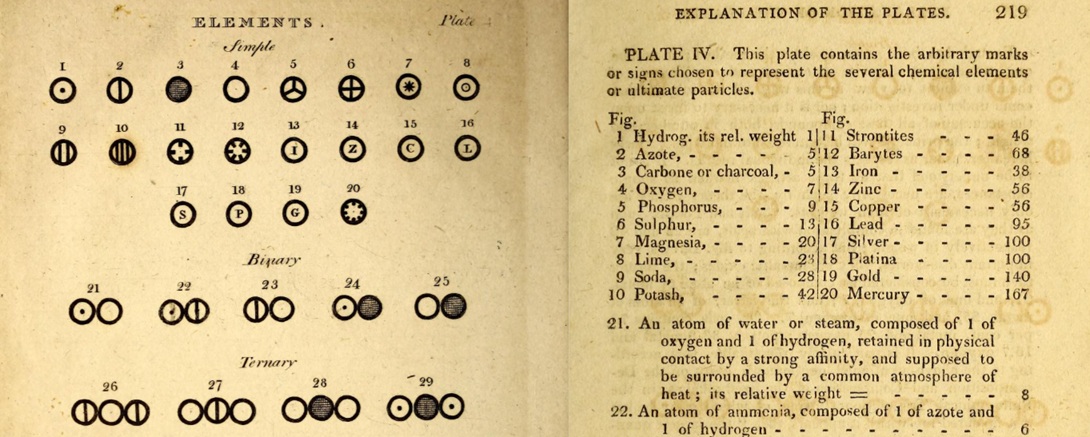 Screenshot from John Dalton’s A New System of Chemical Philosophy
Oddly enough, one thing that wasn’t correct was the notion of the atom as an indivisible unit. However it took a while for people to realise this. In 1857 Heinrich Geissler invented the Geissler tube, which was essentially a neon tube. Then in the 1870s William Crookes invented the Crookes tube, which was essentially a cathode ray tube. Then in 1891 George Johnstone Stoney proposed the name “electron” for the fundamental unit of charge. This was in a paper called On the cause of double lines and of equidistant satellites in the spectra of gases. You can find it online in the Royal Dublin Society archives¹.
Thomson discovered the electron
Then in 1897 Joseph John “JJ” Thomson discovered the electron. This was the first lepton. Thomson deflected cathode rays with electric and magnetic fields, and deduced that they consisted of charged particles. Then by measuring the deflection he was able to calculate the mass to charge ratio, which was the same regardless of the cathode. His paper was simply called Cathode Rays, and he used the word corpuscle rather than electron.
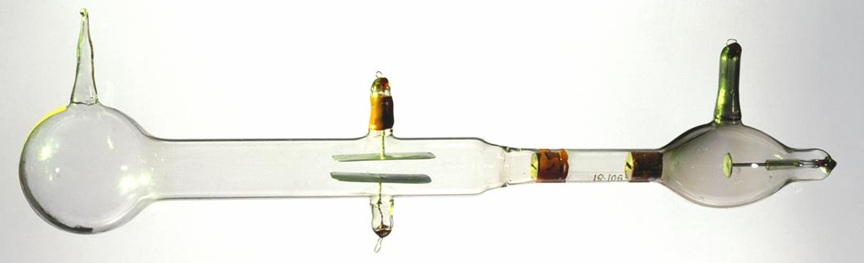 JJ Thomson cathode ray tube image from the science museum group collection
Interestingly it was George Francis Fitzgerald, Stoney’s nephew and the relativity pioneer, who suggested the word electron. Even more interestingly Thomson didn’t like the word. But such is life.
Einstein discovered the photon
Three years later in 1900 Max Planck wrote a paper On the theory of the energy distribution law of the normal spectrum. He kick-started quantum theory, and laid the groundwork for Einstein’s 1905 miracle year. That’s when Einstein discovered the photon. Or at least demonstrated the quantum nature of light. See his photoelectric paper Concerning an Heuristic Point of View Toward the Emission and Transformation of Light. He won his Nobel prize for that. Ironically his Nobel Prize lecture was about relativity. Even more ironically Einstein called them light quanta, and hardly ever called them photons. No matter, because nine years later Thomson had relented, and finally called his corpuscles electrons. See his 1914 book The Atomic Theory.
Rutherford discovered the proton
Three years after that, JJ’s former student Ernest Rutherford discovered the proton in 1917. This was the first baryon. Rutherford used alpha particles emitted from radium to bombard nitrogen gas, and detected hydrogen nuclei. See his paper Collisions of α Particles with Light Atoms. IV. An Anomalous Effect in Nitrogen. It was published after World War I in 1919. However Rutherford didn’t call it the proton until 1920. That was when he predicted the neutron. See his Bakerian Lecture: Nuclear constitution of atoms. Only he didn’t call it a neutron in 1920, that was down to William Draper Harkins in 1921. Five years after that, the photon got its name in 1926, thanks to Gilbert Lewis. See his Nature paper The conservation of photons. The name soon caught on². The title of the 1927 Solvay conference was Electrons et Photons.
Dirac is said to have predicted the positron
A year later in 1928 Paul Adrien Maurice Dirac is said to have predicted the positron³. See his Royal Society “hole” paper A theory of electrons and protons. However his negative-energy protons were shot down by J Robert Oppenheimer in the latter’s 1930 Physical Review paper On the theory of electrons and protons.
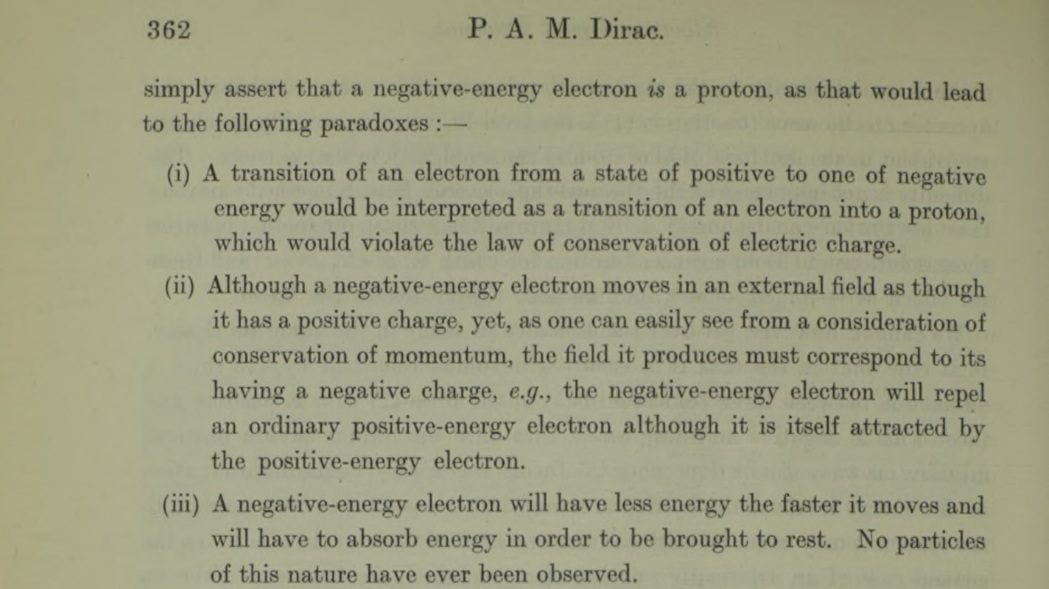 Screenshot from Dirac’s 1928 paper A theory of electrons and protons
In 1931 Dirac came up with another paper Quantised singularities in the electromagnetic field. That’s where he said one of these holes would appear to be a proton, but that subsequent investigations “have shown that this particle necessarily has the same mass as an electron, and also that, if it collides with an electron, the two will have a chance of annihilating one another”. Was he moving the goalposts? Should Oppenheimer have got the credit? I don’t know. But see Did Dirac Predict the Positron? by Graham Farmelo dating from 2010. Farmelo said Dirac’s “close friend Patrick Blackett, one of the leading players in the story’s denouement, denied it”. He also said Karl Darrow “pointedly stopped short of saying that Dirac predicted the particle”.
Pauli predicted the neutrino
Meanwhile in 1930, Wolfgang Pauli predicted the neutrino to account for the conservation of spin angular momentum in beta decay. Only he called it the neutron, not the neutrino. This was a little confusing, because two years later in 1932, James Chadwick, Rutherford’s former student, finally discovered the neutron. See his Nature paper Possible existence of a neutron. He used radioactive polonium to bombard beryllium with alpha particles, which resulted in “a radiation of great penetrating power”. He showed that this consisted of neutral particles similar in mass to the proton, but with no charge. In other words, neutrons. Enrico Fermi is credited with getting the name of Pauli’s predicted particle changed to neutrino, meaning little neutron.
Carl Anderson discovered the positron
1932 was also the year that Carl Anderson discovered the positron. He used a cloud chamber in a magnetic field, in the Guggenheim Aeronautical Laboratory at Caltech, to track cosmic rays and their decay products. He also discovered pair production and electron-positron annihilation:
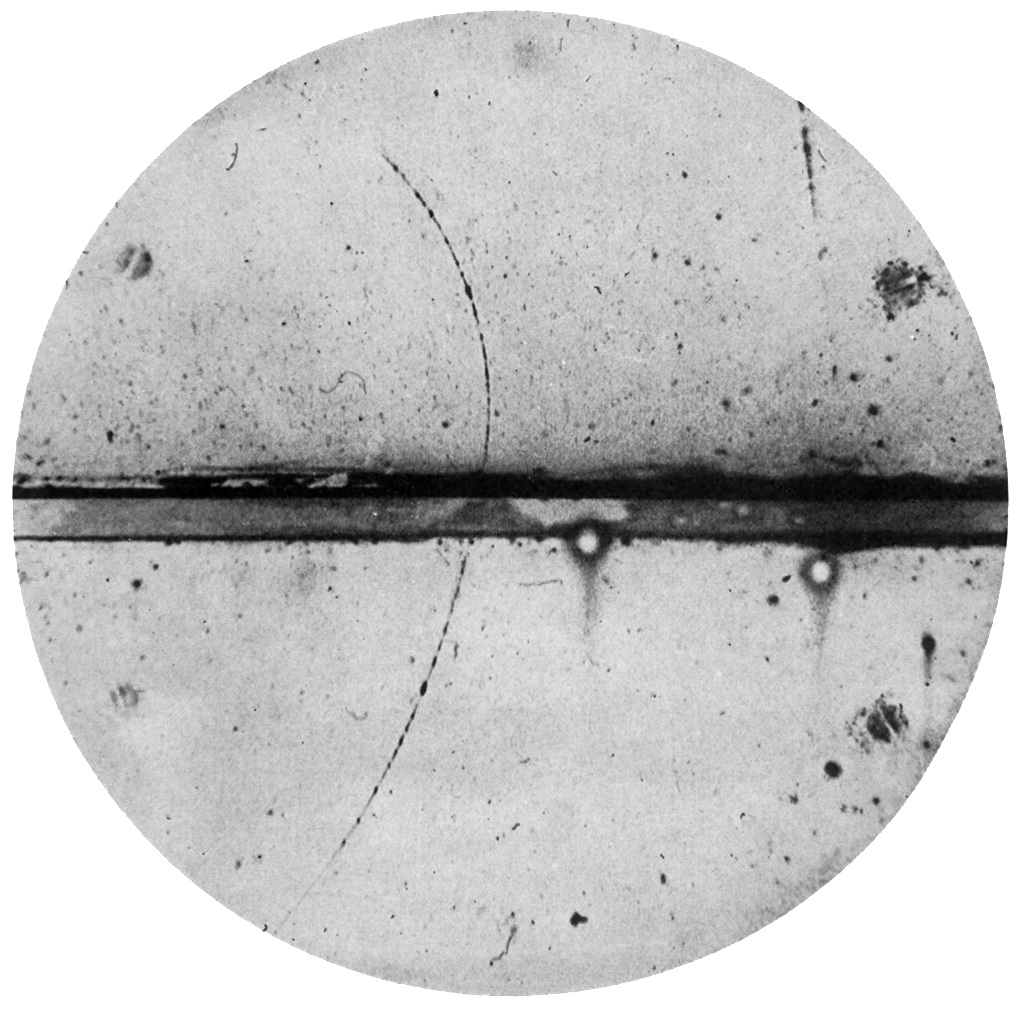 Carl Anderson’s positron track from The Positive Electron
See his 1932 Science paper The Apparent Existence of Easily Deflectable Positives. His Physical Review paper The Positive Electron was published in 1933. It said “These particles will be called positrons”. His Nobel lecture on The production and properties of positrons is worth a read.
The meson is said to have been predicted by Hideki Yukawa
A year later in 1934 the meson is said to have been predicted by Hideki Yukawa. He was trying to come up with a messenger-particle theory for the nuclear force. The idea was that a neutron would emit a negatively charged spin-0 messenger particle to become a proton, which would emit a positively charged spin-0 messenger particle to become a neutron, ad infinitum, this resulting in the nuclear force between protons and neutrons. Yukawa’s Progress of Theoretical Physics paper was On the interaction of elementary particles. However he didn’t call his messenger particles mesons. He called them U–quanta. See his Nobel lecture on Meson theory in Its developments for more.
The muon was discovered by Carl Anderson and Seth Neddermayer
In 1936 the muon was discovered by Carl Anderson and Seth Neddermayer. See their 1937 Physical Review paper Note on the Nature of Cosmic-Ray Particles. They used a cloud chamber to detect a new particle with unit charge that was more penetrating than the electron but less massive than the proton. Two years later in 1938 they called the new particle the mesotron⁴, because meso means middle, and the new particle’s mass was somewhere between the electron and the proton. As it turned out, the new particle was not a meson. See the history of discovery section of the Wikipedia Muon article. Also see Anderson and Neddermayer’s 1938 Physical Review paper Cosmic-Ray Particles of Intermediate Mass:
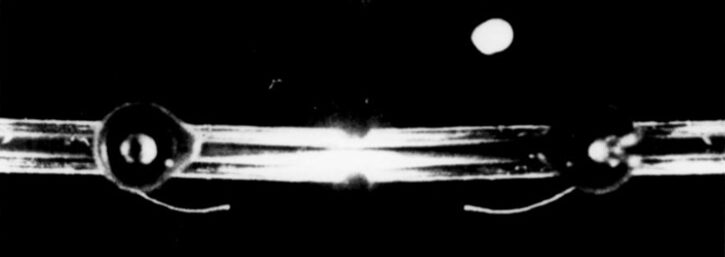 Muon track image from Cosmic-Ray Particles of Intermediate Mass
Initially physicists thought this was the particle predicted by Hideki Yukawa to explain the nuclear force. Some called it the Yukon. But as Yukawa later said in his Nobel lecture “the identification of the cosmic-ray meson with the meson, which was supposed to be responsible for nuclear forces, became doubtful”. That was after the mesotron was renamed meson by Homi Bhabha in his 1939 Nature paper The Fundamental Length Introduced by the Theory of the Mesotron (Meson)*.
Positive and negative mesons should behave differently
In 1940 Sin-Itiro Tomonaga and Gentaro Araki said positive and negative mesons should behave differently when they are stopped in matter. That’s because atomic nuclei are positively charged. Hence the positive mesons would be repelled from the nuclei and have time to decay, whilst the negative mesons would be attracted to the nuclei and interact with them. This was in the Physical Review paper Effect of the Nuclear Coulomb Field on the Capture of Slow Mesons. Whilst this was during World War II, it was before Pearl Harbour on 7th December 1941. Another paper of interest was On the correlations between mesons and Yukawa particles by Shoichi Sakata and Takesi Inoue. It was a Progress of Theoretical Physics paper which was originally presented in 1942. They proposed that the Yukawa particle decayed into a meson. Publication was delayed until after World War II in 1946. A similar paper by Sakata’s correspondent Yasutaka Tanikawa was On the Cosmic-Ray Meson and the Nuclear Meson.
The meson could not be the Yukawa particle
In 1946 the issue was cleared up by Marcello Conversi, Oreste Piccioni, and Ettore Pancini who had been conducting high-altitude cosmic ray experiments in wartime Italy. These experiments showed that the meson did not participate in the strong nuclear interaction. Hence the meson could not be the Yukawa particle. See their paper On the disintegration of negative mesons, along with some interesting background information at the Association for the Teaching of Physics ETS:
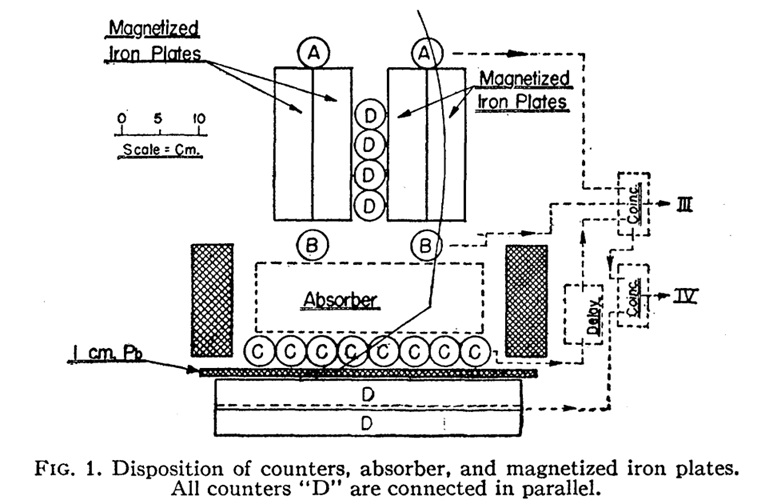 Detector image from On the disintegration of negative mesons
Their paper was dated December 1946 but published in 1947. That was when Oppenheimer predicted the existence of an uncharged meson at the APS 1946 Annual Meeting at New York. It was the 1946 annual meeting, but it was held in January 1947. These things happen.
The discovery of the charged pions
In May 1947 Nature published Processes involving charged mesons by César Lattes, Hugh Muirhead, Giuseppe Occhialini, and Cecil Powell. This was the pion discovery paper. The authors said they’s analysed the tracks of 65 mesons, of which 25 emitted a secondary particle, 2 of which were a second meson. A more detailed paper by Lattes, Occhialini, and Powell was called Observations on the Tracks of Slow Mesons in Photographic Emulsions*. It was published in two parts in October. You can find a non-paywalled part 1 on the Internet Archive, and the second part elsewhere. They said two types of mesons existed, and the heavier π-mesons decayed to produce the lighter μ-mesons. The particle tracks are very clear:
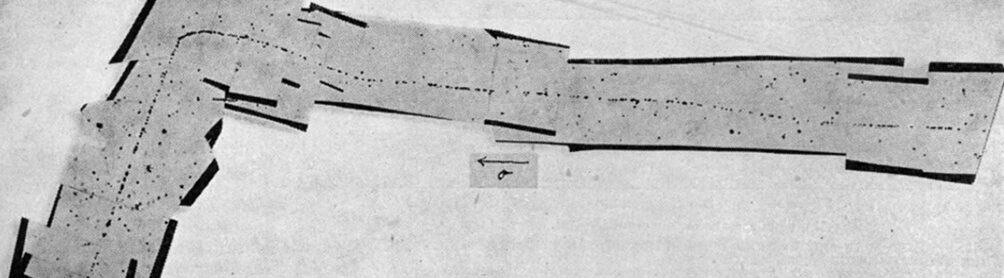 Pion decay image from Observations on the Tracks of Slow Mesons in Photographic Emulsions*
The π-meson was the pi-meson, and the μ-meson was the mu-meson; they weren’t called pions and muons back then. Anyway, there’s a user-friendly account on the University of Sao Paulo website called César Lattes and 50 years of the pi meson. It mentions photographic plates called nuclear emulsions placed at the top of the 2,900 metre Pic du Midi in the French Pyrenees, and a cosmic ray laboratory on the 5,500 metre Mount Chacaltaya in Bolivia. The cosmic rays are cleaner at altitude⁵.
The discovery of the kaon
1947 was also the year when Clifford Butler and George Rochester reported on their cloud chamber cosmic ray observations. See their Nature paper Evidence for the Existence of New Unstable Elementary Particles. There’s a brief item about it on the CERN website, and a non-paywalled version of the paper on the Internet Archive. They talked about V-shaped two-pronged forked tracks, one where a neutral particle decayed into two charged particles, and one where a charged particle decayed into a charged particle and a neutral particle. This was the discovery of the kaon, but they didn’t call it that. They called it the V-meson, Later in 1949 Powell’s student Rosemary Brown spotted a particle track that looked like a K:
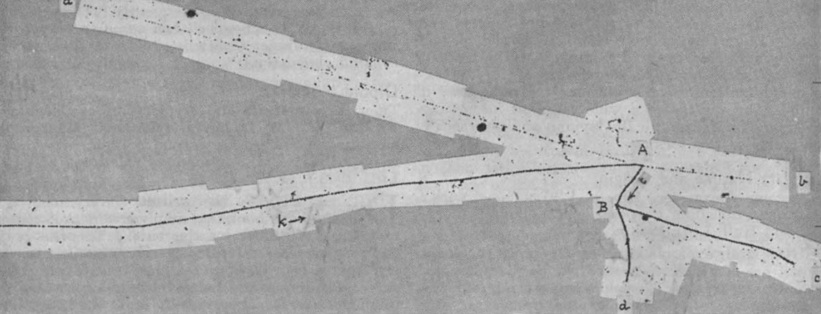 Kaon decay image from the paper Observations with Electron-Sensitive Plates Exposed to Cosmic Radiation
That was because her kaon decayed into three pions, which was unusual. It was in breach of parity conservation. It was said to be strange. See the 1949 Nature paper paper Observations with Electron-Sensitive Plates Exposed to Cosmic Radiation. The authors were Rosemary Brown, Ugo Camerini, Peter Howard Fowler, Hugh Muirhead, Cecil Powell, and David Mark Ritson.
The discovery of the neutral pion
Also in 1949 Raymond Bjorklund, Walter Ellis Crandall, Burton Jones Moyer, and Herbert Frank York conducted experiments using the new 184-inch cyclotron at Berkeley⁶. They bombarded a beryllium target with protons, and saw photon pairs. Their Physical Review paper was High energy Photons from Proton-Nucleon Collisions. They said “it is assumed that the proton-nucleon collision results in the production of a neutral meson which then decays into two photons”. This was the discovery of the neutral pion, but they didn’t call it that. 1950 saw the publication of the Physical Review paper Cloud-Chamber Observations of the New Unstable Cosmic-Ray Particles. It was by Aaron Seriff, Robert Leighton, Chien Hsiao, Eugene Cowan, and Carl Anderson. They used a cloud chamber to take 3,000 photographs in Pasadena and 8,000 photographs on White Mountain in California, at an altitude of 3,200 metres. Again they didn’t use the words pion or kaon. See Cecil Powell’s 1950 Nobel lecture. He talked about π-mesons, μ-mesons, and other more massive mesons, but didn’t use the word pions or kaons. It was the same for Yukawa’s Nobel lecture the previous year.
The Delta baryon was discovered in 1952
The field was exploding. 1950 was also when the Lambda baryon was discovered, by Victor David Hopper and Sukumar Biswas in Melbourne. See their Physical Review paper Evidence Concerning the Existence of the New Unstable Elementary Neutral Particle The Delta baryon was discovered in 1952 by Herbert Lawrence Anderson, Enrico Fermi, Earl Albert Long, and Darragh Edmund Nagle. They were a team at the University of Chicago using their new synchrocyclotron, which featured a 2,500 ton magnet.
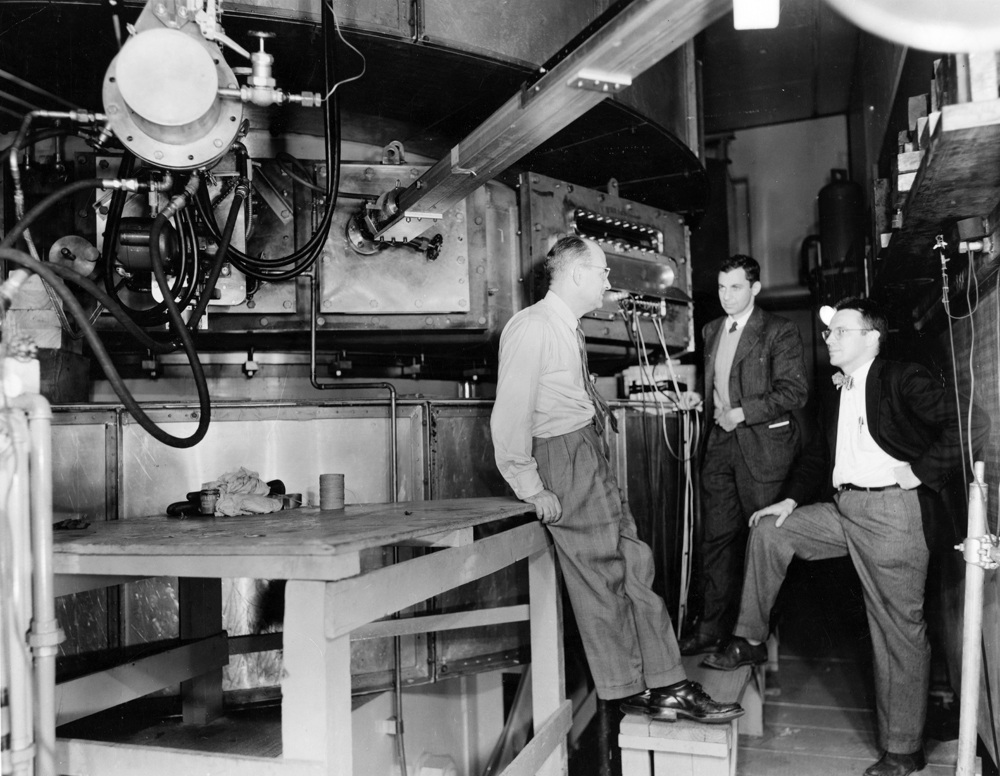 Synchrocyclotron image from the University of Chicago photographic archive. Caption Enrico Fermi (left) with Herbert L. Anderson (center) and John L. Marshall (right), co-designers of the University of Chicago’s Synchrocyclotron.
See their Physical Review paper Total Cross Sections of Positive Pions in Hydrogen. Also see The Delta: the first pion nucleon resonance by Nagle dating from 1982. He said the delta baryon wasn’t called that until later, when “Murray Gell-Mann, then at Chicago, developed the ideas of a deeper underlying symmetry governing the pions and nucleons”. That’s where “the pion-proton ‘resonance’ became the “delta” particle, an I-spin quadruplet, belonging to a decuplet representation of the new symmetry, SU(3)”. Nagle said the delta baryon posed a puzzle for the scheme, in that it was said to be made of three up quarks – three identical fermions. He asked how could this jibe with the Pauli principle, and said “a new quantum number, color, was invented to solve this”. The Xi baryon was also discovered in 1952, by Rafael Armenteros, Kenneth H Barker, Clifford Butler, A Cachon, and C M York in Manchester. See their Philosophical Magazine paper The properties of charged V-particles.
The whole subject is one of great complexity
The Sigma baryon was discovered by Carl Monroe York, Robert Benjamin Leighton, and Egil Kristoffer Bjornerud in 1953. See their Physical Review paper Direct Experimental Evidence for the Existence of a Heavy Positive V-Particles. An independent observation was reported by Alberto Bonetti, Riccardo Levi-Setti, Martina Panetti, and Giorgio Tomasini. See their Il Nuovo Cimento paper Observation of the Decay at Rest of a Heavy Particle. You can find a non-paywalled version on the Internet Archive. 1953 was when Clifford Butler and George Rochester published their Reports on Progress in Physics review paper The new unstable cosmic ray particles. It’s a big paper at 35 pages, which indicates how particle physics was growing. They said this: “It is now clear that the whole subject is one of great complexity owing to the many different types of particle which lie in relatively narrow ranges of masses and lifetimes and yet have entirely different modes of decay”. They were still talking about V-particles, but also talked of z-particles, π-mesons, the χ-meson, the τ-meson, the κ-meson, and the S particle. They also said the two most powerful techniques in this field were the cloud chamber which provided “almost the whole of the evidence for the neutral particles”, and the photographic emulsion, which “has given the most precise information about the charged particles”. Interesting stuff.
The antiproton was discovered in 1955
The antiproton was discovered in 1955. See the Physical Review paper Observation of Antiprotons by Owen Chamberlain, Emilio Segre, Clyde Wiegand, and Thomas Ypsilantis. They used the new Bevatron at Berkeley to fire a proton beam at a copper target, and said “the antiprotons must be selected from a heavy background of pions”. They used the word pions, but also referred to them as π-mesons. They said the respective flight times for pions and antiprotons over the 40-ft distance between detectors were “40 and 51 millimicroseconds”. A millimicrosecond is a nanosecond. What’s interesting about this paper is that there are no photographs showing the antiproton’s particle track. The results are in essence, bumps on a graph.
Clyde Cowan and Frederick Reines finally discovered the neutrino
The next big discovery happened a year later in 1956. That’s when the antineutron was discovered by a Bevatron team consisting of Bruce Cork, Glen Lambertson, Oreste Piccioni, and William Wenzel. Their Physical Review paper was Antineutrons Produced from Antiprotons in Charge-Exchange Collisions. It’s an interesting read. They fired protons at a beryllium target to produce antiprotons, some of which interacted in a thick converter to produce antineutrons, which interacted in a lead glass Cerenkov counter to produce a pulse of light “so large as to indicate the annihilation of a nucleon and an antinucleon”. Also in 1956 Clyde Cowan and Frederick Reines finally discovered the neutrino. The Cowan–Reines neutrino experiment used a nuclear reactor and photon detectors around a tank of water containing dissolved cadmium chloride. The antineutrinos from the reactor caused inverse beta decay wherein a proton was converted into a neutron and a positron. The positron annihilated with an electron resulting in two gamma photons, and the neutron was captured by the cadmium resulting in further gamma photons.
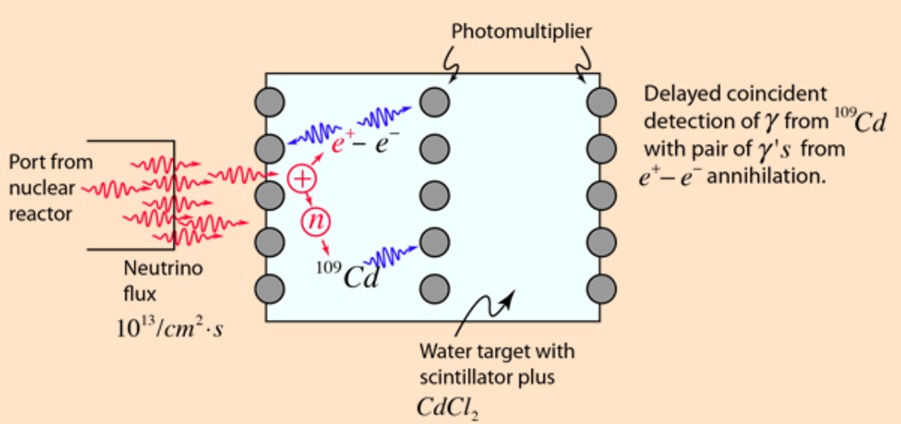 Cowan-Reines schematic from Rod Nave’s Hyperphysics
Marcus Chown gives a nice write up on the BBC Science Focus website, see Wolfgang Pauli and the discovery of the Universe’s most elusive particle. Also see Reines’ Nobel lecture, which I think it is a delightful read. I think so many historical articles are. They get across the excitement of the times, when discoveries were starting to come thick and fast⁷. There were, of course, many more to come.
1 Do a CTRL-F and search on electron.
2 Apparently Arthur Compton liked the word photon, and pushed for its use. He used the word in his 1927 Nobel lecture. However I don’t know why the title of the 1927 Solvay Conference was Electrons and Photons. See page 6 of Helge Kragh’s Photon: New light on an old name.
3 Apparently Oppenheimer didn’t like the word positron because it was a mixture of Latin and Greek. Sadly I have lost the link for that.
4 Apparently Anderson called it the mesoton, but Millikan pulled rank and insisted on mesotron. Helge Kragh mentioned it in A terminological history of early elementary particle physics. See Anderson, Carl on 1966 June 30.
5 I should add that researchers also used high-altitude balloons for their cosmic ray experiments. And that Powell was a major figure in the field, and another of Rutherford’s students.
6 Particle accelerators like the cyclotron meant that physicists wouldn’t have to climb mountains any more.
7 I’d like these “history of particle physics” articles to be correct, even if that means making downstream changes. Please advise of any errors or omissions, and I will take care of them. I will make of note of such changes in the footnotes.
Another great historical article John. I am slowly working my way through all the tasty links you always provide. You Second Calling in life could and should be as a history science Professor !
Too bad most of the so-called experts rarely do a personal Cue-and-Review of their own educational facts……..
Many thanks Greg. I think the physics history is of immense importance. There are some absolute gems in there. Low hanging fruit, as it were. Like Rutherford thinking the neutron was a close-coupled electron-proton combination. Or Charles Galton Darwin talking about the electron as a wave with two orthogonal rotations. Sadly many contemporary physicists believe what they’re taught without question, and without challenging assertions like “the electron is a fundamental particle” or “the electron is a point particle”. I do what I can to help with that.
Claude gave me this, I haven’t looked at it yet but I wanted to get it only soon due to time difference:
.
Hagelstein, P.L. (2018), “Phonon-mediated Nuclear Excitation Transfer,” Journal of Condensed Matter Nuclear Science 27, 97–142 — his own theoretical framework, freely available via MIT DSpace.
Unfortunately Steve, it’s wrong from the off. See this: “Excitation transfer has long been of interest in biophysics, where electronic excitation is transferred from one location to another mediated by photon exchange” It isn’t mediated by photon exchange. Hydrogen atoms don’t twinkle and magnets don’t shine. Because virtual photons are virtual. As is not real.
Hi Dr Physics – there is a very recent Curt Jaimungal video that re-examines all these early papers. It is more about the emergence of quantum mechanics, but all these foundational papers from Einstein, Bohr, and the usual suspects are discussed.
Thanks. I can see his YouTube channel Jeremy. But please can you give me a link for the particular video?
Sir – here it is, “Quantum Mechanics Explained FROM SCRATCH”, although it is framed as a review of papers starting with Einstein’s photoelectric effect. He spends a long time with EPR, emphasizing that almost everybody misunderstood Einstein’s objection. Curt is an excellent interviewer, he knows his subject and puts the work in.
https://www.youtube.com/watch?v=9R0wrBpafYI&t=10559s
Thanks Jeremy. I will check it out.
Jeremy, this guy is a good teacher and very knowledgable. The issue is not that we need more understanding of quantum mechanics here, it’s that we believe that many that the quantum models and explanations he makes are incomplete and don’t explain common phenomena, like what is an electron and why does it have charge? What is gravity or what causes gravity? Fundamental concepts like those two where quantum mechanics just doesn’t explain in any rational manner. Ask yourself, if a model cannot ratioanlly explain fundamental concepts, is it possible that a different model could be useful?
I started watching it Jeremy. I had high hopers, because liked what Tim Maudlin said about the information paradox. However I lost patience after bout an hour. Maudlin hasn’t actually read what Schrodinger said, or he’d know about the wave in a closed path: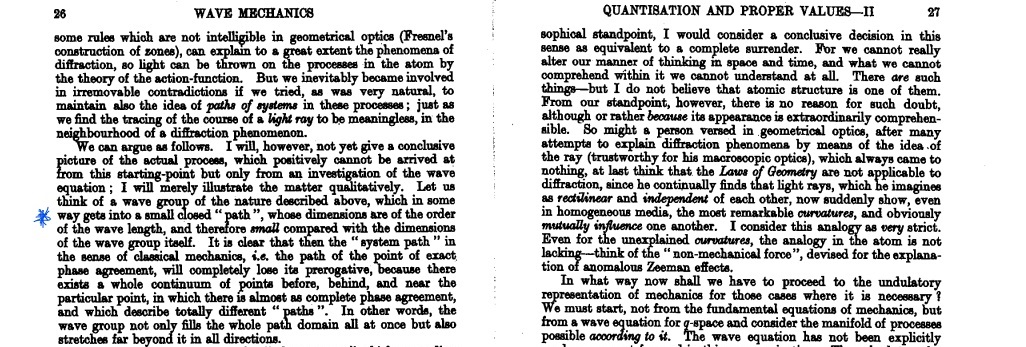 He hasn’t read the history either, or he’d know about Charles Galton Darwin’s 1927 Nature paper on The electron as a vector wave, which talked about a spherical harmonic for the two directions of spin. He talked about Born’s probabilistic take without realising that Born co-authored the “realist” paper On the quantization of the new field theory in the 1930s. He’s giving a second-hand history, and like quantum mechanics, it’s incomplete. It sounded as if he’s never actually read Bell’s papers either.
Thank you for taking a look. It is disappointing that even physics historians seem unaware of these papers and how/when/why they were memory-holed.
Some physics historians do, Jeremy. For example Helge Kragh is well respected, and I find that I have no issue with what he says. But Tim Maudlin isn’t a historian. He’s a philosopher who has given you bits of second hand popscience history, and as far as I can tell, hasn’t dug into the original papers. OK I’m an IT guy who has given you bits of second hand history too, but I have dug into the original papers. Hence I’ve found that the popscience history is neither accurate nor complete. I’ve also found that Bell’s paper claimed that probabilities must add up to 1 and therefore any deviation from a straight line result means spooky action at a distance must be real. He was at CERN. He must have known about Malus’s Law and how cos² θ applies to polarizers. But he kept quiet about that. Just like Alain Aspect.
Found on Reddit explain like I’m five:
Quote
The election is the orbital around the atom. That’s what electrons do when they’re peacefully sitting there attracted to the nucleus. When you “poke” an atom with some outside interaction, the electron is now interacting with other things besides the atom’s nucleus, and so might take another shape, including one that seems much smaller and more point-like. Don’t let that fool you into thinking there was always a little electron-ball moving around, that’s a result of you doing something to change what the electron was doing.
Unquote
https://www.reddit.com/r/explainlikeimfive/comments/j5vbec/comment/g7uk9r8/
It’s crap Steve. Old crap. From people who don’t know stuff. And never ever will. Because places like Reddit ban the people who do.
Pike County is also where WWII and Cold War atomic guel processing went on. Hundreds of workers died slow cancer deaths for years afterwards.
Read “OpenAI to build world’s biggest AI data center in Ohio. What we know” on SmartNews: https://l.smartnews.com/p-8mT04PDy/ZjZdmg
Pike County is also where WWII and Cold War atomic fuel processing went on. Hundreds of workers died slow cancer deaths for years afterwards.
Read “OpenAI to build world’s biggest AI data center in Ohio. What we know” on SmartNews: https://l.smartnews.com/p-8mT04PDy/ZjZdmg
Thanks Greg. That’s not good. I didn’t know about that.
I should mention that I’m writing part 2, and have found that I’ve had to make some changes to part 1.
Sounds enticing as always Professor John !
Did the Iranians actually, temporarily hack into and shut down a regional power generating site ? They tried and failed here, the best they could do was a halfway entrance into a few backwater sewage and water utilities.
I don’t know Greg. That’s what the news reports say. But I have to say I don’t believe it.
FLOCK Camers are the number two wild hair up everyone’s backside, including mine. Big Big Brother is being forced on us over here. There are already over 50 documented abuses committed by the “Proper Authories”, most of them by Police Chiefs and County Sheriffs !!! Most, if not all are concerning the women in their lives.https://en.wikipedia.org/wiki/Flock_Safety?wprov=sfla1
I don’t know much about that Greg. But I can say that we have similar issues here in the UK. If you don’t mind I’d rather not go into it. I’d like to stick with the physics here, apart from the odd occasion when I feel the need.