The Mechanical Universe is the name of a series of YouTube videos by Chantal Roth and James Ellias¹. As per convention I will refer to them by their surnames: I know Roth. I’ve spoken to her on Zoom about physics and simulations. She has a YouTube Channel called Red Pill. I don’t know Ellias, but he has a YouTube channel called Inductica. I didn’t mention either of them when I talked about YouTube physics a couple of months ago. Sorry about that.
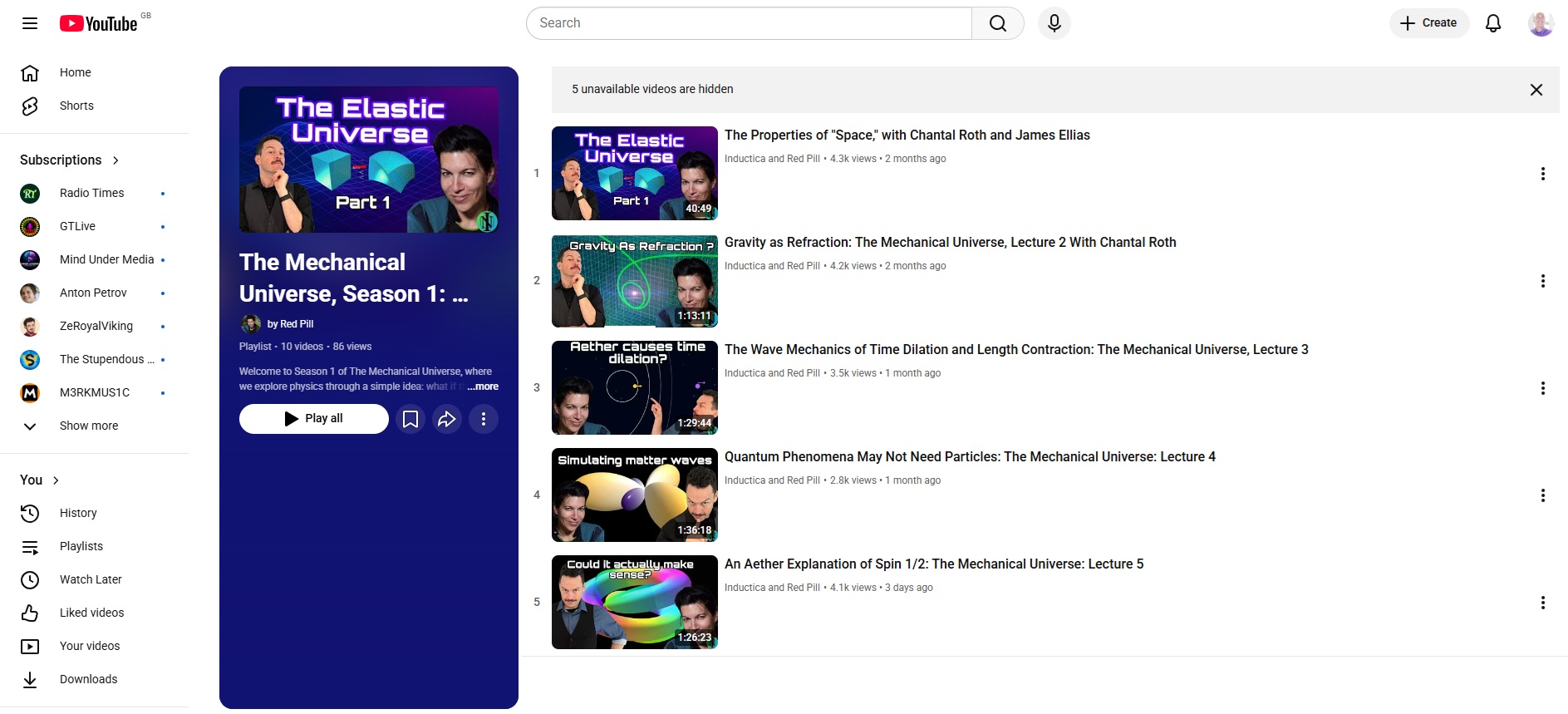 Screenshot from the Mechanical Universe YouTube playlist
Roth also has a website called the Elastic universe. That’s something I’m totally on board with – I’m very fond of saying space is like a gin-clear ghostly elastic solid. Ellias also has a Patreon website called Inductica which you can access for free. I totally agree with him when he says modern physics is fundamentally flawed.
An overview of The Mechanical Universe
You can find an overview of The Mechanical Universe on Roth’s Elastic Universe website. It starts by saying “we explore physics through a simple idea: what if the universe works through real, physical mechanisms rather than abstractions?” That’s good to hear. The overview goes on to say they look at the big picture, from “the properties of space and the nature of waves, to photons, matter waves, electromagnetism, charge, spin ½, relativity, and more”. What’s not to like? The overview also says “each episode builds step by step, using intuitive explanations, hands-on simulations, and a mechanical way of thinking inspired by ideas from Newton, Maxwell, Einstein, and modern researchers such as Robert Close or Marek Danielewski”. Bravo. By the by, Robert Close is another guy I know. I think he’s written some great stuff. See his classical matter website, where you can find papers such as The Other Meaning of Special Relativity and Exact Description of Rotational Waves in an Elastic Solid. That’s also on the arXiv:
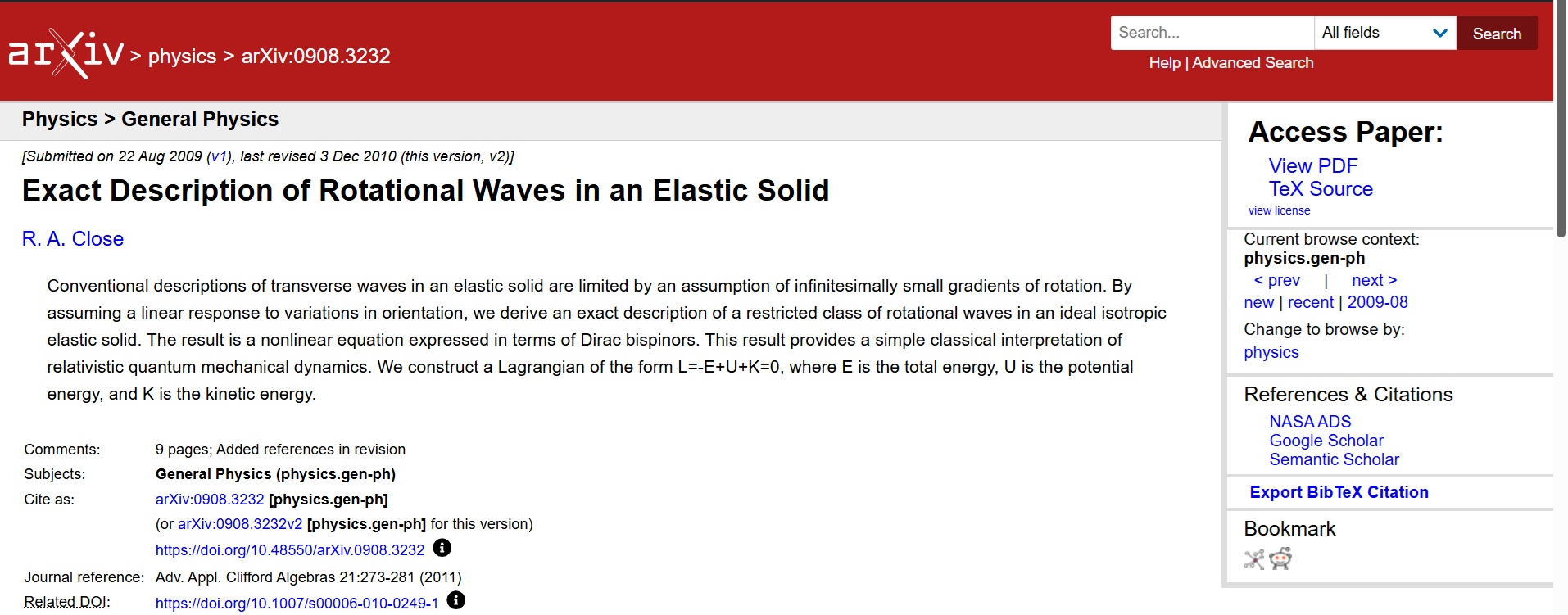 Screenshot from the arXiv
I don’t know Marek Danielewski, but it looks like he wrote a crystal-space² paper called The Planck-Kleinert Crystal. Lower down on the page Roth refers to Sergey A Rashkovskiy, who’s somebody else I don’t know. However an internet search looks promising. It says he’s known for proposing classical field theories as an alternative to standard quantum mechanics, and that quantum effects can be explained using classical electrodynamics. Music to my ears. I am reminded that there’s a lot of realist physicists out there that we don’t always hear about. I have to say though, that I wasn’t too keen to read that the goal is not to replace mainstream physics, but instead to give it a clear ontology. I have no issue with the clear ontology, but I nowadays think mainstream physics is cargo cult crap³.
The properties of space
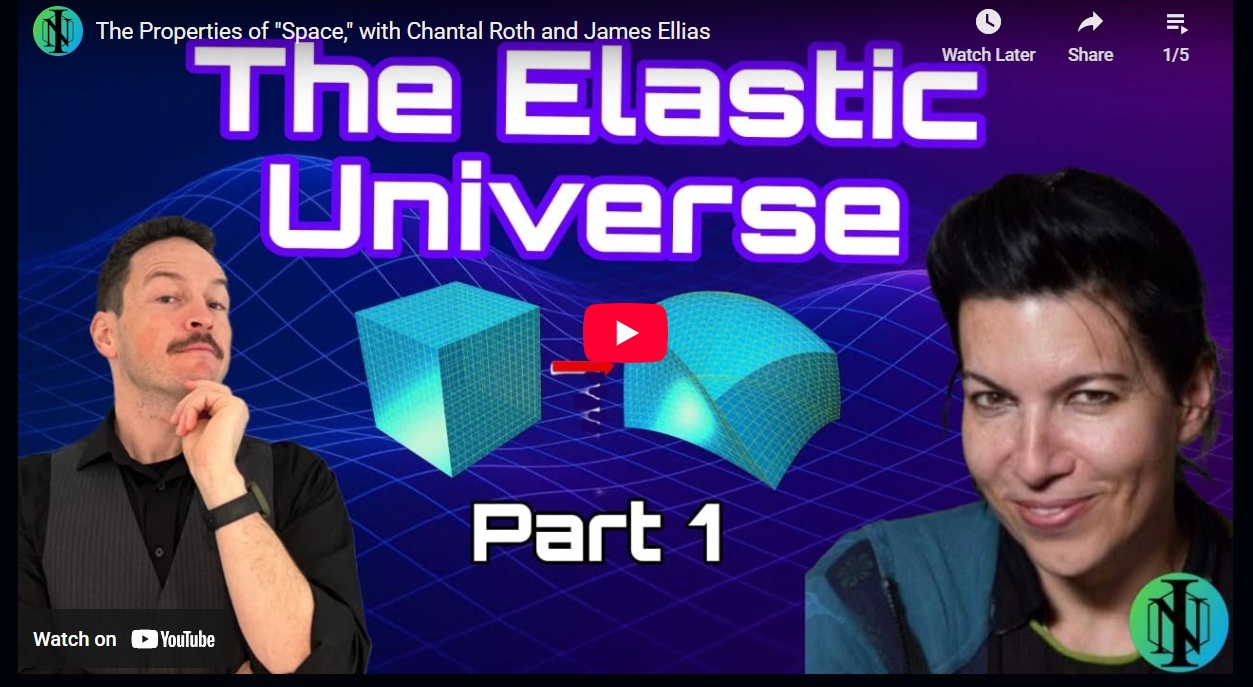
Anyway, the first video in the playlist is The Properties of Space. It’s 40 minutes long, and starts with (James) Ellias giving an introduction to (Chantal) Roth. He tells us that she has a PhD in Scientific Computing from ETH Zurich, which is the same university that Einstein went to.
 Screenshot from Chantal Roth’s Elastic Universe website
He also tells us she’s worked as an independent researcher to come up with an integrated hypothesis of how the ether works. The idea is that modelling the universe as an elastic solid could explain many physical phenomena, such as “time dilation, length contraction, matter waves, gravitation, electromagnetic forces, and many more”. Ellias also said⁴ this: “What most impresses me about Chantal’s work is that it is an impressive step forward in understanding how all physical phenomena we see around us could be constituted of the waving of a single unified medium”. I agree with that one hundred percent⁵.
There are answers out there
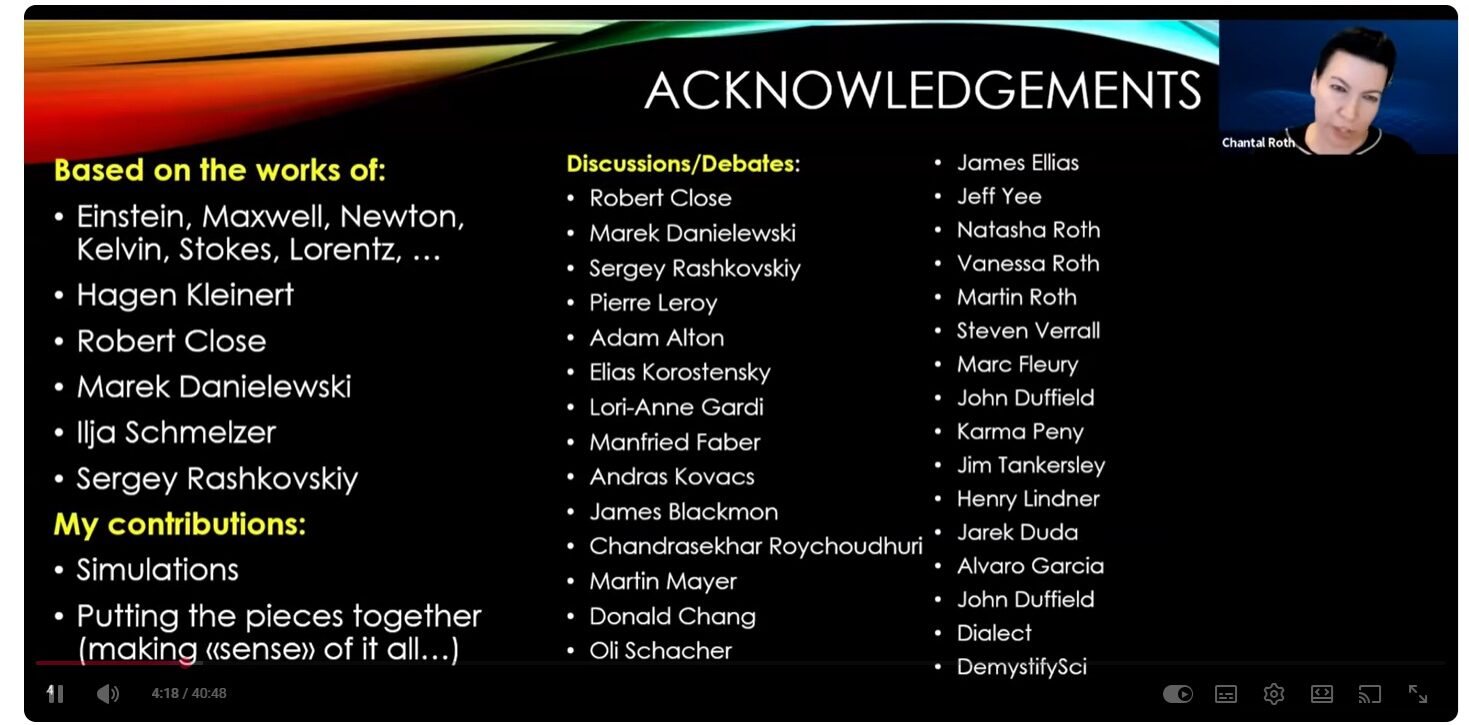
Roth then starts her presentation by saying there are concepts in physics “where I really have no idea how they work”. She says when she asks why is the speed of light constant, the usual answer is something like “well it’s just a postulate”. She says there’s no mechanism to explain it, and it’s similar for time dilation. She also says it’s similar for how a magnet works, wherein the usual virtual photon explanation just doesn’t cut it. She says she wants to know how things work just as we know how a car works. She then refers to quantum mechanics, and says the various interpretations don’t explain it. She adds that we’re normally told that there are no deeper explanations, and we just have to accept it. She says she doesn’t like that, and seeks explanations that don’t rely on magic. I utterly empathize. She then talks about supposedly unanswered questions, such as how do we turn light into matter, and what is charge? Then she says there are answers out there, and the ideas are not new. Then she acknowledges a long list of people, including me:
 Screenshot from The Properties of Space with Chantal Roth and James Ellias
In fact I get two acknowledgements, which is nice. LOL! Moving swiftly on, she also refers to some of the physics greats such as Einstein, Maxwell, Newton, Kelvin, Stokes, and Lorentz, and to people I know like Robert Close, Ilja Schmelzer, Andras Kovacs, Chandrasekhar Roychoudhuri, Marc Fleury, Jarek Duda, and Álvaro García. She says her contribution is to pull the pieces together and do simulations. I really like that. Especially since I think simulations will make a big difference, because as Roth says, it’s all too easy to get lost in maths. She goes on to say it’s a lot of material, and the way to tackle it is step by step one concept at a time. I couldn’t agree more. She then talks about her goals, which I share. We can understand all this. I think it’s simpler than people think, and I also think it will make the world a better place.
There’s nothing in General Relativity to explain how matter bends space
At 6:44 Roth starts talking about the properties of space. She refers to the mainstream view of spacetime and says there’s nothing in General Relativity to explain how matter bends space⁶. She also says spacetime is just abstract, and there’s no mechanism to explain how gravity works. Roth then gives us a simulation⁷ as Ellias talks about what most physicists think. He says when they reject philosophy they’re also rejecting physics. Hear hear. They don’t call it a PhD for nothing.
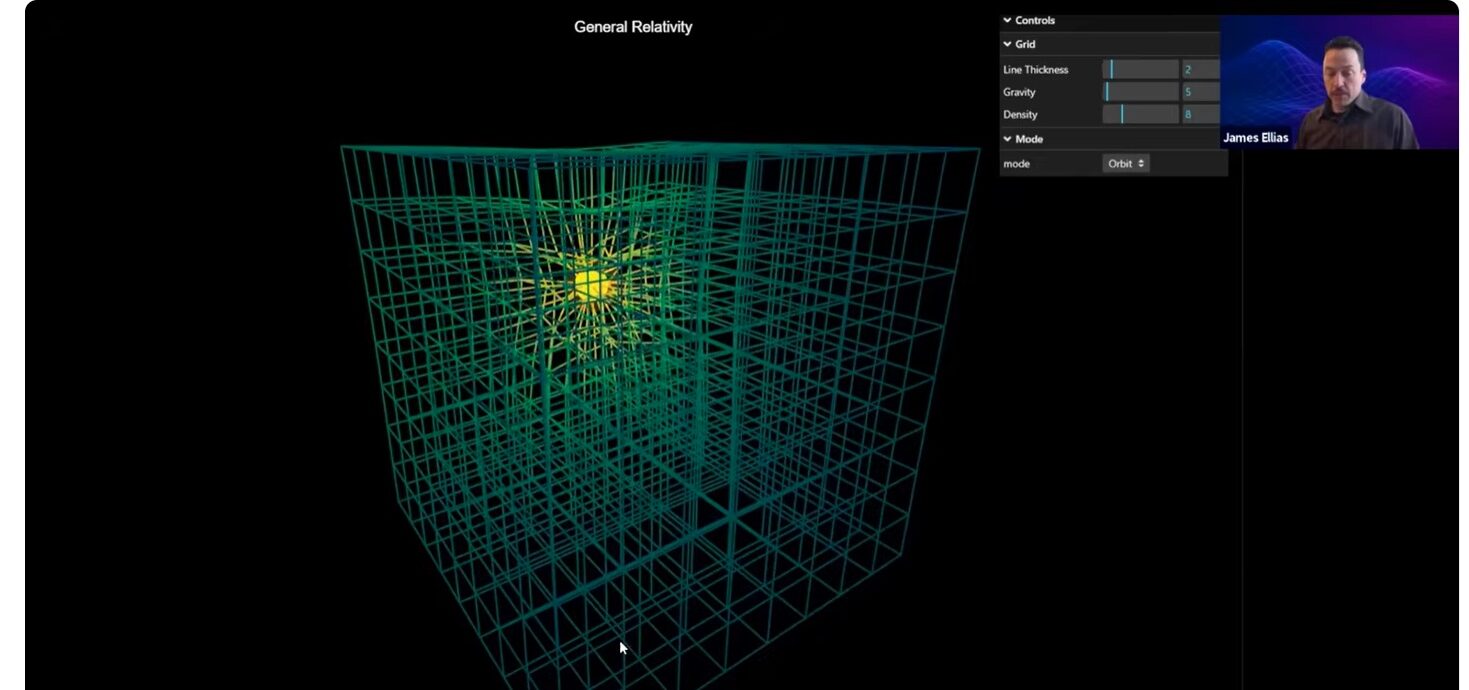 Screenshot from The Properties of Space with Chantal Roth and James Ellias
Ellias also says he thinks people should talk about ether or a plenum as opposed to space. However Roth disagrees saying people have a fear of using the word ether. I’m with her on that. I prefer to call it space too. Einstein called it space, so space it is.
Space is endowed with physical qualities
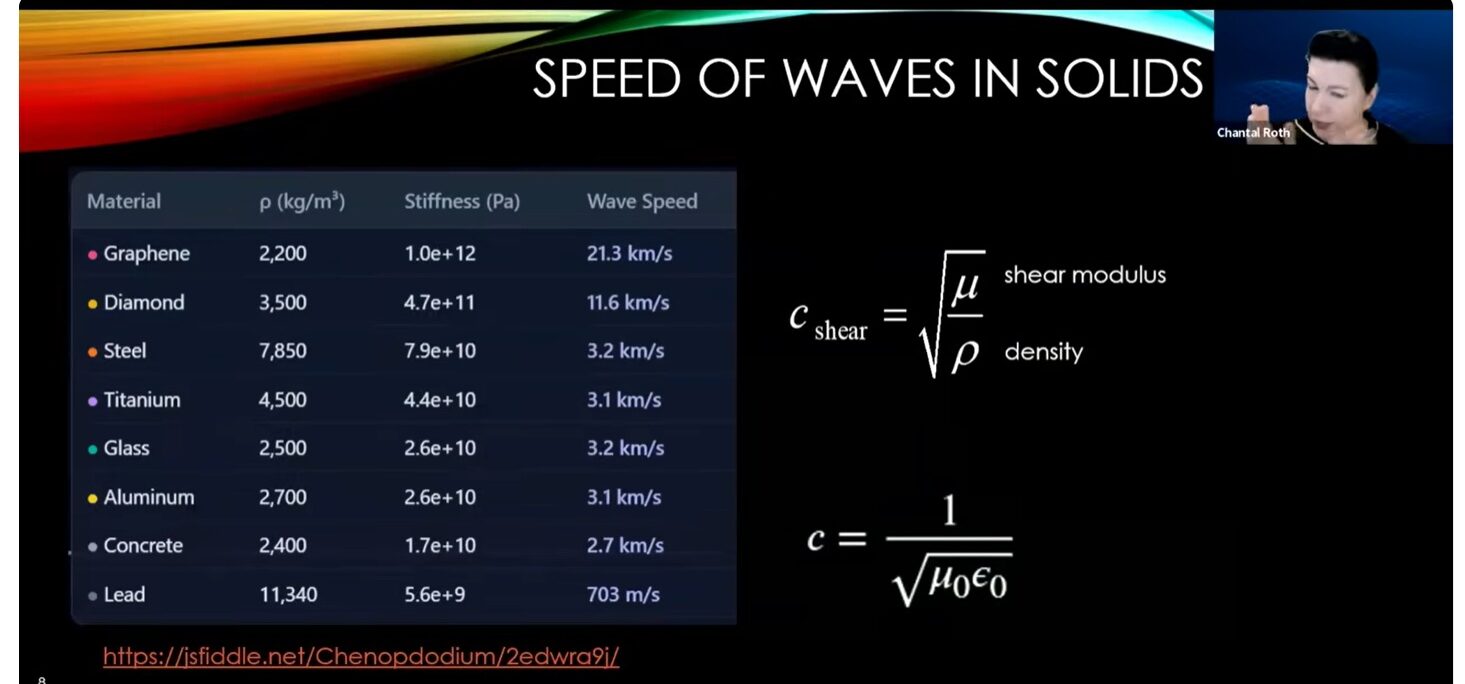
Speaking of which, Roth then says let’s see what Einstein says about this. She quotes him saying “space is endowed with physical qualities”. That’s from his 1920 Leyden Address, where he said space was the ether of general relativity. In the next slide she reminds us that the 1887 Michelson-Morley experiment is said to prove that there is no ether, and the speed of light is constant for all observers. She then gives a nice simulation of the Michelson-Morley experiment. She gives the usual length-contraction explanation⁸, then she moves on to talk about the speed of waves in solids:
 Screenshot from The Properties of Space with Chantal Roth and James Ellias
She gives the speed of a shear or transverse wave as cshear = √(μ/ρ), where μ is the shear modulus or stiffness, and ρ (rho) is the density. Then she gives the speed of light as c = 1/√(ε0μ0). As somebody who knows about Einstein’s variable speed of light, I know what’s coming. Oh I just love this stuff.
The variable speed of light
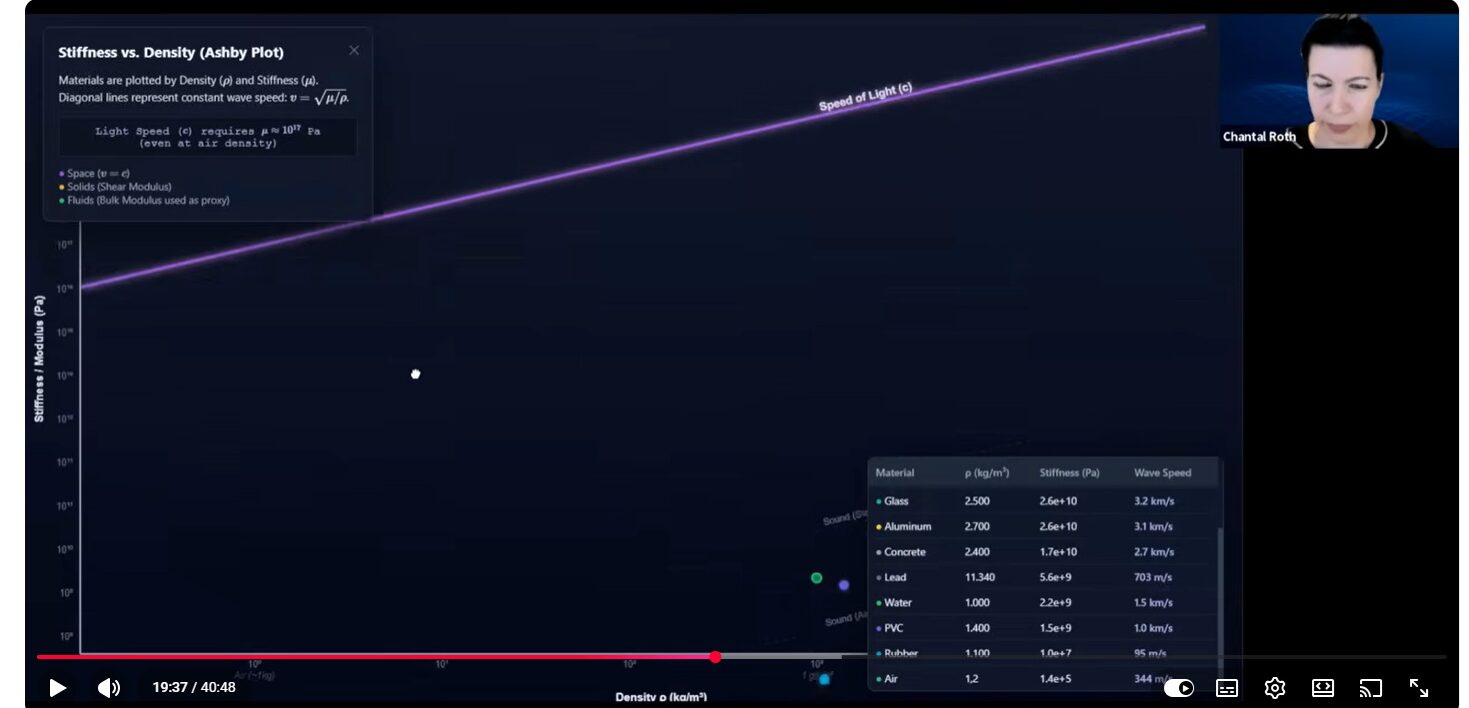
Sure enough in the next slide she gives a plot⁹ showing the variable speed of light. She concedes that she can’t explain how space has a stiffness or a density, but agrees with Ellias that space does exhibit some kind of resistance to deformation as well as a restoring quality. It’s a really interesting conversation. A great discussion.
 Screenshot from The Properties of Space with Chantal Roth and James Ellias
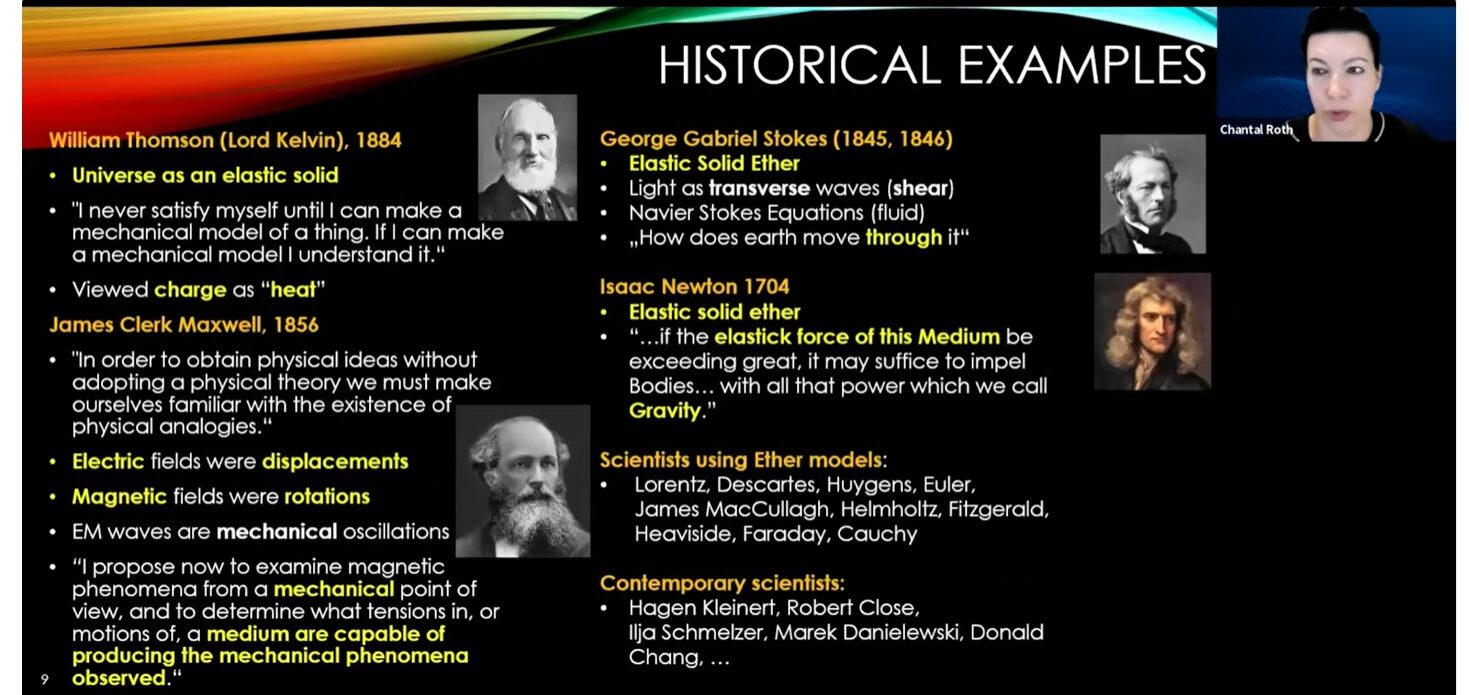
After that Roth points out that Einstein wasn’t the only person who thought space had properties. She showed a slide mentioning some of the greats like Kelvin, Maxwell, Stokes, and Newton. I’m a big fan of Newton¹⁰. I think he nailed gravity in Opticks query 20 when he talked about the varying density refracting light and bending it gradually in curved lines. Einstein spoke in similar terms. He referred¹¹ to Huygens and spoke of “the refraction of light rays by the gravitational field”. I’m a big fan of Einstein too. And Maxwell, and Kelvin, and many more. I love to see people referring to them:
 Screenshot from The Properties of Space with Chantal Roth and James Ellias
The moot point is that Roth ably demonstrates that elastic space is not just some fringe notion, but has pedigree¹². Quite. How can physicists not know about it? Or think that space is just nothingness, when waves run through it? When they already know about the quantum vacuum?
Roth summarizes the physical properties of space
But I digress, apologies. After that Roth summarizes the physical properties of space. She says it has a geometry or curvature, citing gravitational lensing. She says it can ripple, citing LIGO. She says it supports transverse waves which are also called shear waves. She says space can expand, citing ΛCDM. She also says space must be very rigid with the properties of an elastic solid, not a gas or liquid.
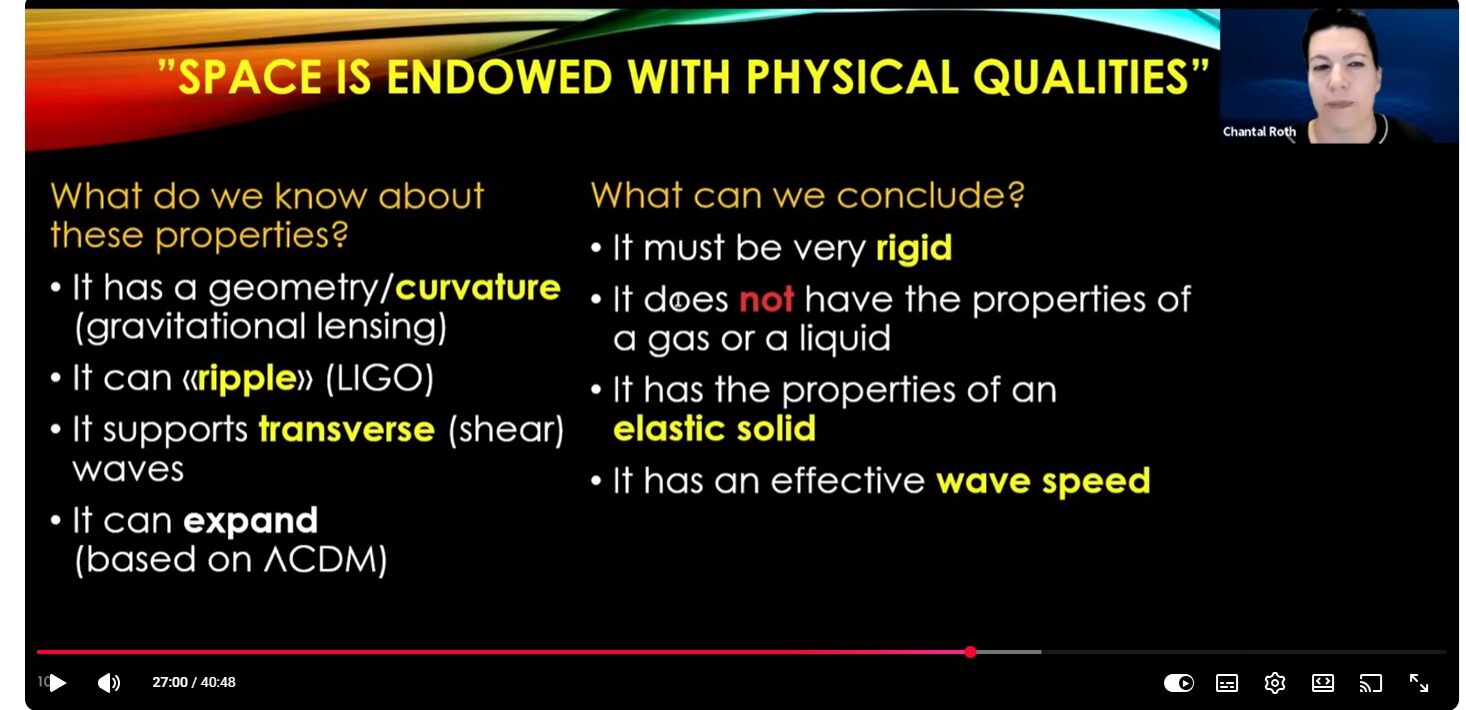 Screenshot from The Properties of Space with Chantal Roth and James Ellias
It’s all good stuff, but I have to say I thought it would have been better to cite electromagnetic waves when saying space could ripple. A gravitational field is a place where the refractive index of space varies, not a place where space is curved. So a gravitational wave isn’t a place where space is curved either.
Space is real
But there I go butting in again. Apologies again. Ellias and Roth then discuss liquids and shear waves and non-Newtonian fluids. Ellias then says he’s done a video of a fluid model of electromagnetism¹³. Roth reiterates that the transverse waves mean it’s got to be a solid, then moves on to talk further about the properties of elastic space. She likens it to the fabric of spacetime. She says space is real, and agrees with Ellias that it is an entity. Then she discusses the fine structure of space, saying we don’t know if it’s continuous. She shows a beautiful simulation that looks like a wobbling cube of jelly. She then shows a simulation of a crystal structure, then a diamond-like lattice, and says we don’t know about any granularity. Roth explains that in a simulation she has to show something such as springs or squares so you can see what’s going on, but these spring or squares aren’t actually there¹⁴. Ellias then asks if Roth thinks space is moving when it waves, and Roth says she doesn’t know¹⁵. Again, I think it’s a great discussion.
The other properties of space
The video finishes up with the shape of things to come. Roth talks about some of the other properties of space which are associated with things like wave propagation, special relativity, general relativity, quantum mechanics, spin ½, electromagnetism, mass, matter, antimatter, and charge:
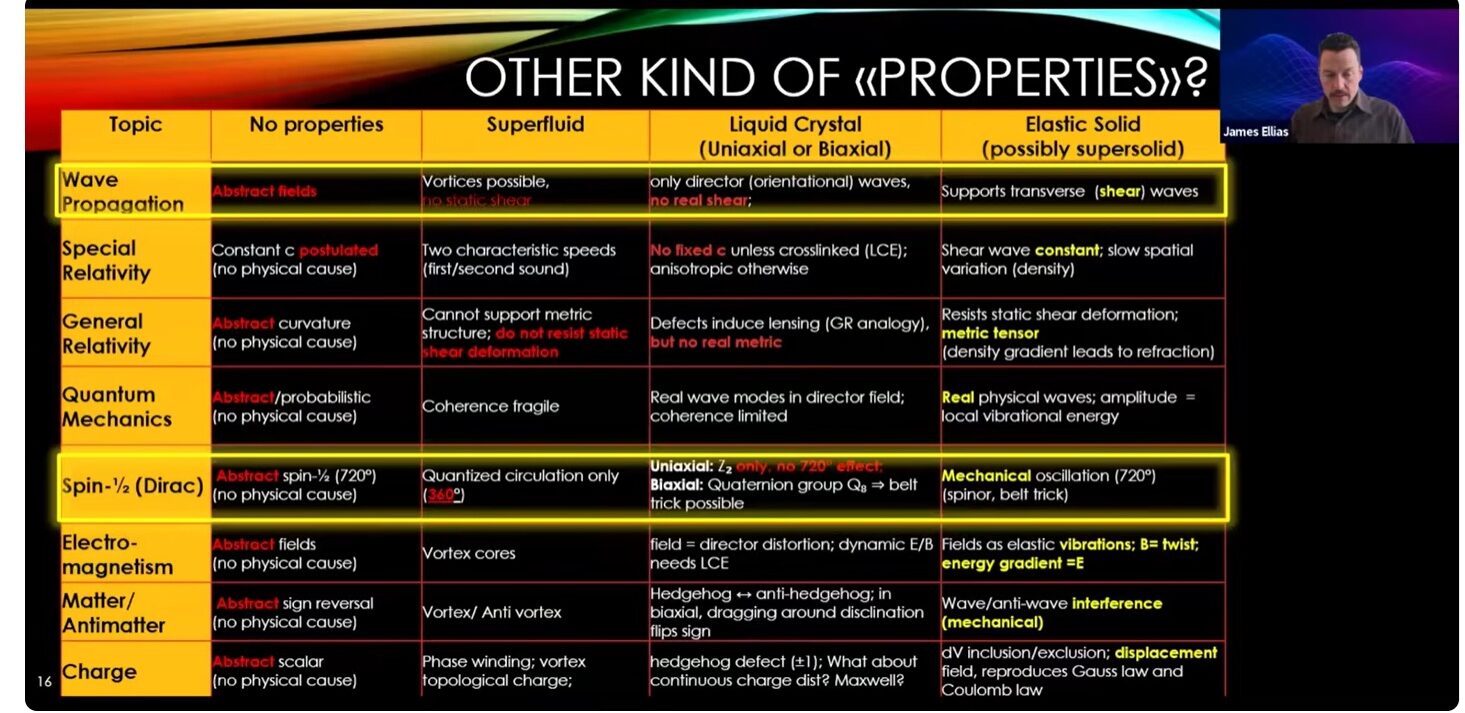 Screenshot from The Properties of Space with Chantal Roth and James Ellias
I was especially pleased to see mention of refraction and vortices and topological charge and twist. All in all I think it’s great stuff, and look forward to the rest of the videos. I’m sorry I couldn’t cover more of them this time. That’s because I think the first video demanded close attention, and I enjoyed paying attention. That’s because I’m convinced that simulations are what physics needs. In my experience three-dimensional geometry can be surprisingly difficult to grasp, especially when it’s dynamical, and the maths just isn’t enough. How do you describe a hurricane using mathematics? I don’t know. But what I do know, is that if you can see it, you can understand it. Not only that, but when one simulation works and another doesn’t, that might point to what’s really going on. I’m absolutely sure Roth is on the right lines with all this. Physics needs people like Chantal Roth. And James Ellias. I wish them every success. I look forward to seeing them on TV. On prime time TV. In high definition. On a big screen. On The Discovery Channel. Good job.
1 I should mention that there’s also a series of 52 Caltech undergraduate physics videos called The Mechanical Universe.
2 I think of crystal space as akin to elastic space, which is why I’ve said space is harder than diamond and stronger than steel. However I don’t think space is made of atoms the way a crystal is. I think it’s the other way round. Atoms are made of space. You know how people say an atom is 99% empty space? I think that’s wrong, by 1%. I say that because in 1929 Einstein said a field is a state of space, and because modern physicists say fundamental particles are field excitations. Space, the aether, is the fifth element, the quintessence. But it ought to be called the first element, because at the fundamental level, it’s the only thing that exists. For the cherry on top, space has its vacuum energy and its density variations, there’s a lot of it about, and in case you hadn’t noticed, space is dark.
3 I mean the fundamental physics, not the optics and condensed matter et cetera. For example the Standard Model of particle physics is wrong on multiple counts. Not only that, but the Standard Model of Cosmology is wrong on multiple counts too. Because modern general relativity flatly contradicts Einstein and gives a phony explanation of how gravity works. But hey, I can appreciate that it’s a tough sell to tell your audience that everything they think they know is lies-to-children, pseudoscience, quackery, mysticism, woo, hype, and horseshit.
4 You can get a transcript of a YouTube video online using facilities such as YouTubetotranscript.com. It’s not a great transcript, but it can be useful.
5 I think the theory of everything goes back to William Kingdon Clifford’s 1870 space theory of matter. That’s where he said “this property of being curved or distorted is continually being passed on from one portion of space to another after the manner of a wave”. He also said “in the physical world nothing else takes place”. Sadly, like his contemporary James Clerk Maxwell, he died before his time. Where would we be now if they had not?
6 Sadly I am a nitpicking pedant. How matter bends space ought to be how energy curves spacetime. This is important because Einstein said a gravitational field was a place where space is “neither homogenous nor isotropic”. The spatial inhomogeneity is non-linear, and we label it as curved spacetime. But space isn’t curved. The “metric” is curved, but that’s not space, it’s our plot of our measurements of space and time. Curved space is not the same as curved spacetime. See the Baez preliminaries article which says the distinction is crucial. Also see the 2008 paper Inhomogeneous vacuum: an alternative interpretation of curved spacetime where Ye Xing-Hao and Lin Qiang talked about a graded refractive index.
7 While I’m on my gravitational hobby horse, I think the simulation should be pushing out rather than pulling in. I say that because in 1930 Einstein said “it appears that space will have to be regarded as a primary thing and that matter is derived from it”. We usually think matter is made of energy. If it’s made of space, Einstein was saying space and energy are the same thing. So a gravitational field is like a region of space where you’ve used a gedanken hypodermic needle to inject more space in the middle. The result is a density gradient wherein space bulges outwards.
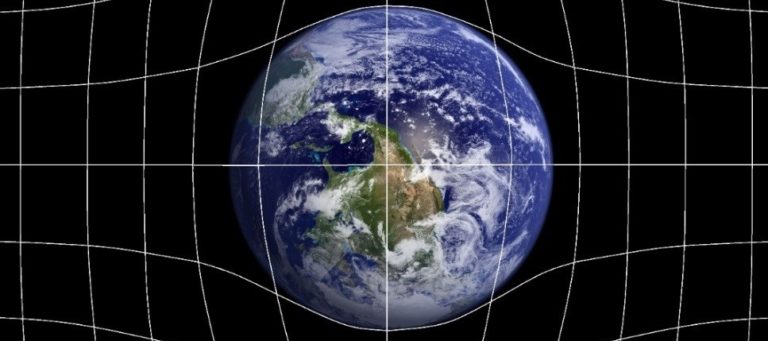
8 I’m a big fan of Einstein and I know how Special Relativistic time dilation works. It’s because of the wave nature of matter. The Lorentz factor is just Pythagoras’s theorem in disguise. But I still don’t like length contraction. When an electron is accelerated through space, it is length-extended, not contracted. If you were that electron you might claim that everything else looked contracted. But everything else didn’t change when you were accelerated. You did.
9 Nitpicking pedant readers will notice that the plot of the speed of light doesn’t start from zero. That creates a problem for black holes. The event horizon is a place where the “coordinate” speed of light, which is the speed of light, is zero. See Einstein’s 1939 paper On a stationary system with spherical symmetry consisting of many gravitating masses. He said “g44 = (1 – μ/2r / 1 + μ/2r)² vanishes for r = μ/2. This means that a clock kept at this place would go at the rate zero”. Think light clock. Light doesn’t move at the event horizon. That’s why a black hole is black. Ah, isn’t physics fun?
10 I am a very big fan of Newton. See Mr Newton’s Classroom to understand just how big a fan I am.
11 Einstein referred to Huygens and refraction, but the links don’t work because the Einstein digital papers are currently offline. This also causes an issue for my links to Einstein talking about the variable speed of light in 1911, 1912, 1913, 1914, 1915, 1916, and 1920. I think it’s rather odd that Princeton took them offline.
12 Elastic space has a thoroughbred pedigree. I say that as somebody who has read a great deal of the old papers. So many that after a whilst I think you start to get the gist of how things hang together. Because those old papers are gold dust, low hanging fruit, and an absolute treasure trove.
13 Does he know about The screw nature of electromagnetism I wonder? Or that electromagnetism is all about twist and turn?
14 I totally agree with having to show something so you can see what’s going on. When I’ve drawn a lattice, I’ve stressed that the lattice lines are only there to show the deformation of space.
15 I think she should have replied with an emphatic yes. I say that because when an ocean wave propagates through the sea, the sea waves. When a seismic wave propagates through the ground, the ground waves. So what waves when an electromagnetic wave propagates through space? The answer is space. Don’t overthink it, James. It’s simpler than you think.
KUDOS John for making the contributors list twice ! 👏 Now back to finishing Video #1 by Dr. Roth……..
Karma, Greg. Karma. LOL!
Thank you so much for taking the time to write this great summary! I also appreciate it that you wrote it in your own words, and did not use AI – it is getting rarer these days!
Always a pleasure, Chantal, many thanks. I have to say that whilst artificial intelligence has it’s uses, it sometimes comes across as artificial stupidity. I have a physics discussion forum, and of late I’ve noticed a lot of AI-generated twaddle. IMHO if you ask it a question it will give you the most common answer, which is not necessarily the correct answer.
Thank you very much for sharing this. Indeed, the Michelson-Morley experiment does not actually disprove that space is a real object. As long as matter itself is also a kind of traveling wave packet excited within space, the speed of light would naturally not be additive with the speed of its source. I also believe that spatial realism is the starting point of physics. Without discussing reality and by basing everything purely on mathematics, it becomes hard to form a physical intuition. Although ontological commitments are easier to falsify , It is precisely this “falsifiability” that drives scientific progress. (while purely phenomenological mathematical modeling seems immune to criticism, it also appears to lack a ladder for progress).
Based on my personal, not-so-comprehensive understanding, even during the era of the aether, there were already vague ideas that matter is a part of space. In the last century, we had the de Broglie–Bohm pilot-wave theory for matter waves, soliton theory, Wheeler’s idea of “mass without mass”,Loop Quantum Gravity (LQG), recent developments in condensed matter physics (like Wen’s string-net condensation), and many discussions on space as an elastic solid, such as this paper: John M. Baker. (2008) A New Approach to Quantum Gravity from a Model of an Elastic Solid. https://doi.org/10.48550/arXiv.0810.4659
While this concept is conceptually self-consistent and has broad explanatory power, to be truly established and accepted by the physics community, it likely needs concrete outputs, such as the specific wave packet spectra for material wave packets—from electrons to protons and then to material crystal forms—as well as a discussion on the topological configurations of space.
Zou, utmost apologies. Your comment was in the spam folder for some reason.
Thank you for sharing Exact Description of Rotational Waves in an Elastic Solid by R. A. Close. I’ve bookmarked it for study.
Again, utmost apologies Zou. This comment was also in the spam folder. I am remiss for not checking it all month.
Hi John, I am trying to get through all of your posts, which is a time consuming treasure trove with all it’s links. Many ideas I agree with, some I don’t, a few are very far out but fun to think about.
Of course I have my own model which shares some origin with van der Mark & Williamson but when it came to gravitation Kaluza (without Klein!) was the natural link between EM and GR. Other ingredients are Ockham and „shut up & calculate“. Unfortunately Kaluza never got the attention I think he deserved.
I’d really like to get some feedback from your perspective. A short version is at the forum: https://physicsdiscussionforum.org/kaluza-s-theory-of-everything-revisited-t3307.html
the most current version is on Researchgate: https://www.researchgate.net/publication/400350490_Theodor_Kaluza%27s_Theory_of_Everything_revisited_update_February_2026
Cheers, Thomas
It looks interesting Thomas. It will take me some time to go through it and get back to you. But I will. Please give me a couple of days.
I like how this piece questions familiar assumptions in physics. I also use https://youtubetranslate.net when I want science videos to stay understandable across languages.
Hey John, as an IT Guy, you might just be interested in this historical tidbit that explains the little known, American WWII contribution to the British Bletchley Park project. And happened right here in Dayton.
https://www.facebook.com/share/1DHiyenK4B/
That’s interesting, Greg. Funnily enough I find myself watching quite a few documentaries about World War II. Last night I watched a PBS program about the battle of the Philippines sea. The Japanese thought they had the advantage with their longer-range planes, but didn’t realise the Americans carriers now had combat information centers working off radar signals. The air battle turned into a turkey shoot.
We definitely have very simular tastes. I would like to see a companion piece to the movie Oppenheimer titled The Deamon Core.
Also the real life exploits of the infamous Dr. Pavlov(and Contemporaries) with his dogs makes H.P. Lovecraft gore seem tame !
Sorry to be slow replying Greg. I didn’t like Oppenheimer. IMHO it was too full of flashbacks and overly laden with guilt and communism. When the wife and I first bought a house it was from an older lady called Mrs Goodland. He husband had been a Japanese POW in World War II, and was so badly treated that he came back a broken man. I know of similar stories. Hence when I see hand-wringing angst about Hiroshima and Nagasaki I have no sympathy. In similar vein I turned Oppenheimer off, and didn’t watch it to the end. Sorry if that was a mistake. But I am sick to the back teeth of being lectured to in movies these days.
You might like “war machine” jaws and Jurassic park and predator and every scary movie rolled up into pure fear.
Sounds great Steve. I didn’t read too much about it, but it sounds just my thing! A thousand thanks. Again.
Very Fascinating. Chantal is right on almost every count. The math ironically can be shown by Clifford’s Geometric Algebra for all of the above.
What’s even more fascinating Tracy, is that the elastic universe is in essence Clifford’s space theory of matter.
https://arxiv.org/pdf/2509.11896 when you read this you’ll hear the sound of an old rusty door opening. That’s the scientific community starting to listen!
https://tritonstation.com/new-blog-page/
No dark matter! It’s all lies!
Who knew?
I started reading that blog post. I thought gosh, there’s no structure here, and it goes on and on. Then thought I’d take a look at the comments. What I saw was comments are closed. Then I thought here’s a guy who’s talking, but he ain’t listening. I’ve come across too many people like that. People who pontificate, even though they know fuck all physics, and never ever will because they just don’t listen.
Yeah he’s a published scientist alright and a professor which explains the ad nauseam.
Here is a video embedded in the tirade making fun of scientists who believe in dark matter, despite no evidence what so ever.
https://youtu.be/72FkbGo78RQ
He’s a big MOND guy…
He Should try variable speed of light…
I usually read un the middle of the night when I can’t sleep. I should have warned you I know, apologies.
It’s good to see the doors of perception start to creek open.
I agree completely with your overall sentiment concerning the cinema director’s imposed rose filtered religious/political revisionism. But not on this film tough. One movie that should be avoided at all costs would be Reds by Warren Beatty. Who knew being a Commie was so much good, clean family fun ?
Fun Fact : all the real life Commies involved in The Manhattan Project were jailed, even executed !
The sponsor of these articles, Stacy McGaugh, is a Cleveland professor who’s been chewed up and run over by the Status quo police for backing MOND so that makes him the enemy of your enemy…
I’ve written him about variable speed of light but crickets back. Maybe he’s busy.
Commiserations, Steve. Unfortunately a lot of astronomers and cosmologists have a rather scant knowledge of fundamental physics. It’s rather sad how little they know. It’s like this: very few of them have ever read what Einstein actually said, so they don’t understand gravity, and it’s all downhill from there. So they end up pontificating about things they know nothing about. Oh Lordy, look here, a paper co-authored with Sabine Hossenfelder: https://arxiv.org/abs/2301.03499.
I recently refound Albert’s 1911 English version, by way of good news.
Do you have a link for that Steve?
I was afraid you’d ask but I re looked it up and it’s still there, here you go ( small payback for the 100’s of links you’ve provided):
.
https://www.google.com/search?q=einstein+1911+paper&client=safari&hs=e1tU&sca_esv=b522c9179c1acadb&hl=en-us&sxsrf=ANbL-n6M0aQH_6k-wwwliaLgA4E8pz1vmw%3A1774204173113&ei=DTXAaYPMBrOrp84PmLW2gAY&biw=1038&bih=608&oq=einstei+1911&gs_lp=Egxnd3Mtd2l6LXNlcnAiDGVpbnN0ZWkgMTkxMSoCCAAyChAAGLADGNYEGEcyChAAGLADGNYEGEcyChAAGLADGNYEGEcyChAAGLADGNYEGEcyChAAGLADGNYEGEcyChAAGLADGNYEGEcyChAAGLADGNYEGEcyChAAGLADGNYEGEdI6CNQAFgAcAF4AZABAJgBAKABAKoBALgBAcgBAJgCAaACCJgDAOIDBRIBMSBAiAYBkAYIkgcBMaAHALIHALgHAMIHAzItMcgHA4AIAA&sclient=gws-wiz-serp
.
Also something on vixra
.
And boiler up!
Many thanks Steve. I have downloaded them. I will henceforth download everything from Einstein that I can.
Great
Steve, thanks from myself as well. Not that I will ever understand most it, but at the least I can now share it as too !
After a few decades I find ( I’m using the term loosely) and pun intended that stuff I’ve downloaded for safe keeping gets just as buried as in giant stacks of paper!
Pd I think you have the right idea in spreading info far and wide.
But still info gets lost over enough time…
It does that Steve. I have folders on this laptop containing information not just from my previous laptop, but from the one before that too. And the one before that. Which reminds me: I promised to buy my son a backup drive. Duty calls!
https://www.google.com/search?q=has+anyone+measured+what+happens+in+a+wter+wave&ie=UTF-8&oe=UTF-8&hl=en-us&client=safari