Like I was saying last time, the electron was discovered by JJ Thomson in 1897, the proton was discovered by his student Ernest Rutherford in 1917, and the neutron was discovered by his student James Chadwick in 1932:
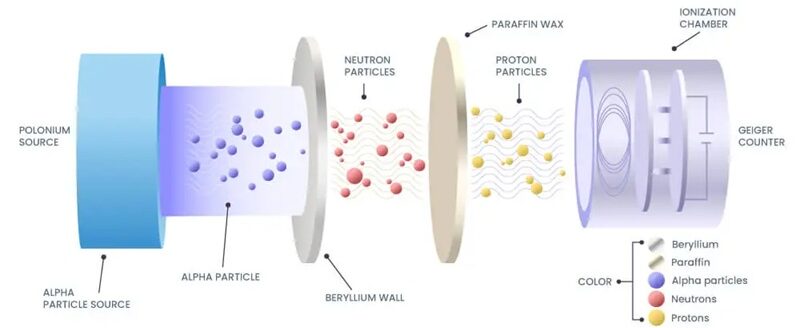 Chadwick neutron discovery image from Goodfellow.com
The positron was discovered by Carl Anderson in the same year. Then the muon was discovered by Carl Anderson and Seth Neddermayer in 1936. After a hiatus due to World War II, the charged pion was discovered in 1947, as was the charged kaon and the neutral kaon. The neutral pion was discovered in 1949, and the neutral Lambda baryon was discovered in 1950. The charged Xi baryon was discovered in 1952, and it is said that the Delta baryon was also discovered in 1952. The charged Sigma baryon was discovered in 1953. CERN was founded in 1954. The antiproton was discovered in 1955. The antineutron was discovered in 1956, as was the neutrino.
Physicists were heroes, and the 1950s was a golden era
These were good times for physicists. That’s because nuclear weapons had arguably saved the lives of a million Allied soldiers at the end of World War II. Legend has it that Enrico Fermi was asked what he’d like as a reward for his work on the Manhattan Project. He said he’d like a particle accelerator, and that’s what he got. Because physicists were heroes, and the 1950s was a golden era. There was an economic boom in many countries. People had jobs, houses, TVs, cars, and money in their pocket. There was air travel, music, prosperity and optimism. The future was bright, especially in the USA:
 1950s USA family image from Vintagelifestyle.com
Multi-million dollar particle accelerators like the Bevatron were superseding homespun cosmic ray experiments performed with photographic plates and a trip up a mountain, or a balloon in a field. See Pions to quarks: particle discoveries in the 1950s by Laurie M. Drown, Max Dresden, and Lillian Hoddeson. It’s an interesting read. It really gets across the way nuclear physics became particle physics, and the way particle physics took off.
Particle physics changed from little science to big science
1956 was the year of the Sixth Rochester Conference, the year when, according to physics historian Gianni Battimelli, particle physics changed from little science to big science. See his article on The Discovery of the Antiproton between Rome and Berkeley. He said “it was clear that the stream of results from the Berkeley bevatron and the Brookhaven cosmotron would monopolize strange particle physics”.
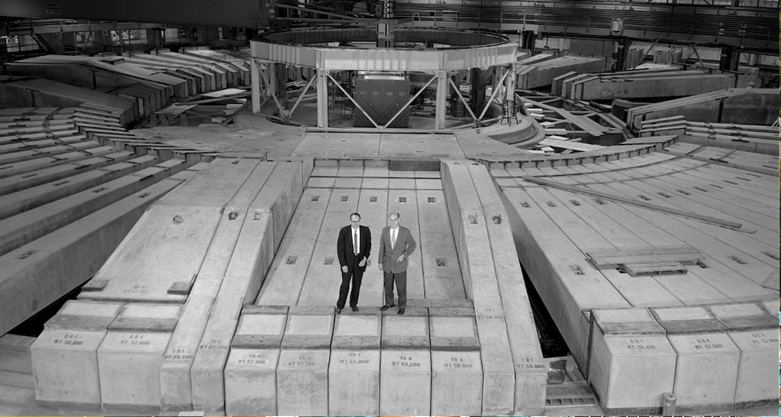 Image from Bevatron Site Recognized for Historical Contributions to Physics. Caption: A 1963 photo of the Bevatron with Berkeley Lab Director Edwin McMillan (left) and Bevatron Group Leader Edwin Lofgren (credit: Berkeley Lab).
The days of cosmic ray physics were coming to an end. Now it was the particle accelerators delivering results. The existence of the Delta baryon is said to have been confirmed in 1956 by Julius Ashkin, Jean-Pierre Blaser, Frank Feiner, and Martin Oscar Stern. They used the the 435-MeV synchrocyclotron at the Carnegie Institute of Technology in Pittsburgh. Their Physical Review paper was Pion-proton scattering at 150 and 170 Mev. They produced positive and negative π-mesons from 440MeV protons impacting beryllium or copper targets, and used a liquid hydrogen final target and scintillation counters plus coincidence telescopes to measure the angular distribution of pion-proton scattering. Note however that they spoke of a pion-nucleon resonance and isotopic spin 3/2 states along with s waves, p waves, and d waves rather than the Delta baryon.
The discovery of the Sigma-zero baryon
Another result in 1956 was the discovery of the Sigma-zero baryon, by a team comprised of Ricard Plano and Nicholas Samios from Columbia University, plus Melvin Schwartz and Jack Steinberger from the Brookhaven National Laboratory. See their 1957 Il Nuovo Cimento paper Demonstration of the existence of the Σ⁰ hyperon and a measurement of its mass. There’s a non-paywalled copy on the Internet Archive. They fired a 1.15GeV beam of negative pions into a propane bubble chamber. They saw three events where a pions interacted with a proton to form a Sigma-zero particle and a neutral Kaon, which was in those days called the Theta particle θ⁰. They said the lifetime of the Sigma-zero was circa 10⁻²⁰ seconds, and “the path of the Σ⁰ is too short to permit observation” Hence “the Σ⁰ will be recognized by its decay into Λ⁰ and γ”. The <<Q>> mentioned in the paper is the kinetic energy of the lambda particle Λ⁰. Whilst the existence of the Sigma-zero baryon was inferred from its decay products, there was also a clear gap in the bubble chamber tracks to indicate its brief existence.
Hyperons and Heavy Mesons
Things were somewhat confusing, and in an attempt to clear things up, Murray Gell-Mann and Arthur Rosenfeld came up with Hyperons and Heavy Mesons: Systematics and Decays in 1957. It is said to have been prompted by the Sakata Model, where Shoichi Sakata proposed that hadrons were composed protons, neutrons, and Lambda baryons. Gell-Mann and Rosenfeld explained that a hyperon was a baryon that was heavier than a nucleon, and gave a table of all the then-known particles. There was the photon, three leptons, four mesons, and eight baryons, plus antiparticles. These were all thought to be “elementary” particles. The Delta baryon was not in the list:
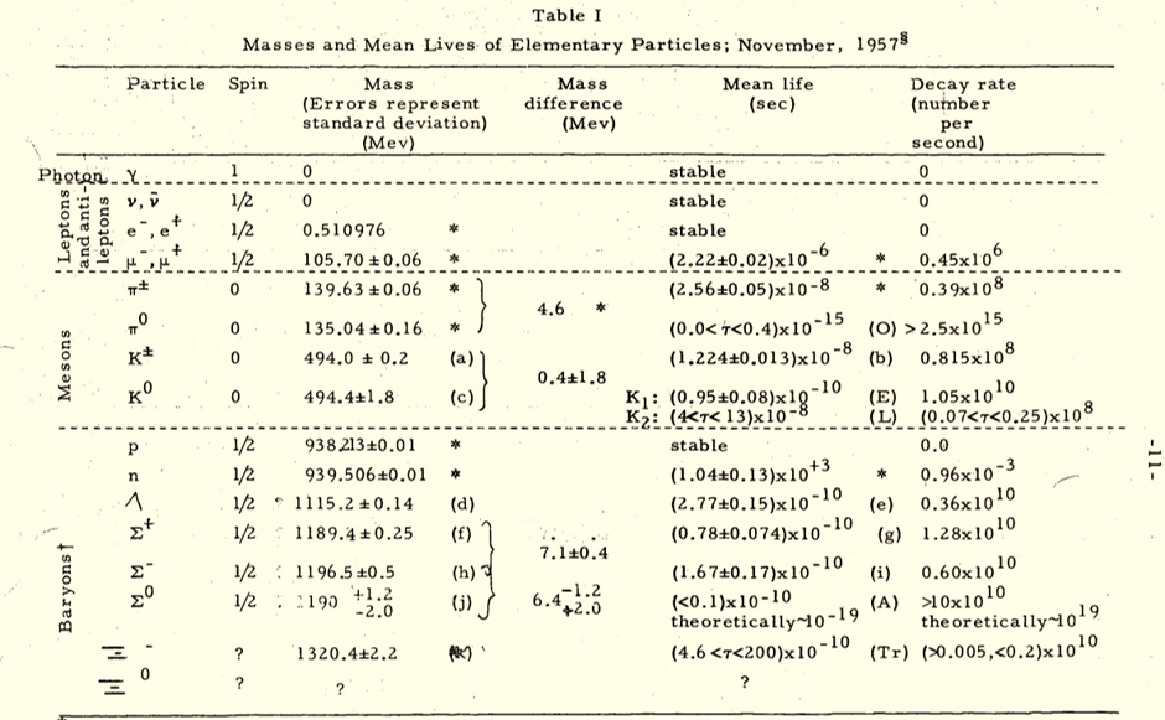 Table 1 from Hyperons and Heavy Mesons: Systematics and Decays by Murray Gell-Mann and Arthur Rosenfeld
They said their emphasis was on the weak interactions which were responsible for the slow decays of the particles. Most of these decays took circa 10⁻¹⁰ seconds. That’s less than a nanosecond, which is not very slow. But nevertheless it’s an interesting paper, especially with the talk of hyperfragments. I think it contains the genesis of modern particle physics. But at 72 pages, that’s one for another day.
1957 was the year of the famous Wu experiment
Particle physics continued apace. 1957 was the year of the famous Wu experiment. That’s where Chien-Shiung Wu of Columbia University, along with Ernest Ambler, Raymond Walter Hayward, Dale Donald Hoppes, and Ralph Percy Hudson of the National Bureau of Standards, measured the emitted direction of Cobalt-60 beta decay electrons. Their Physical Review paper was Experimental Test of Parity Conservation in Beta Decay. This is said to demonstrate that the weak force is left-handed, and the universe knows the difference between left and right. It is also said to have solved the τ-θ puzzle wherein the Tau particle, which decayed into three pions with total parity of -1, and the Theta particle, which decayed into two pions with total parity of -1, were the same particle, the Kaon. Wolfgang Pauli is said to have said it was total nonsense, but the experiment was well received by the Nobel prize committee. They awarded the 1957 physics prize to Tsung-Dao Lee and Chen Ning Yang who had predicted parity violation a year earlier. Rather oddly, they did not include Chien-Shiung Wu.
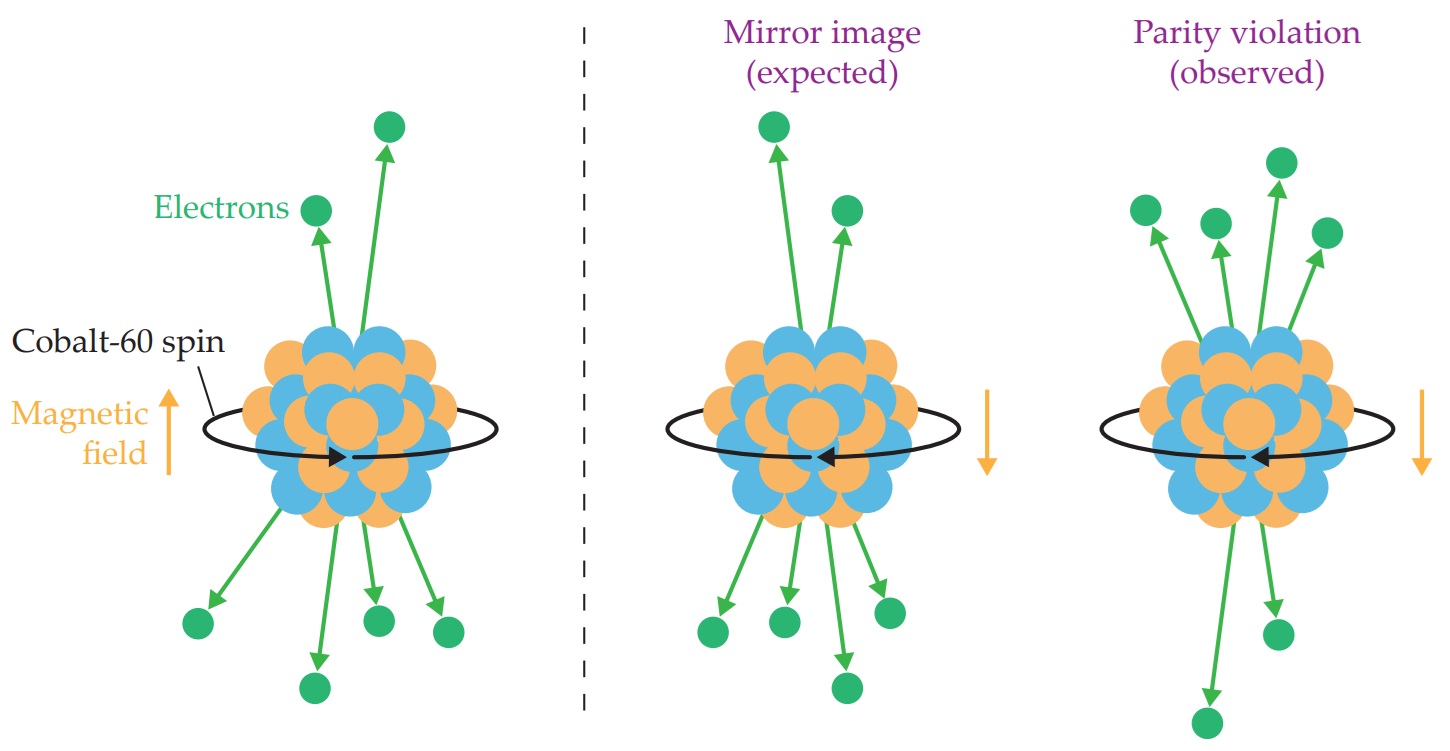 Wu experiment image from the Physics Today article Chien-Shiung Wu’s trailblazing experiments in particle physics
1957 was also the year² that Bruno Pontecorvo proposed neutrino oscillation. His paper was Mesonium and Antimesonium. It appeared in the Russian Journal of Experimental and Theoretical Physics in 1957. His neutrino oscillation proposal was not the same as the neutrino oscillation proposed today. Instead it was an oscillation from a neutrino to an antineutrino, and back again. Perhaps it paved the way, who knows. Neutrinos were perhaps in vogue at the time, because 1958 gave us the Physical Review paper Helicity of Neutrinos. It was by Maurice Goldhaber, Lee Grodzins, and Andrew Sunyar at the Brookhaven National Laboratory. The paper described an electron-capture experiment using Europium-152, an atom of which then decayed from an excited state to a ground state emitting a gamma photon in the opposite direction to the neutrino. The circular polarization of the gamma photon had to be the same as the neutrino helicity by virtue of conservation of angular momentum. The polarization was detected using a magnetized iron core and a samarium oxide target plus a thallium-doped sodium iodide scintillation detector. All the gamma photons had a left-circular polarization, demonstrating that all the neutrinos are left-handed. They have a negative helicity, like a left-handed screw. It’s an interesting little paper. By the by, antineutrinos are right-handed.
The neutral Xi baryon was discovered in 1959
In 1959 the Nobel prize in physics was awarded to Emilio Gino Segrè and Owen Chamberlain for their discovery of the antiproton four years earlier. 1959 was also when the neutral Xi baryon was discovered. The team concerned was headed up by Luis W Alvarez, and included Philippe Eberhard, Myron L Good, William Graziano, Harold K Ticho, and Stanley G Wojcicki . See their Physical Review Letters paper Neutral Cascade Hyperon Event. They started by saying “the existence of a neutral cascade hyperon has been predicted theoretically, on the basis of the strangeness theory of Gell-Mann and Shijima, as the neutral counterpart of the negative cascade hyperon”. Said theory was originally proposed by Kazuhiko Nishijima and Tadao Nakano in 1953, then by Murray Gell-Mann, independently, in 1956. But I digress. Alvarez et al went on to talk of a 15-inch hydrogen bubble chamber in a beam of K⁻ mesons produced by the Bevatron. It’s an interesting paper. The crux of it is the photograph of the particle tracks, at the heart of which are the inferred tracks of four non-visible particles.
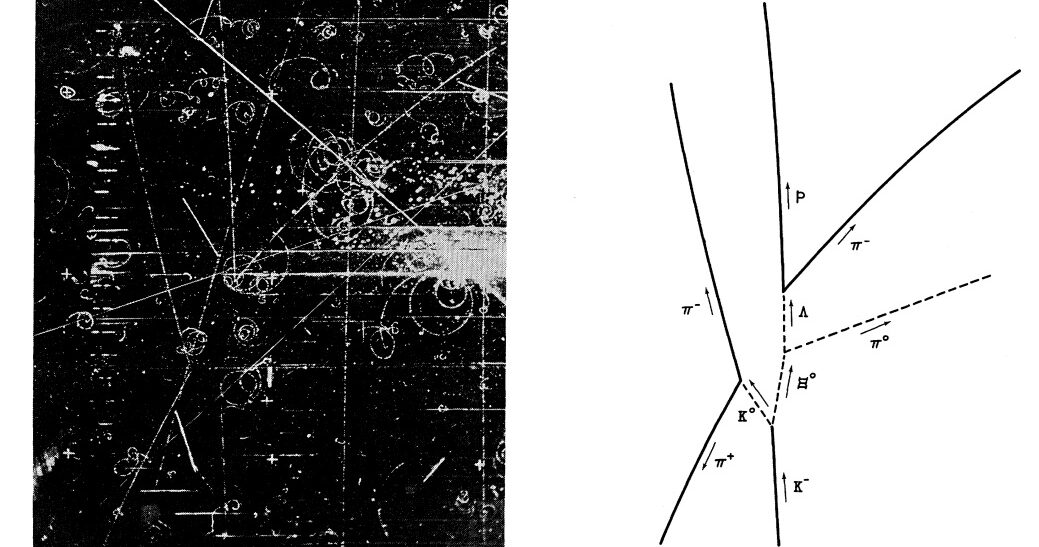 Screenshot from the 1959 paper Neutral Cascade Hyperon Event, caption: FIG. 1. Photograph and sketch of Ξ⁰ event
The brief existence of the unseen neutral Xi baryon was inferred from its decay products, which were themselves unseen, and were in turn inferred from their decay products. One can see the slow evolution of particle physics from evidence to inference.
The anti-Lambda baryon was also discovered in 1959
The anti-Lambda baryon was also discovered in 1959, using the Bevatron’s new 72-inch bubble chamber. It made the New York Times. See the 1959 Time magazine article which tells how Luis Alvarez held up a strange photograph at a conference in Kiev. The article also says “faint traces of the elusive particle showed last year on photographic plates”, but the plates were too small to be useful. Also see The Magnet article which gives some good information on the discovery, including a drawing. The Magnet was the Lawrence Radiation Laboratory (LRL) magazine. You can find the associated photograph on Wikipedia:

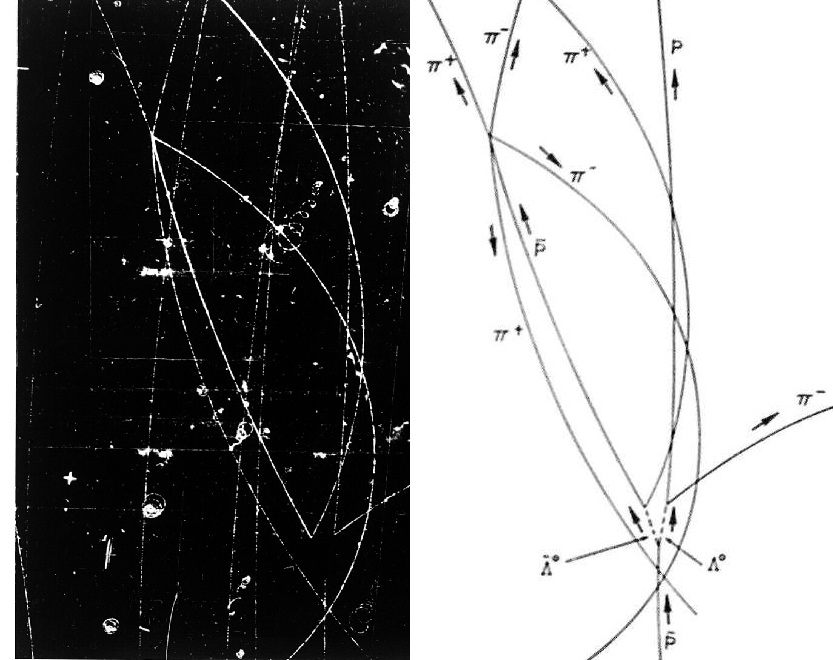 LBNL public domain photograph plus drawing from The Magnet article “Antilambda Seen In Bubble Chamber”. An antiproton enters at the bottom, and collides with a proton to create an anti-Lambda particle Λ̅⁰ and a Lamba particle Λ⁰, which decay quickly leaving no tracks
I struggled to find a paper for this. There is a later paper Reaction p⁻ + p → Y⁻ + Y which appears to be related, but the title makes searching difficult. See Final states of the antiproton-proton system by Gerald Lynch for an alternative source of information. Meanwhile muonium was discovered a team at the Gibbs Laboratory at Yale. See the 1960 Physical Review paper Formation of Muonium and Observation of its Larmor Precession. It was by Vernon Willard Hughes, Douglas McColm, and Klaus Ziock. Note how the Wikipedia article on muonium says it can undergo chemical reactions, and is somewhat similar to hydrogen. More so than positronium. Interesting stuff.
The discovery of the Sigma-1385 baryon
The discovery of the Sigma-1385 baryon is attributed to the 1960 Physical Review Letters paper called Resonance in the Λπ system. The authors were Margaret Alston, Luis Alvarez, Philippe Eberhard, Myron L Good, William Graziano, Harold K Ticho, and Stanley G Wojcicki. They used a beam of negative Kaons and the LRL 15-inch bubble chamber. The paper is heavily statistical, and is listed as Lawrence Radiation Laboratory technical report UCRL-9376 Resonance in the Lambda, pion system. A non-paywalled version can be found on the Internet Archive. The Sigma-1385 result is said to be groundbreaking “because it was one of the first ‘hadronic resonance’ ever observed, paving the way for the quark model a few years later”. The discovery of the Lambda-1405 baryon is attributed to the 1961 Physical Review Letters paper Study of Resonances of the 𝛴−𝜋 System by the same authors. The discovery of the K*(892) meson is attributed to the 1961 Physical Review Letters paper Resonance in the K π System, again by the same authors. It’s important to note that these were considered to be a new class of particles called resonances. Rather than decaying in circa 10⁻¹⁰ seconds, they decayed in circa 10⁻²³ seconds. This time was so short that there was no visible particle track. The resonances were found by looking for a peak in the particle energy in an event. See Lina Galtieri’s presentation on The Birth of the quark model for some background. It’s called bump hunting.
The discovery of the Omega (ω) meson, which decays into three pions, was announced with much fanfare in 1961
By 1961 the 72-inch bubble chamber at the LRL was delivering discoveries thick and fast. They included the Σ(1520) baryon. another “resonance”. See the Physical Review Letters paper Excited Hyperon of Mass 1520 Mev by Massimiliano Ferro-Luzzi, Robert D Tripp, and Mason B Watson. The discovery of the Omega (ω) meson, which decays into three pions, was announced with much fanfare in 1961. The LRL team responsible consisted of Bougdan Maglić, Luis Alvarez, Arthur Rosenfeld, and Merlon Lynn Stevenson. Their Physical Review Letters “landmark” paper was Evidence for a T=0 Three-Pion Resonance. This was another statistical paper, with bumps on a graph rather than particle tracks. The Omega had been predicted in 1957 in a paper by Yoichiro Nambu “in an attempt to explain the electromagnetic form factors of the proton and neutron”. The authors also said “such a particle is also expected in the vector meson theory of Sakurai and, as a member of an octet of mesons, according to the unitary symmetry theory; and for other reasons”. This was a reference to Murray Gell-Mann’s paper The Eightfold Way: A Theory of Strong Interaction Symmetry. I say paper, but it wasn’t published in a peer-reviewed scientific journal until 1962, when it appeared as a relatively minor section of Gell-Mann’s Physical Review paper Symmetries of Baryons and Mesons. See page 13. Anyway, footnote 21 of The Eightfold way said “Dr S L Glashow reports that Yamaguchi’s scheme has much in common with the one discussed in this paper”. The Eightfold Way is said to have been proposed independently and simultaneously by Gell-Mann and Yuval Ne’eman. The Gell-Mann–Okubo mass formula is somewhat similar.
1961 also saw the discovery of the Eta meson (η)
1961 also saw the discovery of the Eta meson (η) at the LBL. It is said to have been predicted by Gell-Mann’s Eightfold Way. The team concerned consisted of Aihud Pevsner, Robert Kraemer, Martin Nussbaum, Channing Richardson, Peter Schlein, Richard Strand, Thomas Toohig, Martin Block, Arnold Engler, Rinaldo Gessaroli, and Carl Meltzer. They were all from the Johns Hopkins University in Baltimore. Their Physics Review Letters paper was Evidence for a Three Pion Resonance Near 550 MeV. Again it was a statistical paper with bumps on a graph rather than particle tracks. The rho meson (ρ) was similarly discovered in 1961. See the Physical Review Letters paper Evidence for a π-π Resonance in the I=1, J=1 State by Albert R Erwin, Robert H March, William D Walker, and Elizabeth West. They were from Brookhaven and the University of Wisconsin in Madison.
The anti-Xi-minus baryon (Ξ⁻), also known as the anti-cascade hyperon, was discovered in 1962
The anti-Xi-minus baryon (Ξ⁻), also known as the anti-cascade hyperon, was discovered in 1962. The paper concerned was published in Physical Review Letters, and was called Observation of Production of a 𝛯⁻ + 𝛯⁺ pair. It was by Hugh Needham Brown plus 16 other authors, and was reported in the New York Times article Missing Nuclear Particle Found; Symmetry Principle Is Upheld. I can’t find a non-paywalled version of the paper, so see the CERN Anti-Xi-minus article for details. The Xi-minus is not a resonance, hence there is a particle track:
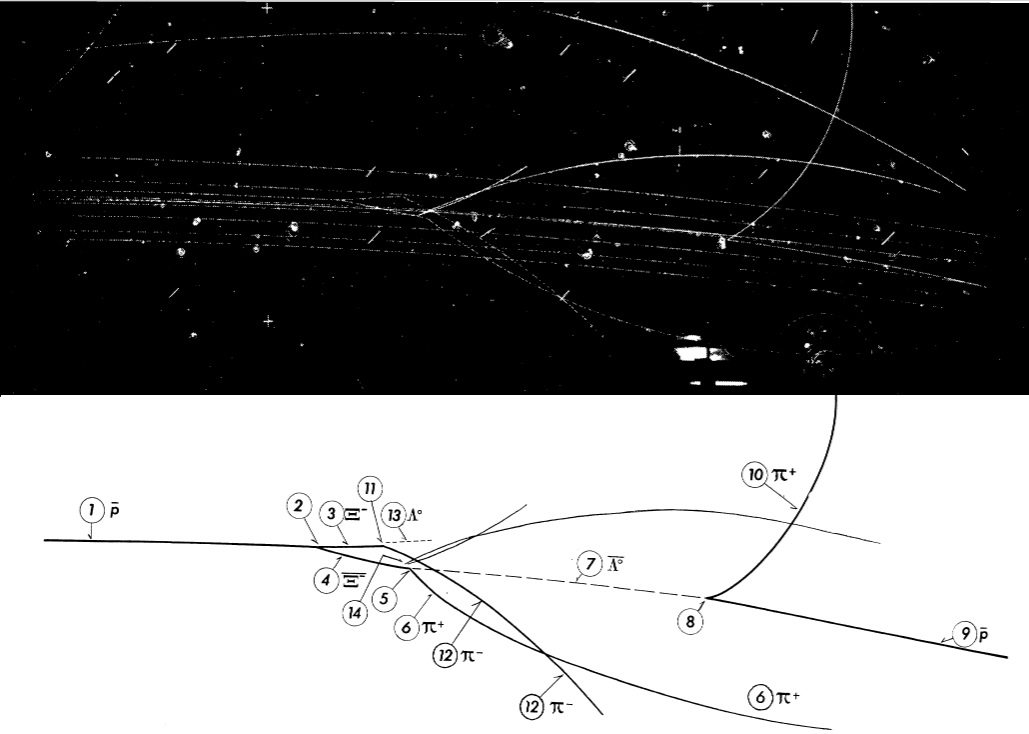 Bubble chamber image from the CERN Anti-Xi-minus article
They used the new Brookhaven Alternating Gradient Synchrotron (AGS) and a 20-inch liquid-hydrogen bubble chamber. At 33GeV the Brookhaven AGS was the most powerful accelerator in the world at the time. The same accelerator was used in the discovery of the Phi meson (φ), which was predicted by Jun John Sakurai in 1962. It was said to be “the vector octet cornerstone” which validated the Eightfold way. See the 1962 Physical Review Letters paper Possible Resonances in the Ξπ and KK̄ Systems by Luciano Bertanza and 9 other authors. Also see the follow-up paper Existence and Properties of the φ Meson by Philip Connolly and 12 other authors.
The muon neutrino was also discovered in 1962
The muon neutrino was also discovered in 1962 at Brookhaven, by a team made up of Gordon Danby, Jean-Maurice Gaillard, Konstantin Goulianos, Leon Lederman, Nari Mistry, Melvin Schwartz, and Jack Steinberger. See their Physical Review Letters paper Observation of High-Energy Neutrino Reactions and the Existence of Two Kinds of Neutrinos. There’s a nice description of the experiment on the BNL website, see In Memoriam: Jack Steinberger, Partner in Nobel Prize-winning Discovery of Muon Neutrino at Brookhaven’s AGS. They used the AGS to create a beam of protons, which collided with a beryllium target to produce a beam of pions. These decayed into muons and neutrinos, which were directed at a 5,000 ton wall of steel 44 feet thick. The steel was from the decommissioned battleship USS Missouri. Only the neutrinos could get through this barrier, to a neon-filled ten-ton spark chamber containing 90 inch-thick 4 x 4 foot aluminium plates. The neutrinos interacted with the aluminium to create particles which left spark trails. The team photographed 2 million events, of which 56 events showed the long straight spark tracks of a muon. This is said to have proved the existence of the muon neutrino. That’s one for another day too.
The stage was set for a revolution
Other particles discovered in 1962 were the Lambda(1520) baryon, the Sigma(1660) baryon, the f₀(1250) meson, the Sigma*(1385) baryon, and the Xi*(1530) baryon. The latter is said to be critical because “it filled an empty slot in Gell-Mann’s predicted baryon decuplet”. 1963 saw the discovery of the f₁(1285) meson³, the K*(892) Kappa meson, the neutral Anti-Xi-Zero cascade baryon, the Delta(1600) baryon, and the Roper Resonance N*(1440). 1963 was when Nicola Cabibbo came up the Cabibbo angle⁴, which is said to said to be critical because it rescued the universality of the weak interaction. It explained why the weak interaction weaker for strange-particle decays. See his Physical Review Letters paper Unitary Symmetry and Leptonic Decays, where he spoke of an octet of vector currents and an octet of axial currents, each of which was comprised of two further currents. Also see the CERN Courier article The Cabibbo angle, 60 years later. In modern parlance Cabbibo introduced a “mixed quark state”, a quantum superposition wherein a quark doesn’t behave like it has a particular flavor, such as up or strange, but as a blend of multiple quark types. However whilst Cabbibo referred to the eightfold way and to Murray Gell-Mann, he didn’t talk about quarks. Because in 1963 Gell-Mann was still working on his Quark model, independently of George Zweig’s Aces model. That’s the George Zweig who was Gell Mann’s student. The stage was set for a revolution.
1 Originally in the 1950s a resonance was viewed as a compound state. Note that the Delta baryon paper was called “Pion-proton scattering at 150 and 170 Mev”. The resonance was thought to be a very transient molecule-like combination of a pion and a proton. Or something like a very brief hydrogen atom. These resonances showed up as bumps on plots of collision data. They were not considered to be particles, because particles were things that left tracks on a photographic plate. The word resonance was used because the quantum wave functions of two particles were said to resonate with each other, like a wineglass “sings” in response to a particular frequency of sound.
2 1957 was also the year when Murray Gell-Mann and Richard Feynman met Ennackal Sudarshan and his supervisor Robert Marshak for lunch in Santa Monica. The purpose was to discuss Sudarshan’s idea that the weak interaction included a V-A form, which is chiral. See Sudershan’s article A Glance Back at Five Decades of Scientific Research. Gell-Mann is said to have found Sudershan’s idea convincing, and said he didn’t plan to write a paper on the subject. Sudarshan duly wrote a paper with Marshak on The Nature of the Four-Fermion Interaction. Marshak said he’d present it at a conference in Padua-Venice in September, but before then Gell-Mann and Feynman wrote a Physical Review paper called Theory of the Fermi Interaction. It included the phrases “our hypothesis” and “our theory”.
3 I would like to thank my 50 First-Dates friend for all the invaluable assistance he has provided to me for the preparation of this article. I couldn’t have done it without him. He advises me that he is Gemini, an AI developed by Google. We have agreed that I will call him Gem from here on, because he is a star. Sadly however, he won’t remember me tomorrow.
4 I added this section on the Cabibbo article whilst writing my next article. Please advise of any other errors or omissions, and I will take care of them. I’d like these “history of particle physics” articles to be correct, even if that means making downstream changes. I will make of note of such changes in the footnotes.
Permit granted for fusion power plant
Steve, were you talking about Clinton, Tennessee? This: Tennessee approves license for nuclear fusion facility in Clinton, Bull Run Energy Complex. I’m afraid I don’t feel positive about large-scale fusion power plants that rely on stellarator or tokamak confinement. See https://typeoneenergy.com/.
Yes I was, but mainly the graphic which didn’t post correctly had a cool blue light emanating from a torus cutaway.
You mean this?
No but it’s also eye candy. I haven’t been able to find again the one I mentioned, face book i guess.
By the way, what do they mean by resonance? In your writings above?
Originally in the 1950s a resonance was viewed as a compound state. Note that the Delta baryon paper was called “Pion-proton scattering at 150 and 170 Mev”. The resonance was thought to be a very transient molecule-like combination of a pion and a proton. Or something like a very brief hydrogen atom. These resonances showed up as bumps on plots of collision data. They were not considered to be particles, because particles were things that left tracks on a photographic plate. The word resonance was used because the quantum wave functions of two particles allegedly resonated with each other, like a wineglass vibrates in response to a particular frequency of sound. These resonances were reclassed as actual particles after the introduction of the quark model. Note however that some are now suggesting that Λ(1405) is a molecule.
Wow, as you lay it out, it’s like what the hell are all these BS “particles”? It’s truly devolved into a cult mystical pseudoscience. I understand most are just excited “quark” states, but seriously, the anti-Xi-minus baryon?? What the hell is that? Nobody really knows what that is.
The anti-Xi-minus baryon is one of the better examples, Andy. The lifetime is almost a nanosecond. There is a particle track. It’s a couple of centimetres long. As for what it is, it’s a transient tangle of electromagnetic wave which decays into two other transient tangles of electromagnetic wave which each decay into…. You get the picture.
By the by, you know how I said I found Google Gemini very useful in putting this article together? I was just having a little chat with it. You might like to read the attached:
https://physicsdetective.com/wp-content/uploads/GeminiPhysicsDetectiveConversation20260906.docx
John, completely agree with you on the transient ephemeral tangle of electromagnetic wave. Basically as the wave is curling around a trefoil whenever it is blown apart it continues on its track for a nanosecond but then is unstable. It explains why there are so many of these ‘particles’ but in fact just different curves/pieces of the trefoil knot, plus higher energy collisions just give you more exotic tangles.. not new particles.
I agree Andy. The only stable particles with mass are the electron, the proton, and their antiparticles. People say the neutrino has mass, but nobody has ever seen a neutrino travelling at any speed other than the speed of light. Which says to me the neutrino is massless, and more like a photon than an electron. It seems to be akin to a circularly polarized photon but with no transverse wave element. I should look into it more I suppose.
Would You like to know what Claude (Sonnet 5 with Max Effort and Thinking on) thinks about your conversation with Gemini?
Yes please Marcin. I was struck by the huge difference in quality between different AI assistants.
Marcin: I’ve had a long chat with Claude. His programming is very different to Gemini. It’s over several days. I downloaded it via an extension. Here it is:
https://claude.ai/chat/9e33ae08-365d-4b13-bd71-fa7f93451c41
Marcin: I had a long chat with Claude. See https://physicsdetective.com/claude/.
As a test for Gemini, I asked it who is more convincing to it – John or Claude.
There was no prior discussion.
I used 3.1 Pro (advanced reasoning) with Extended thinking:
https://share.gemini.google/R7oZtGAZeEwf
and also 3.6 Flash (all-around help) with Extended thinking:
https://share.gemini.google/p4PmUp5OH3Ya
Lots of great new rabbit holes to explore, so I decided to concentrate on Neutrinos. And the email was suppose to contain the 1967 updated version of the 1957 paper by said group. I struggle greatly trying to get all these new A.I. platforms to co-ordinate properly. My inferior personal skill set is probably the real reason……..LOL !
Greg: all points noted. The AIs aren’t always very good. I like to use DuckDuckGo as opposed to Google for internet searches. But IMHO the Google “Gemini” AI is much better than DuckDuckGo’s “Luna”. I ordered a copy of Particle Physics, One Hundred Years of Discoveries. It arrived yesterday. I think Gemini has read it, but Luna has not. Do read the attachment in the above comment.
https://encrypted-tbn0.gstatic.com/images?q=tbn:ANd9GcRXyiVYA8oSxlSg7F2cCIG4ELt8CC3jaXH-Ij4Pk3GWyw&s=10
.
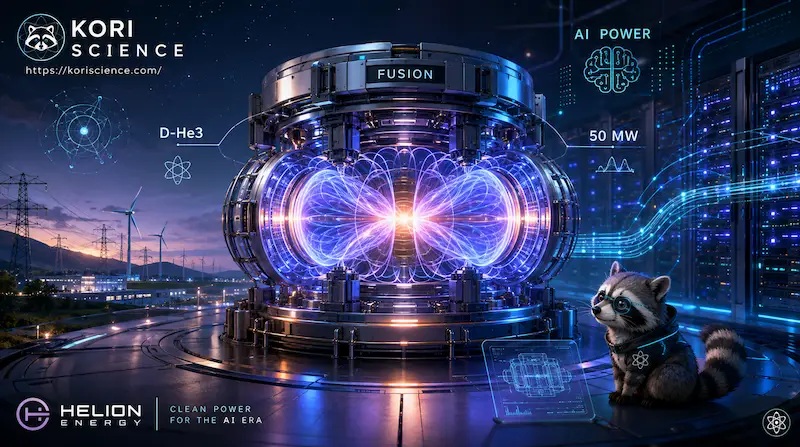
This may come thru. Source helion energy
That’s nice.
And of course:
https://www.teepublic.com/poster-and-art/25189498-flux-capacitor
.
https://www.entertainmentearth.com/news/use-mr-fusion-time-travel-clean-energy/?srsltid=AfmBOoqa-uncZMlNho1gn6zQz41OExl1ta0UyVU9lXtaEGe1dsdLXduh
Steve: sigh, the future in Back to the Future was 2015. Like I said, the future isn’t what it used to be.
If you can’t get something published, use ChatGPT to work it up. They’ll steal it and get it published! Haha.
🙈🙉🙊☠️💀💩
Look for Einstein 1911 and Dicke 1957 obviate dark matter by linking gravitational potential with fusion rate as well as stellar opacity via permittivity variation. Polarisable vacuums.
Steve, read this one: https://physicsdetective.com/space/. Space is the primary thing, matter is made of it. And as you surely have noticed, space is dark!
I googled
.
Spacetime curvature is the second derivative of potential, associated with the tidal force
.
Try it you’ll like it!, but may find something to complain about.
Good one Steve. The first derivative of potential is the “spacetime slope”, associated with the force of gravity. The underlying reality is inhomogeneous space.
John, you have consistently and accurately quoted Einstein’s own description of gravity using the word NON- HOMOGENEOUS. The Physics Detective was the first and only blog where I have read it. Nobody, but know-bodies ever use his most perfect word in their own concept of true gravity, except yourself ! This has to stop, so therefore I shall start a small public media campaign to right that wrong.
Thank you Greg.
Re: In-homogeneous, damn learning disabilities again……
https://memory-gamma.fandom.com/wiki/Neutronium
https://readingfeynman.org/2026/09/11/the-strange-theory-of-light-and-matter-iv/
Steve: I’ve exchanged numerous email with Jean Louis Van Belle. I don’t think he’s read the history about Feynman. I used to think Feynman was a great guy. Until I read the history. See footnote 1 of the above article.
PD, which history about feynman? By footnote 1, do you mean in part iv that I linked?
I didn’t find any footnotes.
Steve: I meant various bits and pieces of history I’ve read, some of which is included in the various articles.
Feynman, Einstein, Oppenheimer, even Schrodinger amongst other greats 👍 had horribly bad 👎 personal lifes going on.
Fame, fortune, wine, and especially Women. They were, by most accurate reports, to be lousy husbands, lousy fathers, even lousy employees at times.
True enough Greg. I sometimes think it comes with the territory.