One website I rather like is called PhysOrg. It’s a news aggregator website which nowadays puts up about two hundred science stories a day. I’ve referred to a fair number of them in my Physics Detective articles. PhysOrg was around when I started digging into physics twenty years ago. Back then the website was PhysOrg.com, now it’s Phys.org. See the Phys.org entry on Grokipedia for some background. It was founded in 2004 by two anonymous PhD students “in response to the scarcity of accessible, high-quality science journalism for informed audiences”.
 Screenshot from the Phys Org website
You can also read that PhysOrg became Science X in 2012, when it broadened its remit from physics to science in general. It’s owned by Omicron Limited which has an Isle of Man accommodation address. See the Science X About Us page for original details. Also see the super-brief Phys.Org Wikipedia page where you can read that it’s “a news aggregator which re-publishes press releases and stories from news agencies”. In the next breath it says this is a business model known as churnalism. Click on the link and you can read that “Churnalism is the production of low-quality or unoriginal news articles, generally by paraphrasing other sources or press releases to avoid the need for time-consuming research or fact-checking”.
PhysOrg is a news aggregator website, and it’s free
I think this comes across as rather churlish from Wikipedia. PhysOrg is a news aggregator website, and it’s free. It isn’t a research lab, and it isn’t the New York Times. Along with the super-brief Wikipedia page, this churlishness makes me think Wikipedia are dissing the competition. Check out the Wikipedia PhysOrg talk page for some pretty unpleasant stuff, such as “right wing pseudoscience” and “woo-pushing puffpiece”. It looks like the Wikipedia editors are playing thought police and censoring things they don’t like. Like they censored Einstein’s variable speed of light on the Variable speed of light page, despite what I told them on the talk page. This is not just my view, and it isn’t limited to physics. Elon Musk accused Wikipedia of bias and called them Wokepedia. Even the Wikipedia co-founder Larry Sanger said Wikipedia was guilty of left wing bias. It looks like it’s true, because Wikipedia banned the Daily Mail. I wonder if they they didn’t like the way PhysOrg reported on that:
 Screenshot from the Phys Org website
I also think it’s unfair to PhysOrg, because newspapers are similar. They take press releases from universities and scientific institutions, and give them wider publicity. They don’t have a panoply of experts on the payroll to make sure it’s rock solid science. Yes, they might consult a friendly physicist, but he’s unlikely to be too disparaging, because that would be bad for physics. Hence a newspaper like The Guardian tends to pass on what they’re given. PhysOrg are the same, but they’re passing on a whole lot more. Like I said, they’re publishing about two hundred science stories a day. A newspaper like The Telegraph publishes maybe a hundred science stories a year. It’s hard to gauge the exact figures, but I had a print subscription until recently, and I tell you, it’s not many. Especially for particle physics and cosmology, where I’d say we’re lucky to see one story a month. If that.
We’re talking around 25 articles a day, of which perhaps 5 are Physics Detective material
Yes there’s some dodgy stuff in the PhysOrg stories, but it’s not as bad as New Scientist, and it’s not PhysOrg’s fault. Journal editors are supposed to filter out the crap, not PhysOrg. Not when they’re giving us two hundred stories a day for free, with an editorial team of 10 plus 22 contributing authors. As for the stories themselves, you need to keep reading what comes up to catch the drift. There’s a lot of stories I don’t care for, but that’s my fault. I’m into fundamental physics and cosmology, which is only a small part of the field. To give you an idea how small, according to the Brave chatbot there are circa 26,400 physicists and astronomers in the USA, of which only a few thousand are particle physicists, and a few hundred are cosmologists. So perhaps a fifth of their total output is my cup of tea. As for how much output there is, a 3-day search in the PhysOrg Physics section returns 30 stories, whilst a 3-day search in the Astronomy & Space section returns 47 stories:
 Physics news screenshot from the Phys Org website
That’s 77 articles in all for 3 days, of which perhaps 15 are my kind of thing. So we’re talking around 25 articles per working day, of which perhaps 5 are Physics Detective material. This is a small fraction of PhysOrg’s total output. All the more so because there are other sections, namely Nanotechnology, Earth, Chemistry, Biology, Other Sciences, Medicine, and Technology.
Black Ivory coffee: Elephant gut bacteria may contribute to its smooth, chocolaty flavor
There’s some really interesting stuff in those other sections. See the nanotechnology story 2D material offers a solution to long-standing obstacle in diamond-based circuits. It’s about a roundabout way of doping diamond for use in electronics, and is related to what I was saying last time about Derek Muller’s blue LED video. I liked it. I didn’t like the Earth story Adoption of electric vehicles tied to real-world reductions in air pollution because I didn’t believe it. I grow vegetables, and I’ve taken a side interest in the subject. But I did like the Chemistry story Black Ivory coffee: Elephant gut bacteria may contribute to its smooth, chocolaty flavor. There is a type of coffee made from coffee beans picked out of elephant dung. Ugh! And of course I absolutely loved the Biology story about Veronika the cow scratching her back with a broom:
 Cell Press image. Caption: Veronika using the broom with the bakery as background. Credit: Antonio J. Osuna Mascaró
That made the national press, so you’ve probably seen it already. I thought it was a lovely story. I like cows. They’re nice, provided you don’t take your dog for a walk in their field, especially when they’ve got calves. I’m sure animals are more intelligent than people think. I’ve thought that for fifty years, ever since my sister’s horse tried to bite me and laughed about it like the famous Mr Ed. Talking of intelligence, I thought the Other Sciences story on AI-induced cultural stagnation is no longer speculation was an interesting read. That’s because I think people misunderstand AI. In my experience it will tell you what most people think, not the empirical truth. I thought the Medical story about Prediabetes was interesting too, as was the Technology story called Engineers invent wireless transceiver that rivals fiber-optic speed. That could be really something.
Particle permutation task can be tackled by quantum but not classical computers, study finds
When it comes to physics, I did not like Particle permutation task can be tackled by quantum but not classical computers, study finds. It’s just vaporware, billed as “a new quantum advantage demonstration”. Only they don’t actually demonstrate anything, just like Kretschmer et al didn’t actually demonstrate anything. These guys never ever will, because quantum entanglement is scientific fraud. Because entanglement experiments are merely demonstrating Malus’s law, not spooky action at a distance. However the PhysOrg staff who wrote, edited, and reviewed this story, namely Ingrid Fadelli, Gaby Clark, and Robert Egan, don’t know that. So whilst I don’t like the article, I’m not blaming PhysOrg for that.
ATLAS confirms collective nature of quark soup’s radial expansion
Nor did I like ATLAS confirms collective nature of quark soup’s radial expansion. As you are doubtless aware, ATLAS is a CERN experiment. The article concerns a PRL paper called Evidence for the Collective Nature of Radial Flow in Pb+Pb Collisions with the ATLAS Detector. It’s an open access paper, which is good. What’s not so good is that the paper uses 10-year-old data and has over three thousand authors. Nobody is going to challenge a paper like that. Especially when it’s full of buzzwords and formulae amd graphs and damned statistics. I didn’t understand it. Even though the paper proper was only 5 out of 24 pages. I didn’t even understand what it was getting at. However I thought the PhysOrg article explained things well. Or should I say the Brookhaven National Laboratory article. PhysOrg did say the article was written by the Brookhaven National Laboratory, and linked to the original:
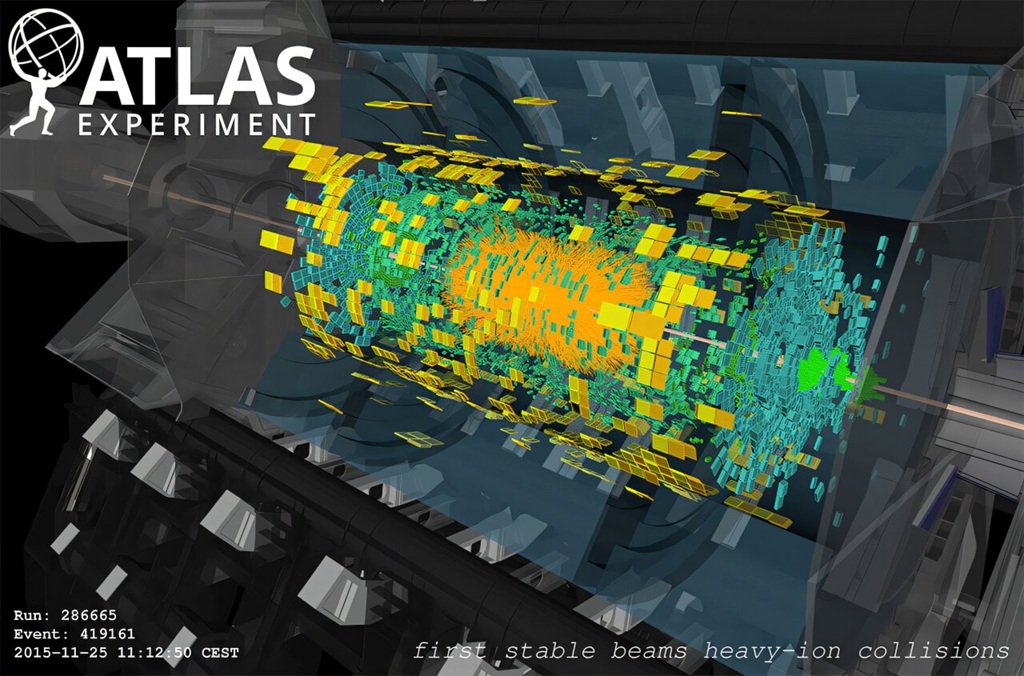 Image from the Brookhaven National Laboratory article ATLAS Confirms Collective Nature of Quark Soup’s Radial Expansion Caption: This is an example of a heavy-ion collision event recorded by ATLAS in November 2015. This analysis used data from the entire 2015 run. Tracks reconstructed from hits in the inner tracking detector are shown as orange arcs curving in the solenoidal magnetic field. The green and yellow bars indicate energy deposits in the Liquid Argon and Scintillating Tile calorimeters respectively. Credit: ATLAS Collaboration.
The original Brookhaven article gives Karen McNulty Walsh and Peter Genzer as contacts, but I’m not sure if they wrote it. I’m note sure what changes PhysOrg made either. Their version, which was edited by Gaby Clark and reviewed by Robert Egan, is a little different but not much. Anyway, the article tells how the an international team used ATLAS data to analyze the radial outflow when two lead ions collide head on. It says the collisions generate temperatures 250,000 times hotter than the Sun. It also said this: “These extreme conditions essentially melt the protons and neutrons that make up the colliding ions, setting free their innermost building blocks, quarks and gluons, to create a quark-gluon plasma (QGP)”. There was more, and then I got the gist. When you collide two gold atoms such that they meet off-centre, you get an elliptical quark-gluon plasma. However when you collide two lead atoms such that they meet head on, you get a more intense spherical quark-gluon plasma. To which my sentiment was so what? Especially since the gluons in ordinary hadrons are virtual. As in not real. Especially since as per Martin van der Mark’s paper On the nature of stuff and the hierarchy of the forces, you can’t fit a 2.3 MeV quark inside a 938 MeV photon. The PhysOrg staff don’t know it, but quark-gluon plasma is like pea soup. There are no peas in pea soup. In similar vein, there are no quarks or gluons in a quark-gluon plasma.
Innovative optical atomic clock could combine single-ion accuracy with multi-ion stability
An article I did like was Innovative optical atomic clock could combine single-ion accuracy with multi-ion stability. The original article was written by Physikalisch-Technische Bundesanstalt. PhysOrg linked to the German version, but there is a version in English. It’s reporting on another PRL paper called Nuclear Spin Quenching of the ²S1/2 → ²S7/2 Electric Octupole Transition in ¹⁷³Yb+. I like it because it’s about optical clocks, and because an optical clock goes slower when it’s lower because light goes slower whern it’s lower. Because the speed of light is not constant. It varies in the room you’re in, just like EInstien said. The article concerns a new improved optical clock. It’s a multi-ion ytterbium-173 optical clock, which “could combine the high accuracy of individual ions with the improved stability of several ions”.
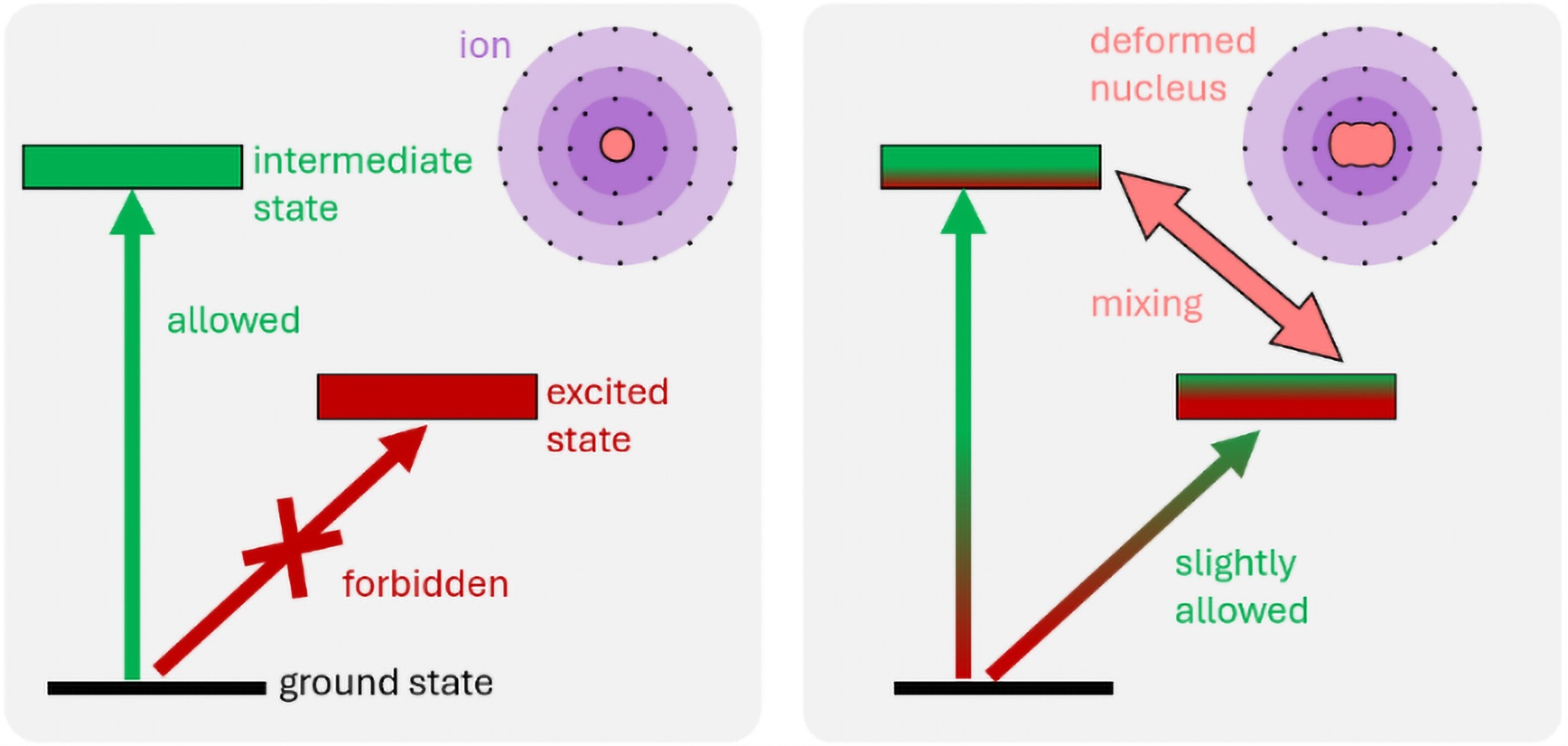 Image from New type of optical atomic clock in sight. Caption: Unlike other atoms (left), ytterbium-173 (right) has a large nuclear spin and a strongly deformed nucleus whose strong fields interact with the electron shell. This turns forbidden quantum jumps into allowed transitions (see red-green arrow “slightly allowed”) and makes it easier to excite the transition with a laser. Credit: Physikalisch-Technische Bundesanstalt (PTB)
It involves an excited state with a very long lifetime, which require a very specific laser frequency, and usually a very strong laser lightm which is problematical. However ytterbium-173 has properties that meant the team could overcome the problems, and “even control several ions simultaneously”. What’s not to like? OK I didn’t like the mentions of quantum computing, but such is life.
Dark Energy Survey scientists release analysis of all six years of survey data
Another article I liked was Dark Energy Survey scientists release analysis of all six years of survey data. This was in the Astronomy & Space section, and refers to a NOIRLab press release. which concerns a paper submitted to Physical Review D. The paper is a summary of 18 supporting papers. I didn’t like the paper much, because it was 41 pages and heavy going, with 172 authors and too many references to ΛCDM for my liking. That’s because I think of dark matter as inhomogeneous space, and dark energy as space itself, responsible for the expansion of the universe as well as the accelerating expansion. But never mind what I think, the DES guys and gals have done the spadework, so fair play to them:
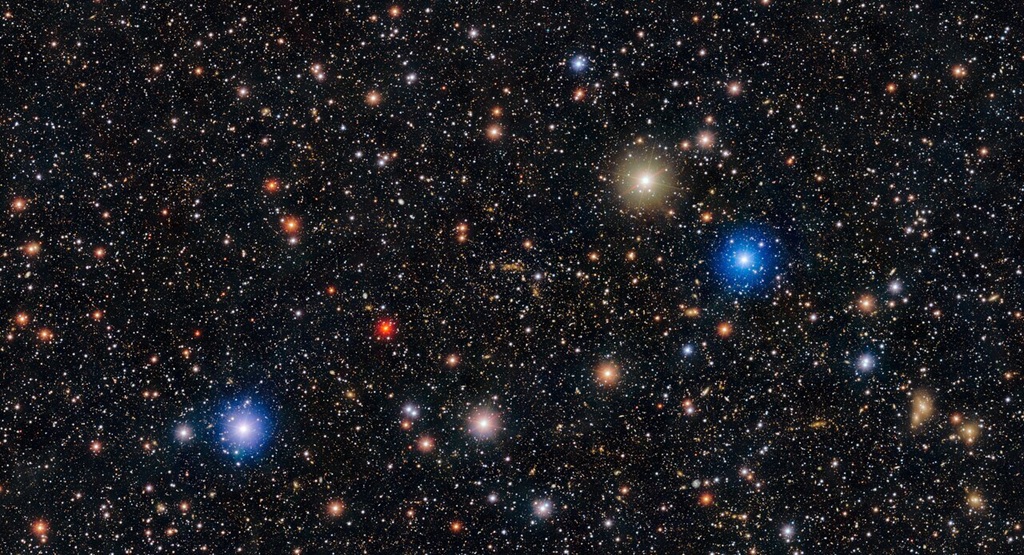 Bullet Cluster image from NOIRLab. Caption: The Bullet Cluster is made up of two galaxy clusters that are colliding, one moving through the other, about 3.7 billion light-years away in the constellation Carina. These galaxy clusters act as gravitational lenses, magnifying the light of background galaxies. This phenomenon makes the Bullet Cluster a compelling piece of evidence supporting the existence of dark matter. Credit: CTIO/NOIRLab/DOE/NSF/AURA
The article tells us how the Dark Energy Survey (DES) is “an international collaborative effort to map hundreds of millions of galaxies, detect thousands of supernovae, and find patterns of cosmic structure that will help reveal the nature of the mysterious dark energy that is accelerating the expansion of our Universe”. There is some debate on that, see The Nobel prize winner who thinks we have the universe all wrong. But regardless, DES observed 669 million galaxies covering one eighth of the sky, and have released results which combine weak lensing and galaxy clustering. They used weak lensing “to robustly reconstruct the distribution of matter in the Universe”, then tested the ΛCDM model and the wCDM model against their data. The latter is where the dark energy density is not fixed, which is what you’d expect from the principle of conservation of energy. Apparently the results fitted the former better, but didn’t rule out the latter. The results did not however fit with predicted galaxy clustering from either model. Hence DES will be investigating alternative gravity and dark energy models. All good stuff. Maybe I should give them a call.
Rule-breaking supermassive black hole discovered in the early universe
There’s lots of other interesting news stories. See for example Rule-breaking supermassive black hole discovered in the early universe. I liked that, because I have a nasty speaking suspicion that supermassive black holes didn’t grow at all, and instead are broken remnants of the pre Big Bang universe. The original article is by the National Astronomical Observatory of Japan.
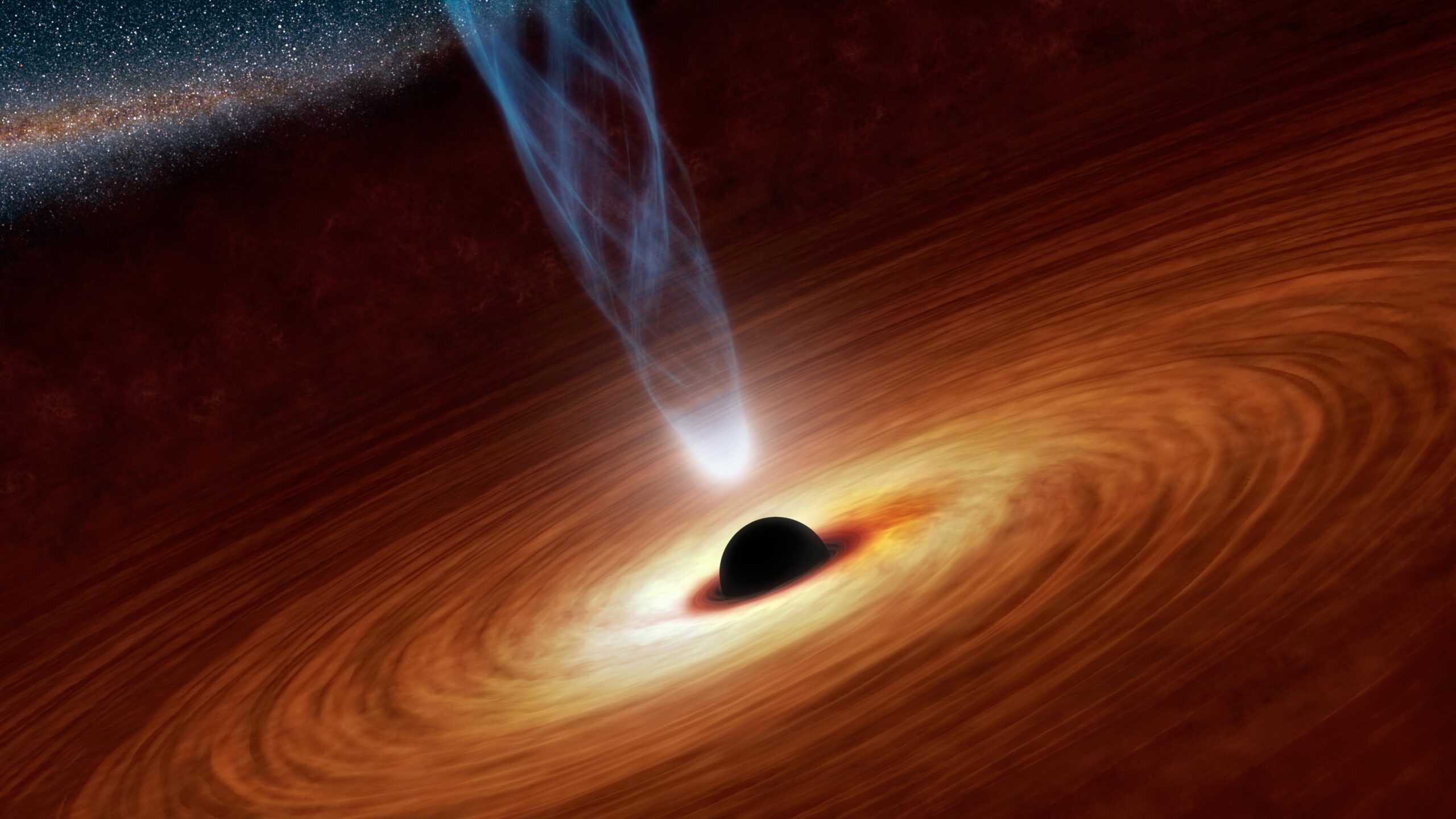 Image from the NAOJ article Theory-Breaking Extremely Fast-Growing Black Hole. Caption: Artist’s impression of a supermassive black hole system. Infalling gas forms a bright corona near the black hole. In some systems, a jet is launched. (Credit: NASA/JPL-Caltech)
The article says “a team led by scientists at Waseda University and Tohoku University used the Subaru Telescope to measure the motion of gas around a supermassive black hole that existed when the Universe was less than 1.5 billion years old and found that it is accreting gas at 13 times the Eddington Limit”. Don’t you just love it when observations demonstrate a problem with a theory? I do when it comes to black holes, because I’ve read Friedwardt Winterberg’s paper on Gamma ray bursts. The associated paper appeared in the Astrophysical Journal, it’s open access, and it’s called Discovery of an X-Ray Luminous Radio-loud Quasar at z = 3.4: A Possible Transitional Super-Eddington Phase.
I recommend it
There’s lots of other gret articles on PhysOrg. See for example EAST achieves new plasma confinement regime using small 3D magnetic perturbations. That’s about nuclear fusion. Bring it on I say. Also see Chiral phonons create orbital current via their own magnetism. I wonder if there’s a parallel between phonons and photons. In addition check out Wormholes may not exist—we’ve found they reveal something deeper about time and the universe. I liked some parts, other parts not so much, because I have a plain vanilla take on black holes. There lots of other stories, far too many to do PhysOrg justice, but I hope this helps. All in I’d say PhysOrg is a cornucopia of science. Yes, some of the stories are hype, and some don’t pass the Physics Detective test. But that’s science for you. That’s life, and like I said, it isn’t PhysOrg’s job to filter out the bad stuff. I think it’s a good website. I recommend it. Well done PhysOrg.
Dear The Physics Detective,
I like PhysOrg, too. There is another aggregator I am checking every day: Science Daily. Many astrophysics news appears simultaneously in both of them
Many thanks Dmitriy. I was thinking maybe I should mention Science Daily in this article. But in the end I thought I would cover them separately in a different article. I should write about New Scientist too. And put them all on my Blogs page, which I should retitle. Along with the YouTube video channels I was talking about last time. So much to do!
Way Cool coffee beans, I always wondered if Civet Cats where the only pre-digested fermented dung beans! I know my local population of wyld o’possums would eat coffee beans, but would they be keen on potty training?
The advances in Cosmology are always great reads, but the links on Phonons was by far most educational and interesting. It’s really enlightening to think that a mostly electromagnetic process turns into a mechanical process can generate a new and novel electron flows creating magnetic fields. More reading is definitely needed by me.
Lastly, I also learned up a new word: Churnalism. A concept I agree with, and more importantly have practiced.
So I offer up a reverse/inverse new word : Fanalism. Fanalism is defined as a fan, reader, or commentor of mass produced public media sites that are basically intentionally picked; mostly as a form of Conmformation Bias. A subject we have both commented on in earlier postings.
Kudos as always, John !
The thing is Greg. is that an electromagnetic process is a mechanical process. Or at least that’s what I think. Space is this fundamental gin clear ghostly elastic thing, and an electromagnetic wave is a literal wave in space. But electron flows don’t “create” magnetic fields. They ARE magnetic fields. It’s all down to twist and turn. An electron is a place where space is twisted, and if you move through it or it moves through you, you would say space is turning. A magnetic field is a “rot” field. Look it up. Rot is for rotor. A magnetic field is a rotor field. A turn field, if you prefer. Because electromagnetism is all about twist and turn. And as I am so fond of saying, it’s all much simpler than you think.
Thanks for the clarification John, I knew my initial interpretation was off. Plenty of great reading to continue though, and also am patiently waiting for your next article with most excellent links to explore.
I finally decided that it’s time to cancel my experiment of a paid Dr. Sabine account and switch to someone much more deserving: Dr. Unzicker !
Hopefully we all will be able to monthly support a Physics Detective 🕵️♂️ Blog in ’26 ?
Good man Greg. Alexander Unzicker will give you some interesting stuff. Sabine Hossenfelder won’t. Her physics knowledge is scant, and she hasn’t learned much over the years. Nowadays her videos are just so lightweight, and IMHO rather unoriginal. I think she made a mistake when she decided to do a video a day. As for this here Physics Detective blog, I’m thinking of getting into videos, because the audience seems to be so much bigger. But I won’t be asking for a subscription.
John, nice article and thanks for the summary! Must have been alot of reading. Your article brought up 2 points I’m interested in discussing:
.
1) In the ATLAS experiment and these colliders, assuming the wave/light nature of particles theory is true (which I definitely think it is), then what do you think they are actually measuring? If the double spinner of an electron or the trefoil knot is literally blown apart into fragments then are they just ephemeral fragments of light that are being picked up by the detector? Like some type of electromagnetic energy that is not in wave form but just randomly scattered or linear, and then immediately absorbed by other nearby particles?
.
2) Your view of dark matter and dark energy is really interesting. So space is this gin clear elastic solid and in absence of ordinary matter or dark matter that is homogeneous and isotropic. Ordinary matter (electrons and protons) are knotted lightwaves and when concentrated into physical tangible amounts they make the surrounding space more ‘dense’. But your thought is that Dark matter is space that is intrinsically inhomogeneous without the presence of ordinary matter? Then your thought is that Dark Energy is the energy stored within the space itself? Like they say there is an edge of the universe beyond which there is actually nothing, but that as the universe expands it’s really the dark energy/space which is filling that void? Would love for you to expand on these two points in your view, or clarify my simple summary…
.
Love coming back to your page. Thanks!
Thanks Andy. Sorry to be slow replying, we have company. Re collider experiments, IMHO what they’re detecting is an unstable region of high density space. That’s what I think a quark/gluon plasma really is. I think a photon is a region of high density space too, but not nearly so intense, and in the form of a stable soliton “pulse” with a twisted E=hf transverse wave nature. See The photon. If I sent a zillion photons from star A to star B, the gravitational field of A would be diminished and the gravitational field of B would be increased. That’s because IMHO a gravitational field is a region of space where there’s a density gradient.
In the collider the unstable region of high density space disintegrates into stable photons and neutrinos, which are similar to photons, which depart at the speed of light. When they do this, they can get tangled up and form knots which we know as electrons and protons, and they can interact with surrounding particles.
Re dark matter, I think it’s just regions of denser space. Yes, I think space can be inhomogeneous without the presence of ordinary matter. Especially if the expansion of the universe is non-uniform. That would leave you with some regions of space that are denser than others. However when it comes to galaxies, we say they are “gravitationally bound”. So it looks to me as if the matter that makes up a galaxy stops the space of the galaxy from expanding, so it ends up denser than the intergalactic space. I should add that matter is just a photon in a closed path, and a photon is a region of denser space too. See Einstein’s 1930 Nottingham lecture where he said this: “it appears that space will have to be regarded as a primary thing and that matter is derived from it”.
I don’t think Dark Energy is the energy stored within the space itself. I think it is space itself. It looks to me as if space and energy are the same thing, and the only thing. Waves run through it, they get twisted and tangled up as matter, and that’s that. See William Kingdon Clifford’s Space Theory of Matter. As for the edge of the universe, see my article on that: https://physicsdetective.com/the-edge-of-the-universe/. I think the universe has to have an edge because it’s expanding. But I also think that there is no space beyond the edge of space. There is no void. There is nothing beyond the edge of space, and no place beyond the edge of space, because space is all there is.
Thanks John, really interesting. I like the concept of Dark Energy as Space itself. This would mean that the ‘ether’ which we consider is space is also dark energy, so Dark Energy is the Ether? This would be a nice full circle, because Dark Energy is somewhat accepted in main stream physics, but Ether is not. So this could would be a nice rejoining to consider the Ether is also termed Dark Energy.
Your concept of Dark Matter is also interesting, so I guess one analogy is like baking a loaf of bread as it expands you can get denser regions and less dense air pockets. It would be a misnomer then since its not really matter, its just inhomogeneous space or inhomogeneous Dark Energy. As the universe rapidly expanded there could have been some regions of space/dark energy that were more dense and other pockets that were less dense. Would a random area of relative increased ‘density’ then attract photons and other matter and then perhaps form a Nebula or Galaxy? The ‘denser’ space would slow down and attract particles traveling through it and act as a gravitational source. The more it attracts the more dense it becomes and more gravity it has eventually resulting in a galaxy. Density is not a great term here as it is really a change in the electric permittivity and magnetic permeability. Isn’t the fact that a total vacuum has a non-zero permittivity and permeability direct evidence of an either of space?
Andy: yes, I think Dark Energy is the ether. See an older version of the Wikipedia Aether Theories article. Nobel prizewinner Robert B Laughlin talked about it, and said it’s a shame it’s taboo. Sadly some Wikipedia thought-police editor has now censored that. Note though that many cosmologists will tell you that dark energy is responsible only for the accelerating expansion of space, and not the expansion of space, which I think is a mistake.
Yes, the raisin-cake analogy is pretty good. The cake expands but the raisins don’t, and they represent the galaxies. The expanding universe plus conservation of energy and gravitational binding means every galaxy is embedded in a region of “denser” space. And any concentration of energy causes gravity, not just matter.
Yes, I think a random area of increased density would result in the formation of a galaxy. Gravity will intensify any initial density variations. And yes, the fact that the vacuum has a non-zero permittivity and permeability is direct evidence of an ether. Something as simple as a magnetic field is too. As is a gravitational field. In 1929 Einstein said a field is a state of space. Have a read of Does matter differ from vacuum? by Christoph Schiller. The answer is no. An atom isn’t 99% empty space. It’s 100% empty space.
Nice, 3 yesses! I think I can go to the next round! 😉 Kidding aside these are really key points though and deserve some airtime. Wonder what others would think about this.
.
Thanks for linking the Does Matter differ from vacuum paper by Christoph Schiller. I skimmed through it. Overall he seems to want to just deconstruct all theories, which is a bit much, but he has some interesting points. One thing that he and many others refer to as key for a grand unified theory is ‘quantum gravity’. I am so sick of hearing about quantum gravity and how it hasn’t been solved yet. What they mean is that it hasn’t been fully cooked or made up yet. There is no god damn graviton particle or quantitized gravity that exists. Gravity is uniform, it doesn’t matter where or when you approach a gravitational field, it just exists uniformly. So some cockamamy graviton particle or quantum gravity theory would literally have to be infinite, just infinite graviton particles emanating from everything everywhere, it’s just such a total crock of shit. And then a single graviton only gives some discrete quantized force of gravity to another object?? Just ridiculous. I guess they are going to add another made up tin foil hat particle to the “Standard Model” to include Quantum gravity.. Such a joke.
Sorry about the quantum gravity. As you say, there are no gravitons. What’s worse is that there are no messenger particles at all. There are no virtual photons. There are no W-bosons or Z-bosons. There are no virtual pions. There are no gluons. Check out the Wikipedia gluon article which says the gluons in ordinary hadrons are virtual. That’s as in not real. Also see Cathryn Carson’s two part paper on the peculiar notion of exchange forces. She says the exchange-particle idea worked its way into QED from the mid-1930s, even though Heisenberg used a neutron model that was later retracted. That means the Standard Model is a joke too. As is modern General Relativity, which has censored Einstein’s variable speed of light. Sadly when it comes to physics, and to some extent cosmology, we are living in a cargo-cult dark age.
Interesting. The Bulk Modulus of Space is actually a function of the Fine Structure constant and ends up being the same as the proton. The confusing part is they overlap so effectively the space where the proton is, seems twice as dense. But think of it as ice in your ice tea. One is hard, and resists being pushed, the other moves out of the way of your straw. But since it is non-viscous it moves out of the way at the speed of light. But https://tracyphasespace.github.io/QFD-Universe/visualizations/field-theory/vortex-dynamics.html Photons are the Toroid that were mentioned in the other blog, Electrons are Hill’s Vortex Sphere but cavitating. Hill and Kelvin made a mistake thinking they were denser.
Tracy: I think they’re related, and not the same as the proton. To appreciate why I say this, I would urge you to start with the electron. I’m pretty sure it’s akin to your animation of the vortex ring and your animation of the Hill vortex sphere, but with a toroidal rotation as well as a poloidal rotation. It’s like a torus that’s so fat it looks spherical. And that’s just the centre of it. It’s not quite Hill’s spherical vortex, but no matter. I think the guys from that period, including Thomson and Tait, were ahead of their time. IMHO it’s a pity the vortex atom was dropped, and was not applied to quantum mechanics in the 1920s. See what you make of this. Ah, I see from your email that you are. Good luck with your QFD.
You are right, I just haven’t gotten the Animation updated in a way that is presentable. The Sketch you showed is cleaner, because the lines get all messed up when you try to show both Poloidal and Toroidal.
The sign of Consilience is when you are right and other things are explained. Or at least others agree with you. I was mentioning that the Martin van der Mark image is Exactly Right, for the photon with the ratio of the poloidal to toroidal flow is polarization, but for reasons that they would have been able to explain better than I, for stability you can’t just have random ratios. They have to have the Helicity / Chirality so they complete loops in 2pi.
This forces structure, but not radius, so you can have any wavelength (2pi time radius, Photons are HUGE). I’ve found the equations fit all the Maxwell’s laws and many other ‘tired’ ideas. But the key is the Toroidal Soliton Gives both the Point and Wave Behavior!!!
Similarly, Hill and Kelvin solved the knots around 1894, but they were thinking of them as Solids, where I’ve found the math works if they are more like whirlpools, with the cavitation limit making the most you can get as -1 charge.
Make sure you look at all the animations, and suggest improvements, like adding the Poloidal and Toroidal turning into helical lines.
Also of note that one of your other pages has and I’ll have to study to gain intuition is the fact that this Cavitating Hill Vortex Sphere Electron has to have two rotations (1/2 spin) to return. I have been puzzling how to draw it and then I find – Valeriy Sbitnev drawings which are helpful.
When the photon reaches the limit of energy to get further up and become an electron it has to fold over itself and twist like your Mobius strip. I need to figure out how to animate that, but then the Diameter of the Vortex sphere electron is 386 fm or 1/2pi the Compton Wavelength. And if it isn’t clear, now Spin is mechanistic at that radius. It’s just a 772 fm flywheel sphere.
Sorry to be slow replying Tracy. I find it amazing how difficult it is to get a handle on three dimensional dynamical geometry. For example, how do you describe a tornado mathematically? Then how do you describe a vortex with two orthogonal rotations? I agree you can’t have random ratios. But I think h is the reason why. It’s common to all photons, such that E=hf. Some people will say it’s just a conversion factor between frequency and energy, but I think it’s more than that. The dimensionality of action can be expressed as momentum times distance, and I think it’s the same distance for all photons. The same amplitude. And if you want a stable vortex, the diameter has to be related to the amplitude. However I’m talking about the electron here, not the photon. An electron where the all-round curvature is seen as unit charge. As for the photon, see what you make of https://physicsdetective.com/what-is-a-photon/ along with https://physicsdetective.com/the-photon/. It sure would be nice to see an animation of a wave spiralling through space. If you have such an animation, please tell me which one it is. Have a look at Adrian Rossiter’s animations to gain intuition about the two rotations. IMHO it’s easy once it clicks.
I make no pretense to being knowledgeable about U.K. politics. So is following article legit and to what extent?
I do know that the Epstein clusterfuck has it’s slimey tentacles into your P.M.’s cabinet. Even that douchebag Fergie is prominently mentioned numerous times.
As an American, I am most definitely concerned about Thiel, Karp, Musk and all things Big Brother.
Read “NHS contractor Palantir will suffer $200bn wipeout, says Big Short investor” on SmartNews: https://l.smartnews.com/p-79Z1dUSk/hllr3Q
I don’t think it’s legit, Greg. The Telegraph is something of a globalist newspaper that’s forever running ant-Trump hit pieces. The NHS here in the UK is failing the public because it’s now run for the benefit of its staff. A lot of doctors are on duty for only three mornings a week. The rest of the time they’re “working from home” allegedly “doing admin”. If you’re unlucky enough to have to go to A&E you will wait for hours because there’s only one doctor on duty. That’s in a hospital that serves half a million people. We have similar issues throughout the public sector. Things are getting pretty grim here in the UK, and the Telegraph plays it down because it started under the Conservatives.
Thanks John, one of my favorite FB feeds is Irish Star USA, which has a Manhattan address. And in turn is owned by Reach PLC , located within the citadel of One Canada Square, Londonminium. So, because of healthy skepticism, I do my research on all of my news sources to begin with, with The Physics Detective being one of a few truly legit science sources on my personal list. And you personally for correct interpretations on British politics.
My pleasure Greg. I had a look at https://www.irishstar.com/. It seems very political, which I wasn’t keen on. And dishonest. See this story for example: https://www.irishstar.com/news/ireland-news/citywest-riot-dublin-immigration-ireland-36119559 . They don’t say that it was an anti-immigration riot. Also, the website seems to have a presumption that everybody of Irish descent in the USA must share the same views. Perhaps I could tell you something about Irish politics too. And propaganda.
Ha ! The joke is on them : 1. Their algorithms reach out to me first on Google.
2. It’s a low hanging fruit kinda website to begin with.
3. And most humoursly, in reality my ancestry is proudly Pictish-Scottish via Switzerland 🇨🇭😀!
This seems worth investigating more :
https://cns.utexas.edu/news/research/physicists-discover-long-predicted-clock-magnetism-atomically-thin-crystal