I just love this time of year. The Sun is shining, the flowers are blooming, the bees are buzzing, and the birds are singing. I think they’re happy. Like the children we hear at playtime in the nearby school. Like the robin that fluttered around me as I weeded the front border on my hands and knees.
 Flowers in my front border
Spring is a time of optimism and promise¹, with so much to look forward to. I look forward to picnics on the beach, sundowners on the porch, a trip to Swanage on the open-top bus, and more. I feel optimism and promise when it comes to fundamental physics too, because like I’ve been saying, there’s more and more people thinking along the same lines as me these days.
Particle discovered at CERN solves a 20-year-old mystery
However that’s no thanks to New Scientist, and no thanks to CERN. Take a look at Particle discovered at CERN solves a 20-year-old mystery. It’s a New Scientist article written by Alex Wilkins dated 17th March 2026. It announced the discovery of the Ξcc⁺ particle by the LHCb collaboration at CERN. It’s what’s known as a double-charmed Xi baryon. You say it as “Xi-cc-plus”, the Xi being pronounced “sigh”. Try it out for size: sigh see see plus. Anyway, unlike most New Scientist articles, it isn’t paywalled. Similar articles appeared on other science websites, such as Science Daily, Scientific American, Science Alert, SciTechDaily, Interesting Engineering, PhysOrg, Futurism, and Universe Today. Most of them refer to a CERN press release called LHCb Collaboration discovers new proton-like particle. Some refer to a University of Manchester press release. Some refer to a Guardian article called Scientists discover heavier version of proton with upgraded detector. Most of them use an image provided by CERN, which shows an artist’s impression of the Xi-cc-plus:
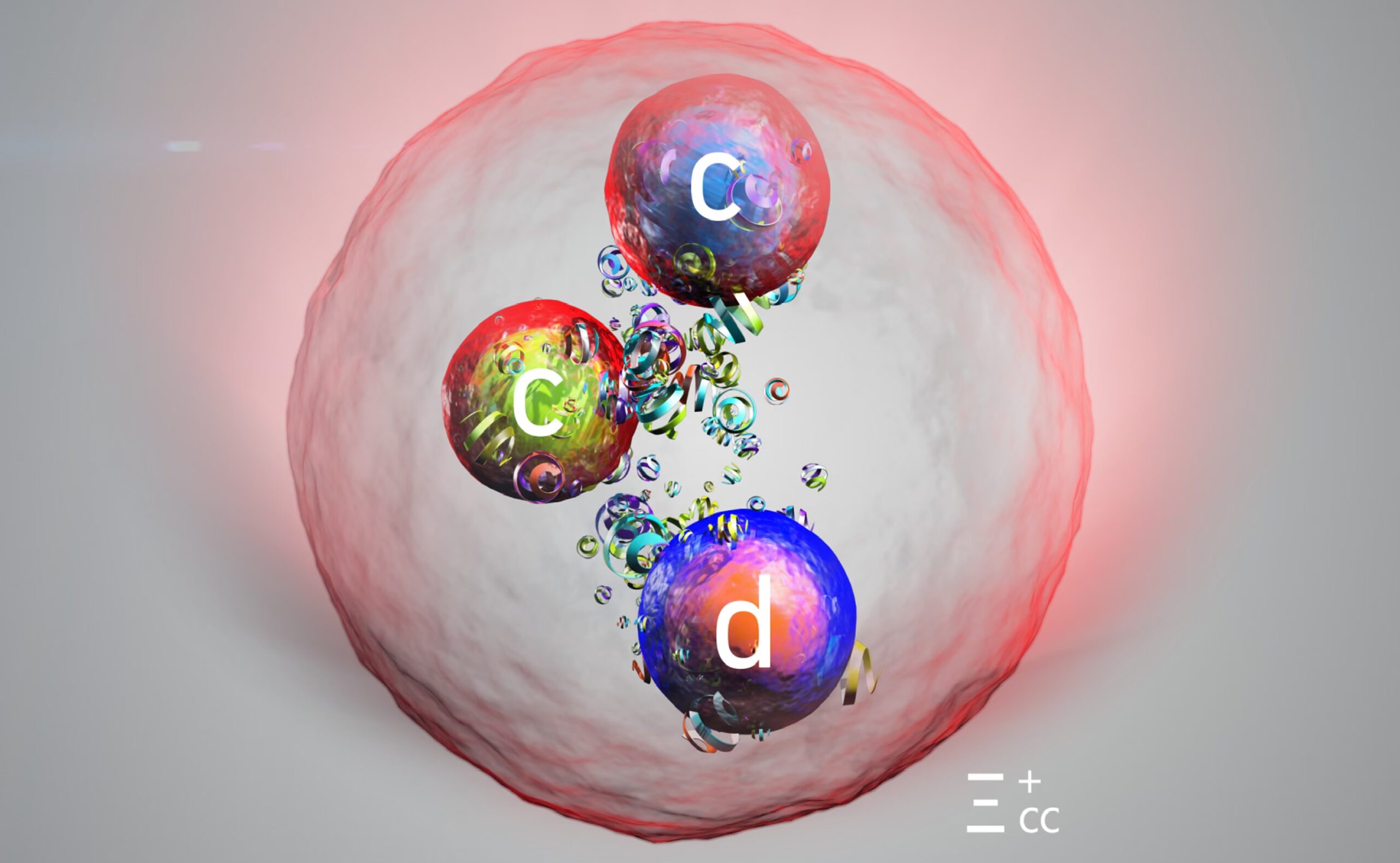 Caption: Artist’s impression of the new particle, which contains two charm quarks and one down quark. (Image: CERN)
They all say the LHCb collaboration has announced the discovery of a charm-quark version of the proton. You will of course be aware that the LHCb collaboration consists of 704 physicists from 69 different institutions and 17 different countries working on the LHCb experiment at CERN. The b stands for beauty.
A heavier and more charming cousin to the proton
The strapline on the New Scientist article spells it out: “Physicists working on the LHCb experiment have spotted an elusive and fleeting particle, a heavier and more charming cousin to the proton, that has been sought for decades”. There follows a picture of the LHCb experiment cavern at CERN:
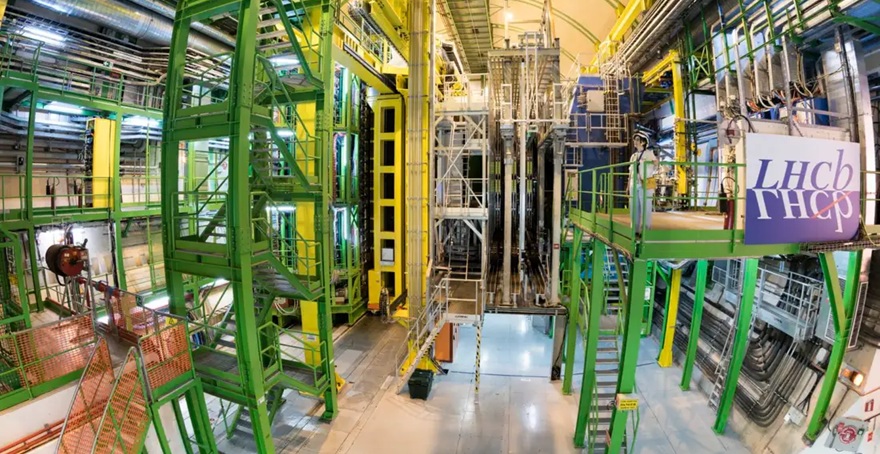 Image from New Scientist, caption The LHCb experiment cavern at CERN, CERN/Brice, Maximilien
The article proper starts by telling us that “a new particle has popped into existence at CERN’s Large Hadron Collider, a heavier proton-like particle that contains two charm quarks”. It goes on to tell us that protons and neutrons are baryons, which each contain three quarks, which come in a variety of flavors. It says “In the case of a proton, there are two up quarks and one down quark that make up the particle”. It then says heavier quarks like those known as charm quarks, can also combine to make baryons. It goes on to say “because these unusual quark combinations are heavier and so more unstable, they often have fleetingly short lifetimes and quickly decay into other particles”. It doesn’t say why a heavier particle should be unstable. That raises an eyebrow, because the proton mass is circa 1,836 times the mass of the electron, and both are stable.
A heavier analogue of the proton
The article goes on to tell us that in 2017, physicists working at CERN’s LHCb experiment glimpsed a particle made up of two charm quarks and an up quark. This was the Xi-cc-plus-plus. Then it tells us that they’ve now glimpsed a sister particle made up two charm quarks and a down quark, “making it a heavier analogue of the proton”. The article goes on to say this Xi-cc-plus particle has very short lifetime, and was only detected after the LHCb experiment was upgraded. It also says this: “The finding has a statistical significance of over 7 sigma, a measure that physicists use to state how confident they are that the result isn’t a random fluke”. Seven sigma, I hear you ask. What’s a statistical measure doing in a particle discovery? I’ll come back to that.
We are left not particularly illuminated
The New Scientist article then quotes Chris Parkes from the University of Manchester². He says the Xi-cc-plus has been searched-for for a long time, and that it “shows the power that these upgrades to the LHC are having”. The article also quotes Parkes saying “In one year’s data sample, we were able to see something that we couldn’t see with 10 years of data from the previous generation”. It then says spotting this particle could teach us about the strong nuclear force, and it also solves a 20-year-old mystery. That goes back to 2002 when Fermilab physicists thought they’d spotted a particle like the Xi-cc-plus, but at a much lower mass than predicted. Parkes says they’ve found it at a mass similar to its [isospin] partner particle, and that “The strength of the new discovery closes the door on the question of this particle’s mass”. The article ended with some obligatory “balance” from Juan Rojo at the Vrije University in Amsterdam. He said this: “There is no rule in quantum chromodynamics which prevents this hadron from existing, but now we’ve measured it exists, we are left not particularly illuminated”. That’s because “our current theories don’t predict well how heavier quarks inside baryons should interact or what their masses should be”. Quite. I’ll come back to that too.
 CERN Globe of Science and Innovation image from New Scientist
There was then an image of the CERN dome, which is a visitor centre. I was wondering why it was there, but it turned out it was part of an advert for a 6-day tour of CERN with prices from £2,979. Regular Physics Detective readers will be bitterly disappointed to learn that it is now sold out.

The massive problem of trying to fully explain what mass actually is
Another advert in the article was for another New Scientist article called The massive problem of trying to fully explain what mass actually is. This was paywalled, but I was interested, so I paid a £10 short-term subscription to find out more. It was written by Chanda Prescod-Weinstein and dated 21st June 2023. She started off by talking about spacetime and the rubber sheet analogy, saying a ball on the sheet causes it to curve, which then “literally shapes where the ball will roll”. I was a little irritated by that, because it’s wrong. The spacetime gradient causes light to curve, not the curvature. Matter is similarly affected because of the wave nature of matter. She then says she thinks it’s strange that no one ever follows up by asking “but what is mass?” Huh? It’s resistance to acceleration. Everybody knows that. Then she gives a dictionary definition which says mass is a quantity of matter, which it isn’t. Then she says mass is conserved, which it isn’t, and then she asks why the elementary particles have mass. After that she says the best description of nature at this scale is the Higgs mechanism, “which interacts with leptons like the electron as well as quarks in a way that leads to them developing the inherent property of mass”. It’s total horseshit from somebody who doesn’t understand gravity or mass and has obviously never heard of E=mc². Einstein didn’t say mass was something mysterious. He said “the mass of a body is a measure of its energy-content”. That was in 1905, in a his famous paper Does the inertia of a body depend upon its energy-content? Yes it does, even when that body is an electron, which Einstein mentioned on page 2. That’s because of the wave nature of matter. As Martin van der Mark³ said in Light is Heavy, you can think of the electron as a 511 keV photon in a gedanken mirror-box. The box is harder to move when the photon is in there, because you have to push against the photon momentum on the near side of the box. Open the box and it’s a radiating body that loses mass, as per the last page of Einstein’s paper. This is not some fringe theory, it dates back to the 1920s when the quantum realists talked about the electron as a wave in a closed path. But it seems that Chanda Prescod-Weinstein doesn’t know any of this, and is peddling ignorance. Where do they get these people?
QBism
A further advert in the Xi-cc-plus article was for a New Scientist article called Forget the multiverse. In the pluriverse, we create reality together. This talked about a radical idea which “resolves many quantum paradoxes” and “suggests there is no objective view of reality”. Author Jo Marchant, who has clearly never thought about the nature of time, starts by asking What is now? She says there’s a paradox because now is the only time we can act, but the conventional view of physics is that now doesn’t actually exist at all. She then refers to Einstein and claims that all events and times already exist. Then she refers to her book In Search of Now, along with Wheeler and the double-slit experiment, the multiverse, quantum mechanics, quantum computing and something called QBism:
 Image from The Participatory Cosmos: How QBism Unifies Science, Spirituality and the Nature of Reality, by Ultra Unlimited
QBism, it would seem, is all about “recasting quantum states as states of belief”. Apparently whales and other living beings take part in creating reality through their beliefs. FFS. Again, where do they get these people? This article is fucking mysticism. It is gobsmacking nonsense. It is jaw-dropping woo.
They’re in the pseudoscience business
But that’s the trouble with New Scientist these days. They don’t inform their readers about science. They peddle myth and mystery and moonshine. They’re in the pseudoscience business, pumping out cargo-cult claptrap and lies-to-children. The trouble is that CERN are too. It’s not quite so obvious, but the clues are there. Like the claim that a heavier particle is unstable, and the seven sigma. There’s also a clue in Five of the biggest unanswered questions about the proton. There was a link to this in the Xi-cc-plus article. It’s a 2023 New Scientist article by Harry Cliff, and the five questions are what are protons made of, how big is a proton, how stretchy is a proton, how often do protons collide inside a nucleus, and are protons eternal. I would say that the answers are light, indeterminate, it isn’t, never, and yes. But that’s not the point. The point is that CERN can’t answer these questions because they don’t understand the proton, because they wilfully ignore the hard scientific evidence. Proton-antiproton annihilation can result in gamma photons. Yes, it’s more usual to see pions, but they decay to neutrinos and electrons, which you can annihilate with positrons to yield photons. So the lowest common denominator is photons, along with neutrinos. Which are similarly massless, chargeless, and as far as we can tell, always move at the speed of light. What you never ever see is quarks. Ever. So the basic building blocks can’t be quarks, can they? Not only that, but the quarks are said to be held together by gluons, only the gluons in ordinary hadrons are virtual. As in not real. As in do not exist. Ever seen a gluon? No. Nobody ever has.
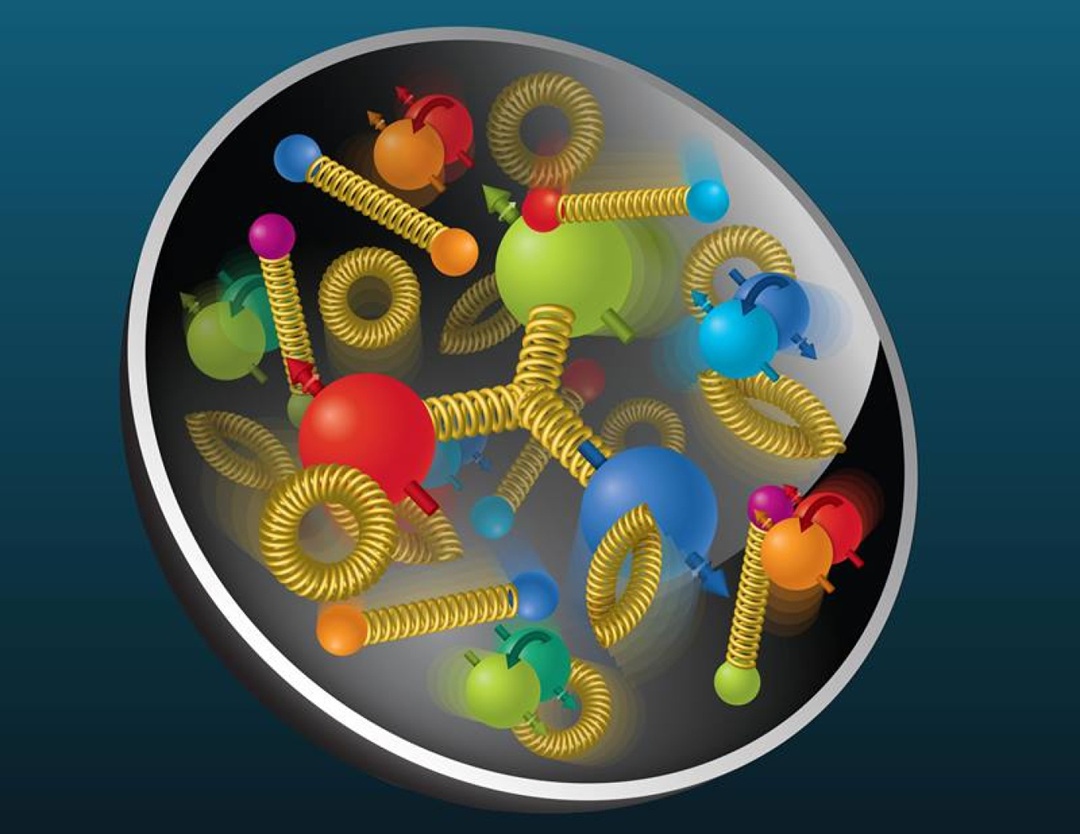 BNL proton image from the DoE website article Theorists Propose a Novel Way to Measure Gluons’ Orbital Motion
If that isn’t enough, the up-quark mass is said to be 2.3 ± 0.7 MeV, and the down-quark mass is said to be 4.8 ± 0.5 MeV. Those are huge error margins and the masses are miniscule compared to the proton mass of 938.272046(21) MeV. Not only that, but as per Martin van der Mark’s paper On the nature of stuff and the hierarchy of the forces, the wave nature of matter means you can’t fit a 2.3 MeV quark inside a 938 MeV photon. And yet CERN will tell you a proton is composed of two up quarks and a down quark. Then they’ll tell you, with a straight face, that they’ve discovered a particle like a proton, which they don’t understand, but with different quarks, which nobody has ever seen. What gives? CERN will try to wriggle out of awkward questions by telling you they were just trying to keep it simple. They aren’t. They’re trying to pull the wool over your eyes, dear taxpayer⁴.
The Standard Model of particle physics is wrong on multiple counts
They know there are serious issues with the quark model. They know that the Standard Model of particle physics is wrong on multiple counts. But they will never admit it. They’re in a hole, and instead of coming clean and climbing out, they keep on digging with particle “discoveries” like the Xi-cc-plus. What did they actually see? Take a look at the CERN press release LHCb Collaboration discovers new proton-like particle. It says the LHCb experiment discovered a new particle with a similar structure to the proton, but “with two heavy charm quarks replacing the two up quarks of the proton, thus quadrupling its mass”. No mention of quark masses there. What they say instead is this: “These unstable hadrons will quickly decay, but the more stable particles that are produced as a result of this decay can be detected and the properties of the original particle can therefore be deduced”. So they didn’t actually see the Xi-cc-plus. They inferred its fleeting existence. A fleeting existence that’s so very fleeting that you don’t know it existed at all.
They “discovered” the W-boson by detecting an electron
They’ve been pulling this stunt for more than forty years. See the January 2003 physicsworld article Carlo Rubbia and the discovery of the W and Z by Gary Taubes. They “discovered” the W-boson in 1983 by detecting an electron. What did they detect this time? A bunch of known particles. Take a look at the CERN news article. The title is “Observation of the doubly charmed heavy proton Ξcc⁺” but that’s not what they observed. They observed decay products. It’s like saying you observed the Loch Ness monster because you found a bone on the beach. It really is. The CERN news article says the Xi-cc-plus “was spotted through its decay into three lighter particles”. The Xi-cc-plus baryon allegedly has a lifetime of less than 3 x 10⁻¹⁴ seconds. It allegedly decays into a Lambda-c-plus baryon Λc⁺, a negative kaon K⁻, and a positive pion π⁺. The Lambda-c-plus baryon allegedly has a lifetime of circa 2 x 10⁻¹³ seconds. It allegedly decays via an 80 GeV W-boson, which allegedly has a lifetime of 3 x 10⁻²⁵ seconds, into a positive proton p⁺, a negative kaon K⁻, and a positive pion π⁺. The negative kaon has a lifetime of circa 10⁻⁸ seconds, as does the positive pion, whereafter you’re left with electrons, neutrinos, and photons. At no point did anybody actually observe a Xi-cc-plus baryon. They didn’t even see a quark or a gluon. Because it’s all ephemera. And as per the fabulous Higgs boson, the “evidence” for the Xi-cc-plus is just a bump on a graph:
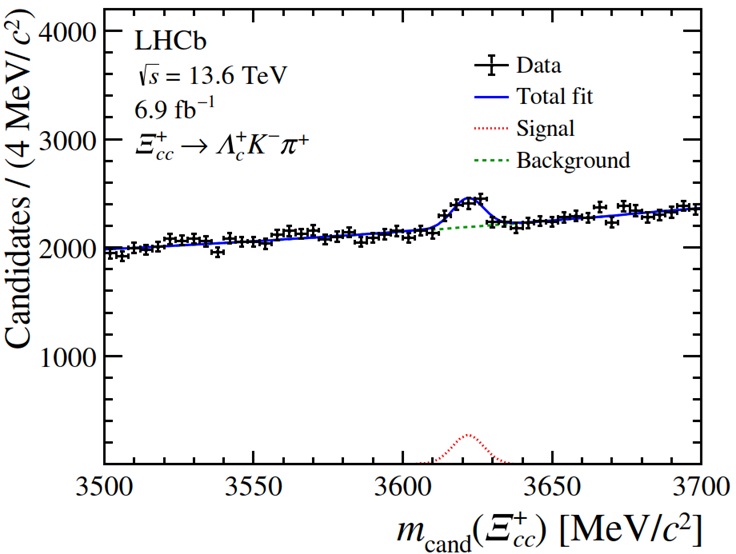 Screenshot from the CERN news item Observation of the doubly charmed heavy proton Ξcc+.
There are lies, there are damn lies, and then there are statistics. Imagine you’re a medieval king of a country besieged by enemies. You hear rumours of a war-winning superweapon called black powder. So you procure a sample from China at great expense. Then you set your alchemists to work, to learn how to make it. Fifty years later after shedloads of gold your treasury is empty, your alchemists are still cataloguing firework explosions, and the barbarians are at the gates. That’s where we are with particle physics. Only worse. Because the alchemists won’t let Friar Bacon, who knows a thing or two about nitre, anywhere near the king.
It’s all just the same old irrelevant useless pseudoscience that gets in the way of the real thing
Sigh. There’s no paper as yet, but there is a PowerPoint presentation. However you won’t learn much more. It’s all just the same old irrelevant useless pseudoscience that gets in the way of the real thing. People are tired of it. They don’t want to pay for it any more. Hence the Guardian article says what it says. It starts with the usual twaddle about recreating the Big Bang in a collider, saying the newfound particle should help physicists refine their understanding of the strong nuclear force. Refine? They don’t understand the nuclear force at all, just as they don’t understand the proton. They don’t even understand spin, never mind isospin. They don’t even understand charge, never mind color charge. The Guardian article then says the discovery comes as the UKRI faces fierce criticism for its plans to pull £50m from the LHCb. And that UK particle physicists have been told their grants will be slashed following cost overruns. My heart bleeds. These guys are guilty of scientific fraud. They’ve been doing it for years. Decades, while blocking the likes of Williamson and van der Mark. If I had my way, every last member of the LHCb collaboration would be incarcerated in an orange jump suit and made to perform dance routines. It would be a lot more useful than what they’re doing now.
 Screenshot from the YouTube video Cebu’s dancing inmates perform for public again after over 2 years
1 It’s a time of optimism and promise so long as World War III doesn’t kick off. Et cetera. But look back at history and you will appreciate that the world has always been full of conflict. So enjoy your time in the sun.
2 I have a Computer Science degree from the University of Manchester. Sadly it isn’t what it used to be. They demolished modern buildings like the Maths Tower to go for the Ivy League look, but it didn’t work and the campus now looks scruffy. Moreover they are super woke, and they’re into the immigration business rather than the education business. Hence they’ve fallen down the UK rankings to 28th position. Hence Ernie Rutherford, who discovered the proton at Manchester, must be turning in his grave. They are not on our son’s shortlist.
3 Sadly Martin van der Mark is no longer with us. He was the co-author of Is the electron a photon with toroidal topology? Sadly his co-author John G Williamson is no longer with us either. See Quicycle.com.
4 Imagine the BBC was the only TV channel. Imagine The Guardian was the only newspaper. Imagine the UK was something like Cuba. That’s what particle physics is like.
John, unfortunately it gets even worser from CERN !
https://youtu.be/XzBP-VtDNHM?si=m4VV1o58ckTGrgEV
The world’s first Sigma Level Manure Transport!