1964 was an important year for particle physics. See the CERN Courier article Nineteen sixty-four. It all started on January 17th with An SU₃ model for strong interaction symmetry and its breaking. This was George Zweig’s 24-page CERN preprint. It said mesons and baryons were composed of fractionally-charged fundamental particles called “aces”:
 Image from An SU₃ model for strong interaction symmetry and its breaking by George Zweig
Also see Zweig’s historical piece on the Origins of the Quark Model for some background. For some further background on the quark model, see From concrete quarks to QCD: a personal perspective by Chris Llewellyn Smith. He talked about Robert Serber¹, who had explained his component-particle idea to Murray Gell-Mann over lunch the previous March. Gell-Mann was apparently dismissive because it would demand fractional charges.
The quark model was born
Gell-Mann had been Zweig’s mentor at Caltech, and was of course the author of the famous 2-page quark paper A Schematic Model of Baryons and Mesons. Rather unusually, Gell-Mann didn’t submit² it to Physical Review Letters, the premier US particle physics journal edited at Brookhaven. Instead he submitted it to Physics Letters, a European journal edited at CERN. They had a reputation for fast-tracking prestige authors. Gell-Mann’s paper was published³ on 1st February. In it Gell-Mann referred to the broken eightfold way⁴, and proposed a triplet with spin ½, a base fractional charge z = -⅓, and baryon number -⅓. The members of this triplet were the up quark u⅔, the down quark d-⅓, and the strange quark s-⅓. He proposed another triplet for their antiparticles, and said this: “baryons can now be constructed from quarks by using the combinations (qqq), (qqqqq̅), etc., while mesons are made out of (qq̅), (qqq̅q̅), etc”. He famously hedged his bets as to whether fractionally-charged quarks were merely a feature of group theory, or genuine particles. Hence he said this: “A search for stable quarks of charge -⅓ or +⅔ and/or stable di-quarks of charge -⅔ or +⅓ or +4/3 at the highest energy accelerators would help to reassure us of the non-existence of real quarks”. Most physicists at the time thought that quarks were not genuine particles, so the quark model was not initially popular. However Gell-Mann’s paper did attract attention. See the citation history on INSPIRE-HEP. There were 28 citations in 1964 alone. The quark model was born.
The discovery of the Omega-minus baryon Ω⁻
The major news of 1964 was the discovery of the Omega-minus baryon (Ω⁻). Gell-Mann had previously predicted it at a conference in Geneva⁵. It was the “apex” of a decuplet of 10 particles arranged into a 4-3-2-1 pyramid, with mass gaps of circa 146MeV per step. At around 1686 MeV, the Omega minus was almost twice the mass of a proton. The discovery paper was called Observation of a Hyperon with Strangeness Minus Three. It was published⁶ on 24th February in Physical Review Letters. It was by thirty-three Brookhaven authors, including lead experimenter Nick Samios. He reported to co-author Ralph Shutt, who was in charge of the new 80-inch bubble chamber. This was housed in a building next to the half-mile circumference Alternating Gradient Synchrotron or AGS. The team found only a single event amongst 100,000 photographs, and the relevant particle track was only a centimetre long. Nevertheless the Omega-minus was heralded as total vindication of the Gell-Mann’s Eightfold Way, and the underlying SU(3) symmetry group:
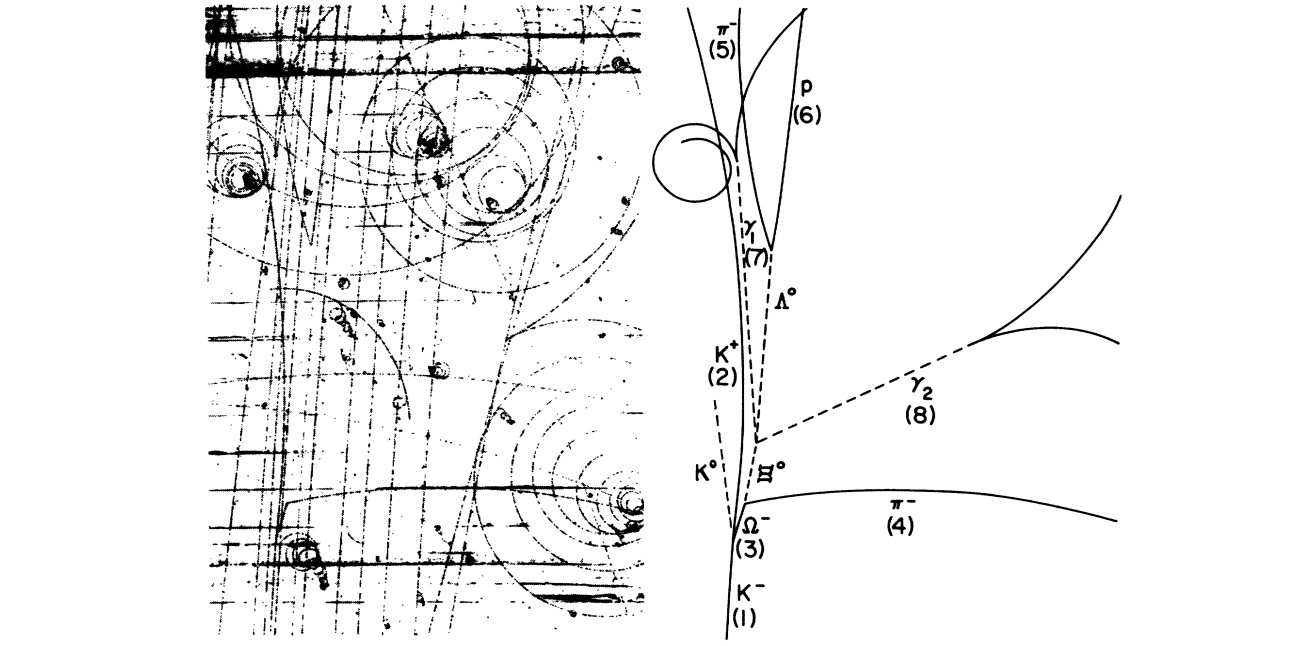 Screenshot from Observation of a Hyperon with Strangeness Minus Three. Caption: FIG 2 Photograph and line diagram of event showing decay of Ω⁻
The discovery was warmly welcomed by theorists and experimentalists alike, who were anxious to justify the billions spent on accelerators. That’s because dozens of mesons and baryons had been discovered. So many, that particle physics was attracting derision and accusations of stamp collecting. It is said that in response to the ever-expanding particle zoo, Wolfgang Pauli said “Had I foreseen that, I would have gone into botany”. Willis Lamb said “When the Nobel Prizes were first awarded, the finder of a new elementary particle used to be rewarded by a Nobel Prize. At present, such a discovery might better be punished by a $10,000 fine”. John von Neumann said “If you run out of Greek letters, you can always use the names of Pullman cars”. Hence the Omega-minus press release was emphatic, and it was headline news. See the CERN Courier article Omega-minus plus 25 years for more.
Short-lived resonances
Other particles discovered in 1964 were “bump hunter” short-lived resonances, which were said to have a typical lifetime of circa 10⁻²³ seconds. This is said to be similar for the time taken for light to travel the width of a proton. One such resonance was the Σ(1760) Sigma baryon reported by an experimental team at Brookhaven. See the Physical Review Letters paper New Structures in the K⁻p and K⁻d Total Cross Sections Between 2.4 and 3.3 GeV/c. The authors were Robert Abrams, Rodney Cool, Giorgio Giacomelli, Thaddeus Kycia, Borislav Leontic, Kelvin Li, and Donald Michael. There was also the Eta prime (η’), reported by George Kalbfleisch and the Alvarez Group at the Lawrence Radiation Laboratory in Berkeley. Their Physical Review Letters paper was Observation of a Non-Strange Meson of Mass 959 MeV. Louis Alvarez was later awarded a Nobel prize for his “decisive contributions to elementary particle physics, in particular the discovery of a large number of resonance states, made possible through his development of the technique of using hydrogen bubble chamber and data analysis”. A similar paper submitted by a Brookhaven group few days later was Existence of a New Meson of Mass 960 MeV. Another particle reported in 1964 was the 𝑎₁( 1260) meson. See the Physical Review Letters paper Evidence for a π-ρ interaction produced in the π⁺-p reaction at 3.65 BeV/c. It was by Gerson Goldhaber and five other authors from the Lawrence Berkeley Laboratory. I gather that other reported resonances included the A₂(1320) tensor meson, the B(1235) axial vector meson, and the Σ(1765) baryon. However records appear to be unclear, so as I write I’m not confident of the details⁷.
CP violation
Another development came from Jim Cronin and Val Fitch. Again using the Brookhaven AGS, they demonstrated that the neutral K-meson, now called the kaon, can decay into two neutral pions. It is said that this was the discovery of CP violation, wherein CP symmetry is violated in weak interactions. It is also said that this explained why the universe is matter-dominated. CP symmetry, or more properly “charge conjugation parity symmetry” is where the laws of physics are the same if a particle is interchanged with its antiparticle, and its spatial coordinates are inverted.
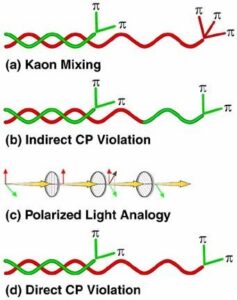 Image from James Schombert’s article on CP violation
Cronin and Fitch’s claim is said to have taken the physics community by surprise, see the CERN Courier article CP violation’s early days. Also see their Physical Review Letters paper Evidence for the 2π decay of the K₂⁰ meson. There were two other authors to this paper, namely James Christenson and René Turlay. However Christenson was Cronin’s graduate student, and Turlay was a visiting postdoc. In line with Nobel practice, as juniors they didn’t share the Nobel prize that was later awarded for the work.
The charm quark
A further development in 1964 came from James Bjorken and Sheldon Glashow. They met at the Niels Bohr Institute in Copenhagen, and proposed a fourth quantum number they called “charm” to maintain lepton-hadron symmetry. In 1964 there were thought to be four leptons: the electron, the muon, the electron neutrino, and the muon neutrino. See the Data on Elementary Particles and Resonant States by Arthur Rosenfeld and other members of the newly-formed Particle Data Group. Bjorken and Glashow’s fourth quantum number is nowadays referred to as the charm quark. They proposed an expanded symmetry group to accompany it, namely SU(4). Hence their Physics Letters paper was called Elementary Particles and SU(4). See Sheldon Glashow’s CERN courier article Charm and synthesis for some historical information.
The Higgs mechanism
Meanwhile three independent groups of theorists were working on an issue with Yang-Mills gauge theory. This required gauge bosons, also known as messenger particles or force carriers, to be massless. For example, photons are said to be the gauge bosons of electromagnetism, and they are indeed massless. However it was said that the weak force was very short range, which is said to require the gauge bosons to be massive. However manually adding mass violated the gauge-invariance that was vital to the theory, and generated infinite results. What came to be known as the Higgs mechanism rescued the situation via what is said to be a loophole called “spontaneous symmetry breaking”, plus a space-filling field. This field is now known as the Higgs field. The idea was that in the hot early universe, all particles were massless and the situation was symmetrical. However as the temperature fell, the Higgs field settled into a state that spontaneously broke the original symmetry. A “Mexican hat” is often used to depict this:
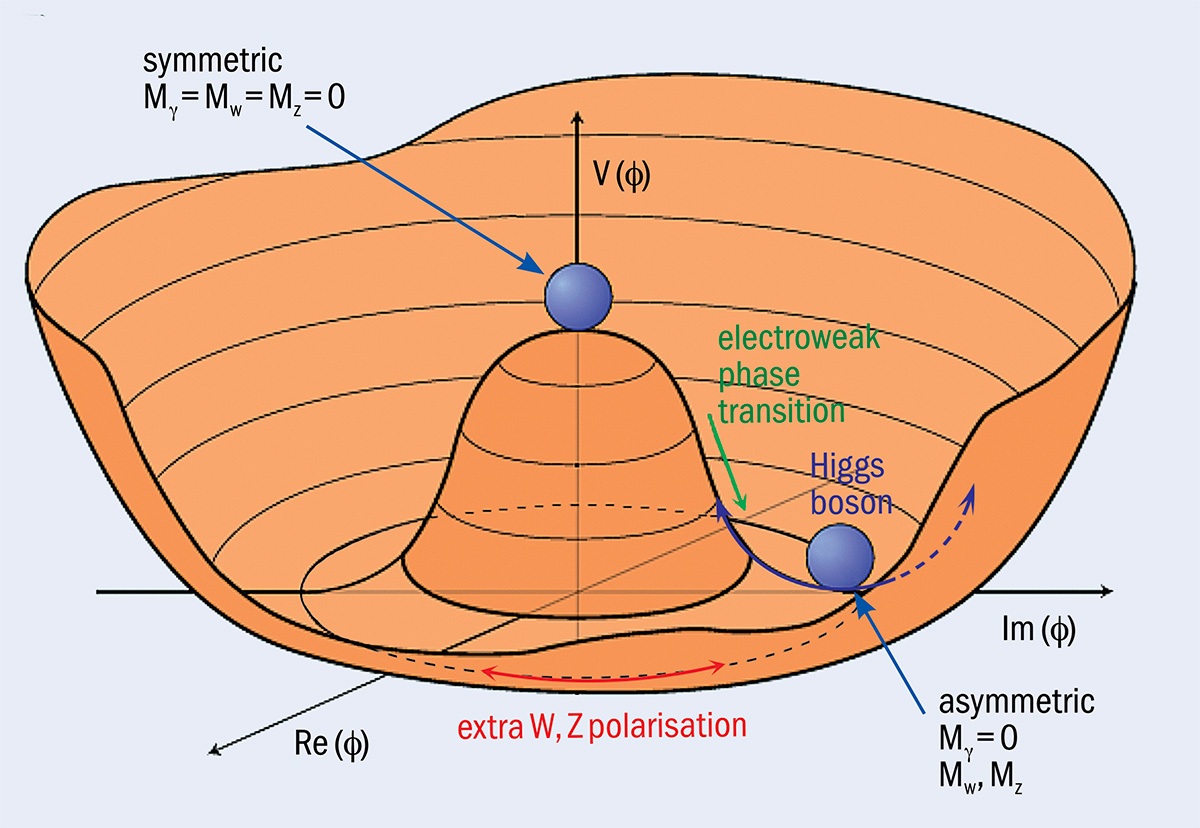 Higgs mechanism image from the CERN Courier article One Higgs, three discoveries, caption: Broken symmetry The energy stored in the Higgs field, as a function of its value. If we look at it from far away, we realise that the Higgs potential is symmetric. However, a local observer sitting in the rim of the potential, at the vacuum state, will not experience a symmetric world. Thus, the theory is symmetric, but the ground state is not. In the Higgs mechanism, the rotational degree of freedom along the rim becomes the longitudinal polarisation of the W and Z bosons, which thereby acquire mass. Credit: J Ellis/M Neubauer
It was also said that the gauge bosons of the weak interaction, nowadays known as the W and Z bosons, interacted with the Higgs field. This is said to have given the W and Z bosons a substantial mass, and preserved the gauge-invariance that was central to the theory. Robert Brout and François Englert of the Free University of Brussels were the first of the three groups to get published. See their 3-page Physical Review Letters paper Broken Symmetry and the Mass of Gauge Vector Mesons. Next was Peter Higgs of Edinburgh University. See his 2-page Physical Review Letters paper Broken Symmetries and the Masses of Gauge Bosons. Then came Gerald Guralnik, Carl Richard Hagen, and Tom Kibble of Imperial College London. See their 2-page Physical Review Letters paper Global Conservation Laws and Massless Particles. Higgs initially submitted his paper to Physics Letters, but it was rejected as being of “no obvious relevance to physics”. He then submitted it to Physical Review Letters with the prediction of “incomplete multiplets of scalar and vector bosons”. It seems unusual for three similar papers to be published in quick succession, especially when they generated very few initial citations.
Color charge
No matter, because while all this was happening, Oscar Greenberg was coming up with his Physical Review Letters paper Spin and Unitary-Spin Independence in a Paraquark Model of Baryons and Mesons. This is nowadays considered to be the birth of color charge, even though Greenberg didn’t call it that. He is however credited with rescuing the quark model in its infancy. The Pauli exclusion principle meant that the Delta-double-plus (Δ⁺⁺) and the Omega-minus (Ω⁻) shouldn’t exist, because they would be composed of three up quarks and three strange quarks respectively. Hence a new three-state property was needed, and the result was a three-triplet model. Abraham Pais is credited with labelling this “color” the following year. See Greenberg’s historical article Color, from baryon spectroscopy to QCD.
They fixed the problem of infinities
New particles continued to be discovered in 1965, such as the Xi cascade baryon resonance Ξ(1950). A collaboration made up of Jaqueline Badier and fifteen other authors used a high-energy kaon beam and the 81-cm liquid hydrogen bubble chamber at CERN. Their Physics Letters paper was Baryonic states of strangeness -2 produced in K⁻ p interactions at 3.0 GeV/c. Another example was the Delta minus meson (δ⁻), which has now been supplanted by the a₀(980) meson. The Physics Letters paper was Evidence for a singly charged boson of mass 962 MeV and narrow width by Werner Kienzle, Bogdan Maglić, Bernard Levrat, François Lefèbvres, Dietrich Freytag, and H Richard Blieden. They used the proton synchrotron at CERN. A further example was the K*(1430). See the Physical Review Letters paper Further Evidence for a Kπ Resonance Near 1400 MeV by Lyndon Hardy, Suh Urk Chung, Orin Dahl, Richard Hess, Janos Kirz, and Donald Miller of the Lawrence Radiation Laboratory in Berkeley.
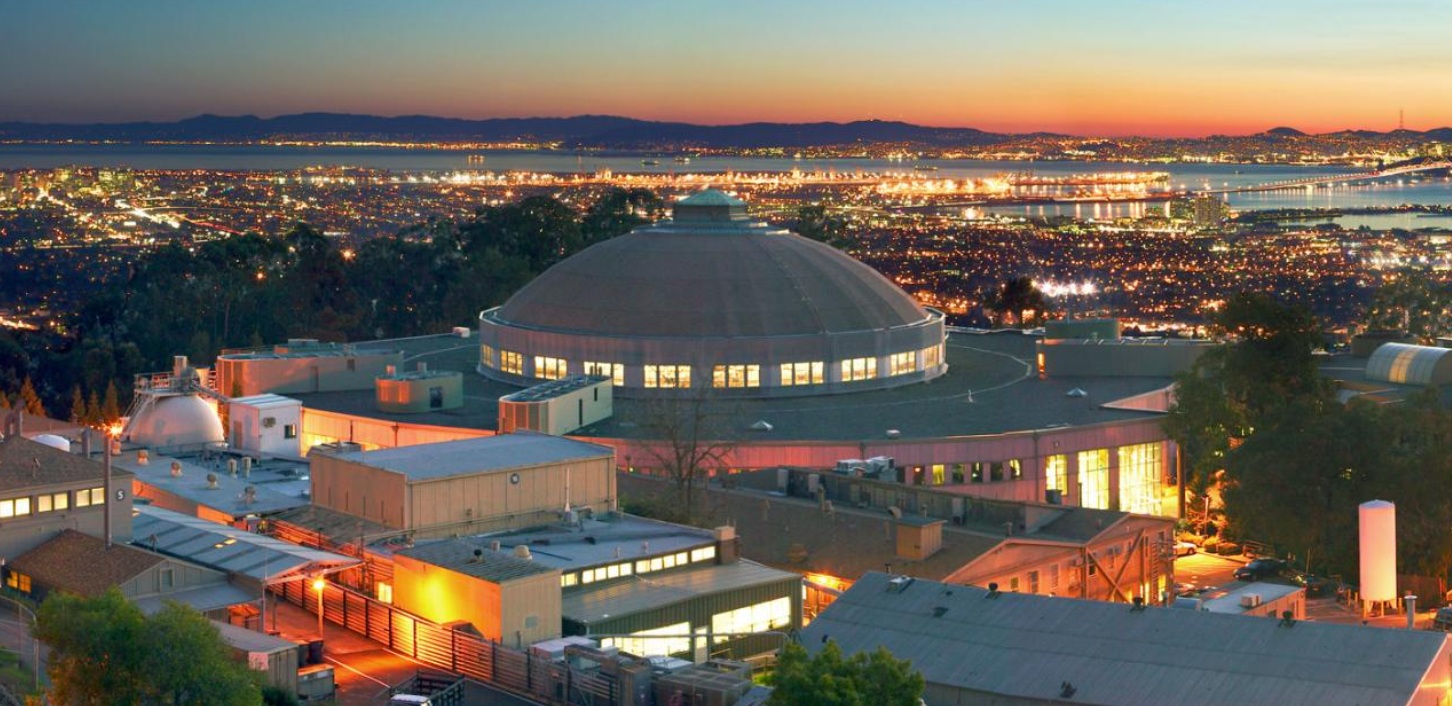 Night-time image of the Lawrence Radiation Laboratory in Berkeley, from Wikimapia.org
Other examples were the N(1680) and the Δ(1920). In addition, the antideuteron was isolated by a team using the Brookhaven AGS. See the Physical Review Letters paper Observation of Antideuterons by David Dorfan, John Eades, Leon Lederman, Wonyong Lee, and Samuel Chao Chung Ting. The antideuteron was also isolated by a CERN proton synchrotron team who submitted first, but were published later. See the Physics Letters paper Experimental Observation of Antideuteron Production by Thomas Massam, Théo Müller, Bruno Righini, Marc Schneegans, and Antonino Zichichi. On top of that, 1965 saw three further papers on what would come to be called color charge. One was the Progress of Theoretical Physics paper Three Kinds of Triplet Model by Yoneji Miyamoto. Another was Boris Struminsky’s JINR paper Magnetic Moments of Baryons in the Quark Model. Another was Moo-Young Han and Yoichiro Nambu’s Physics Review Letters paper on a Three-Triplet Model with Double SU(3) Symmetry. To round off 1965, the Nobel Prize in physics was awarded to three physicists, namely Sin-Itiro Tomonaga, Julian Schwinger, and Richard Feynman, “for their fundamental work in quantum electrodynamics, with deep-ploughing consequences for the physics of elementary particles”. It is said that they fixed the problem of infinities using a technique called renormalization.
It was clear that the ever-growing particle zoo was not a collection of fundamental particles
1966 saw the discovery of the K*(1420) tensor meson, but more importantly the two-mile long Stanford Linear Accelerator Center (SLAC) commenced operations. It was also the year when the United States Atomic Energy Commission (AEC) chose a site in Weston, Illinois, for what would become Fermilab. Big science was getting bigger. Particles discoveries continued at CERN, Berkeley, and Brookhaven. Examples are the K*(1420) tensor meson, the f₀(1370) meson, the high-mass nucleon and Delta resonances: N(2190) and Δ(2420), the Λ(1820), and the Σ(1775). It was clear that the ever-growing particle zoo was not a collection of fundamental particles.
The electroweak unification paper
Particle discoveries in 1967 included the Λ(1520), the Λ(1690), and the Ξ(1820). 1967 also saw the publication of Steven Weinberg’s 3-page Physical Review Letters paper A Model of Leptons. It is said to be the electroweak unification paper. Weinberg referred to a 1961 paper by Sheldon Glashow on SU(2) x U(1) electroweak unification called Partial-symmetries of weak interactions. He also referred to the three 1964 mass-mechanism papers by Brout and Englert, Higgs, and Guralnik Hagen and Kibble. Weinberg spoke of a multiplet of gauge fields along with symmetries, and said “our Zμ and Wμ mesons get their mass from the spontaneous breaking of the symmetry, not from a mass term put in at the beginning”.
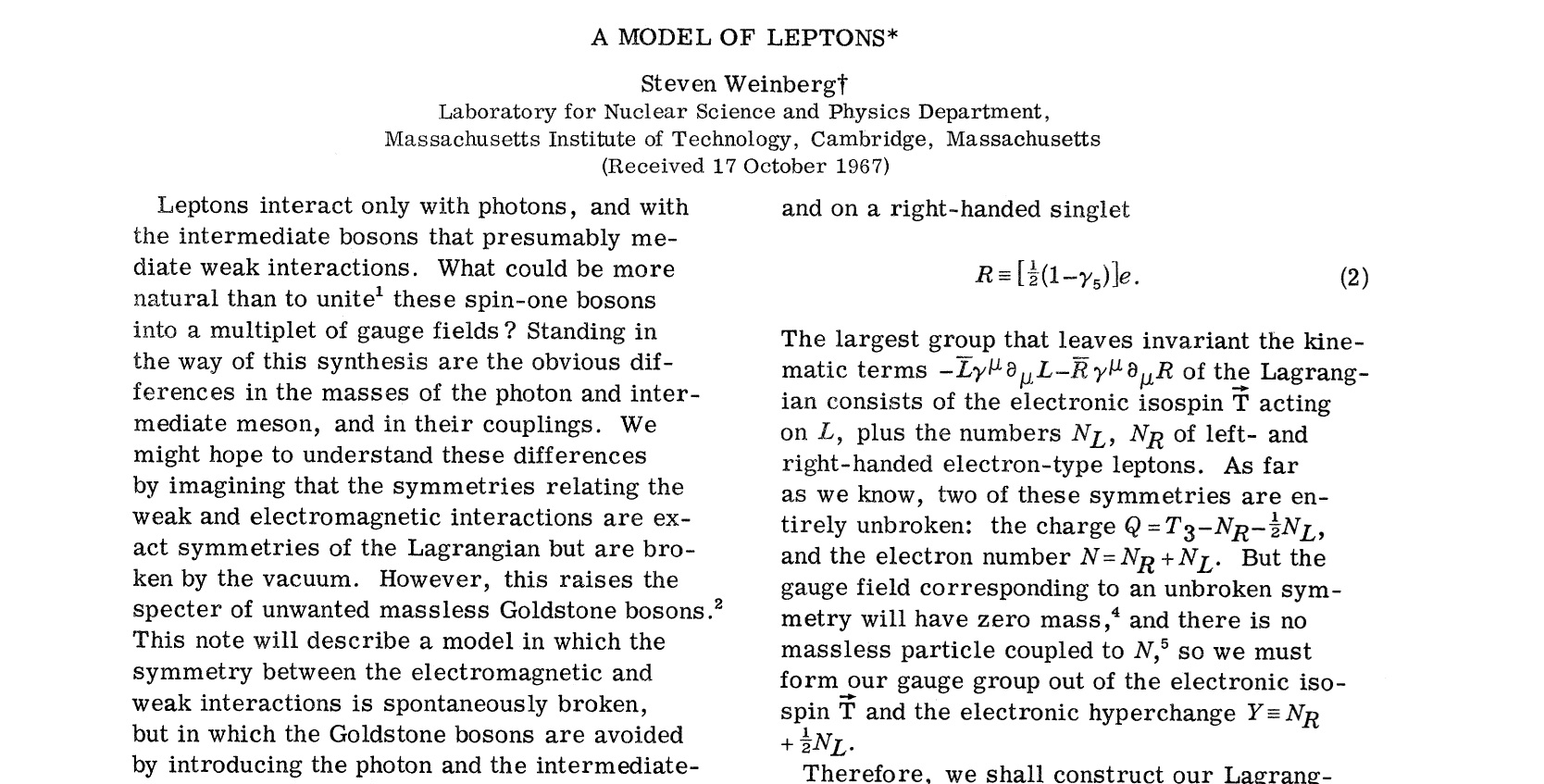 Screenshot of the Physical Review Letters paper A Model of Leptons
His paper was largely ignored for some years, due to issues with renormalization and flavor-changing neutral currents. However Abdus Salam was also working on electroweak unification, and giving lectures on the subject. See the Imperial website for more. However his Il Nuovo Cimento paper Weak and Electromagnetic Interactions wasn’t published until 1968. He later coined the phrase “electroweak” and later shared a Nobel prize with Glashow and Weinberg.
The solar neutrino problem
1967 was the year that the Solar neutrino problem arose. Check out the Homestake Experiment, which was led by Raymond Davis Junior. He used a hundred thousand gallons of perchloroethylene dry cleaning fluid in a tank almost five thousand feet underground, where cosmic rays could not penetrate. About a quarter of naturally-occuring chlorine consists of the isotope chlorine-37. A neutrino interacting with a chlorine-37 atom is said to convert it into a radioactive argon-37 atom, which can be extracted via helium, and measured with a gas counter sensitive to the 2.82keV Auger electrons emitted during decay. Davis detected only a third of the neutrinos he was expecting. See the Science article Solar Neutrinos: A Scientific Puzzle for details. Also see Bruno Pontecorvo’s 1967 JETP paper Neutrino Experiments and the Problem of Conservation of Leptonic Charge. This proposed neutrino oscillation as the solution.
Deep Inelastic Scattering
In 1968 a SLAC-MIT collaboration led by Jerome Friedman, Henry Kendall, and Richard Taylor completed their Deep Inelastic Scattering experiments. That’s where they collided electrons with protons. Theorist James Bjorken, who with Sheldon Glashow had previously proposed what’s now called the charm quark, then came up with what’s now known as Bjorken scaling. This is said to be where the scattering pattern doesn’t change with collision energy because the electrons are colliding with point particles inside the proton. See Bjorken’s Physics Today article Feynman and partons for more. Richard Feynman visited SLAC in August 1968 and analysed the scattering data. Bjorken said this: “It took Feynman only an evening of calculation with his partons to interpret what was going on”. Bjorken said Feynman “assumed the electron scattered elastically and incoherently from these partons, which he regarded as pointlike quanta with no interactions among them”. Feynman started giving seminars on partons⁹ at SLAC in October 1968. Particle discoveries that year included the φ(1660), the Σ(1670), and the f₀(980). 1968 also saw an Il Nuovo Cimento paper by Gabriele Veneziano called Construction of a crossing-symmetric, Regge-behaved amplitude for linearly rising trajectories. It wasn’t actually string theory paper, but it started that field of study.
Observed Behavior of Highly Inelastic Electron-Proton Scattering
1969 saw the discovery of the Ξ(1530) baryon resonance, the Ξ(2030), the Ξ(2430), the Ξ(1815), the Ξ(2500), the Δ(1920), the Δ(1950), the I=5/2(1640 MeV) baryon resonance, the f₀(500) meson, and the η₀⁺(720) Eta meson. It also It saw the publication of the “landmark” SLAC-MIT Physical Review Letters paper Observed Behavior of Highly Inelastic Electron-Proton Scattering. The abstract for this paper is worth reading. It says this: “The results of the SLAC-MIT electron-proton inelastic scattering experiment at 6° and 10° are discussed. Although the kinematic range of these measurements is insufficient to separate the structure functions W₁ and W₂, estimates of W₂ can be obtained. If the interaction is dominated by transverse virtual photons, W₂ can be expressed as a function of ω = 2Mν/q² within experimental errors for q² > 1 and W > 4, where ν is the invariant energy transfer and q² is the invariant momentum transfer of the electron. Various theoretical models are briefly discussed, and the predictions of several sum rules are compared with the data”. The authors were MIT and SLAC experimentalists Martin Breidenbach, Jerome Friedman¹⁰, Henry Kendall, Elliot Bloom, David Coward, Herbert DeStaebler, Jürgen Drees, Luke Mo, and Richard Taylor.
This model envisages the proton to be composed of point-like constituents
James Bjorken was a theorist, and did not participate in the experimentalists’ paper. Instead he co-authored a Physical Review paper with Emmanuel Paschos called Inelastic Electron-Proton and γ-Proton Scattering and the Structure of the Nucleon. They dived straight in with their abstract talking about a model which “envisages the proton to be composed of point-like constituents (“partons”) from which the electron scatters incoherently”. They also talked of the proton being Lorentz-contracted into a thin pancake. On page 8 they gave a “rather small” mean-square charge of 0.16 per parton. They also talked about a three-quark model which didn’t fit the data, and a further model consisting of three quarks in a background of quark-antiquark pairs. Nowadays the latter is labelled “sea quarks”.
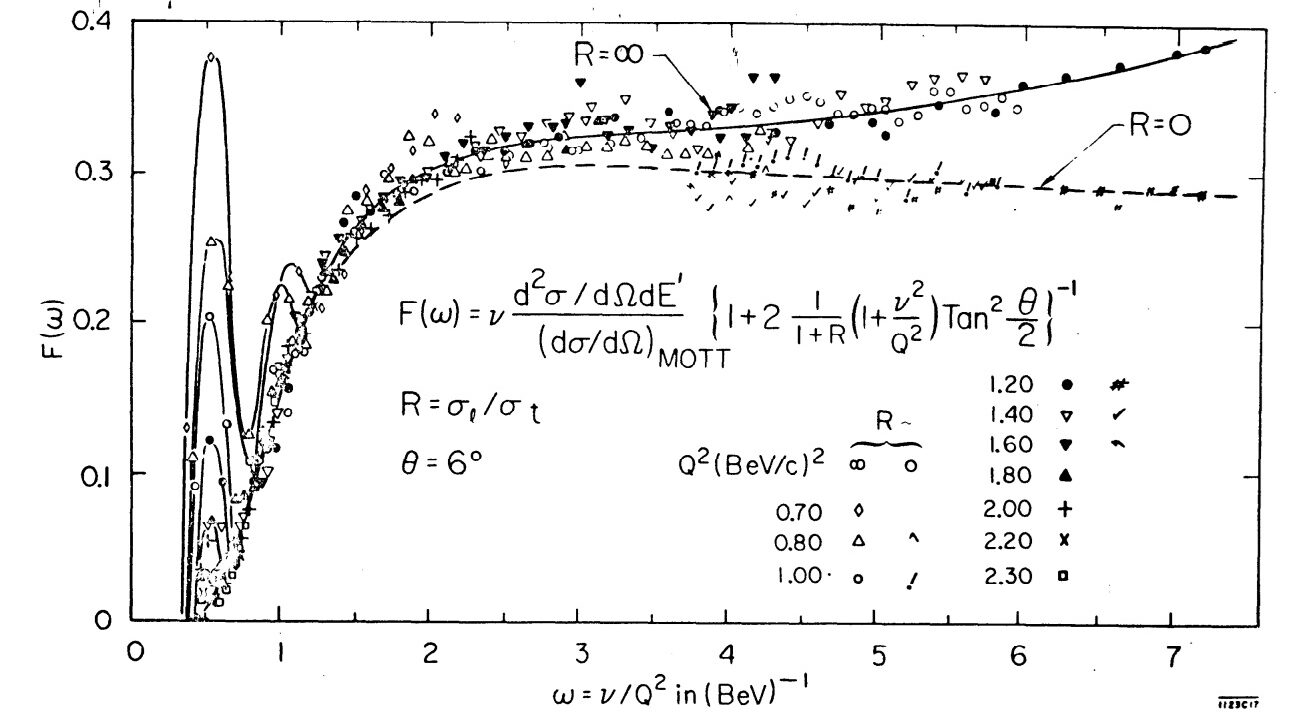 Figure 2 from the Physical Review paper Inelastic Electron-Proton and γ-Proton Scattering and the Structure of the Nucleon
When you read the two papers, it’s a little surprising that the authors were more cautious than contemporary reportage might suggest. There was no evidence of partons or quarks being ejected from the proton. The papers were heavily statistical, and did not claim to have proved the existence of partons, or the existence of fractionally charged quarks.
The stage was set for the Standard Model
However that’s what was coming, because in December 1969 Murray Gell-Mann was the sole recipient of the Nobel prize in physics. It was awarded for “his contributions and discoveries concerning the classification of elementary particles and their interactions”. See the presentation speech and note the references to The Eightfold Way and to quarks. One followed the other as surely as night follows day, because The Eightfold Way used the SU(3) symmetry group to arrange particles into octets and decuplets, and the fundamental building block of SU(3) was a triplet. The stage was set for the Standard Model.
1 Llewellyn Smith said Gell-Mann and Server’s accounts differed. He also talked about André Petermann’s paper Properties of Strangeness and a Mass Formula for Vector Mesons, which was written in French. This was received by Nuclear Physics on 30 December 1963, but wasn’t published until March 1965 and went almost unnoticed for 55 years. It included this: “We then see that the so-called elementary particles such as N, Ξ, Σ etc, are complicated objects, actually the states of strongly bound elementary spinor particles”. It also included this: “Or, if one wants to preserve the conservation of charge, which is highly desirable, particles ꚃ should then have non-integer values of the charge. This fact is unpleasant but cannot, after all, be excluded on physical grounds”.
2 Some sources say Gell-Mann submitted his quark paper to Physical Review Letters, who rejected it, whereupon Gell-Mann was furious. However Gell-Mann later said he didn’t. All this happened over sixty years ago. It can be difficult to determine the true course of events.
3 The head of theory at CERN was Leon Van Hove. He was the person who blocked Zweig’s paper. He was also the editor of Physics Letters, which printed Gell-Mann’s paper very quickly. Gell-Mann’s paper is said to have been received on 4th January 1964. I should add that Zweig produced a second version of his preprint on 21st February, and that his Caltech supervisor Richard Feynman, a close colleague of Gell-Mann, later nominated both Zweig and Gell-Mann for a joint Nobel prize.
4 If SU(3) flavor symmetry was not “broken”, every particle in an Eightfold Way multiplet would have the same mass. A symmetry that is not an exact symmetry is said to be a broken symmetry. In similar vein a lack of symmetry is sometimes labelled as a hidden symmetry, and is said to be an example of spontaneous symmetry breaking.
5 See the CERN Courier article Murray Gell-Mann: my contemporary and friend by André Martin. Martin described how, after a review of hadron spectroscopy by George Snow, Gell-Mann stood up and “pointed out that the sequence of particles Δ, Σ*, Ξ* could be completed by a particle that he called Ω⁻ to form a decuplet in the SU(3) scheme. He predicted its mode of production, its decay, which was to be weak, and its mass”. Yuval Ne’eman was also present at the conference. He had drafted a paper predicting the missing particle and its properties, and had given a copy to the Goldhabers the previous evening. He was planning to present it at the conference, but could only watch as Gell-Mann walked to the blackboard to claim the prediction.
6 They made the discovery on 31st January 1964, and submitted the paper on 11th February. Since it was published on 24th February, Physical Review Letters had worked fast.
7 I am unable to find a definitive list of particle discoveries by date, along with details of the primary citation. I will try to obtain such a list and make corrections as necessary.
8 Interestingly, the beginning of the Higgs mechanism are rooted in superconductivity. A superconductor is not penetrated by an external magnetic fields, this being known as the Meissner effect. It is said to occur because electromagnetism somehow becomes short-ranged. In addition, the alignment of magnetic domains in a given direction is said to be an example of spontaneous symmetry breaking, which is destroyed by heat.
9 See Feynman’s Physical Review Letters “partons” paper, which was published in December 1969. The title was Very High-Energy Collisions of Hadrons. Oddly enough he talked of field and current, and didn’t actually use the words parton or pointlike. Also see Feynman’s conference proceedings What neutrinos can tell us about partons, along with The Science and Legacy of Richard Phillips Feynman by Avinash Dhar, Apoorva Patel, and Spenta Wadia.
10 Friedman, Kendall, and Taylor would later share a Nobel Prize for “their pioneering investigations concerning deep inelastic scattering of electrons on protons and bound neutrons, which have been of essential importance for the development of the quark model in particle physics”.